
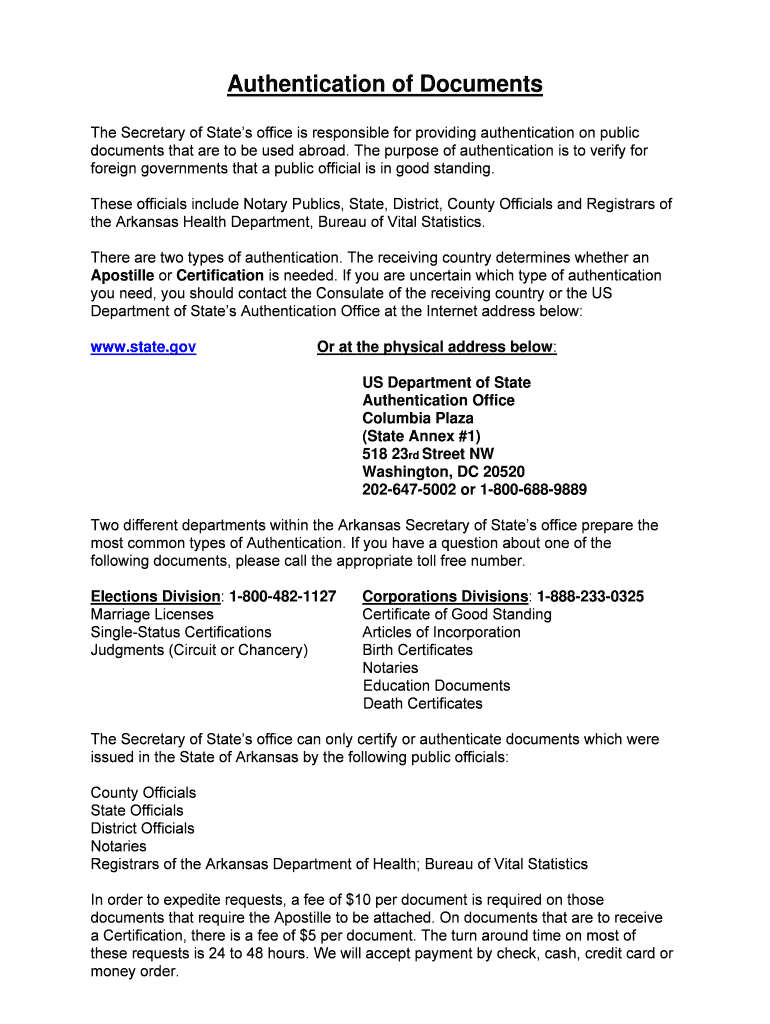







Definition and Meaning of Document Authentication
Document authentication is a formal process that confirms the legitimacy and validity of documents for use in official or legal settings, often across international borders. It involves verifying the authenticity of the document's signature, seal, or stamp to ensure they belong to the appropriate authority. In the context of the United States, the process often includes obtaining an Apostille or Certification, especially for documents being used abroad. This ensures compliance with the Hague Convention or any other relevant international treaties.
How to Use the Authentication of Documents
Understanding how to use authenticated documents is crucial for their acceptance. Once a document is authenticated, it can serve its intended purpose, such as being recognized by foreign governments or used for administrative or business transactions. Common uses include validating educational credentials, confirming business contracts, or certifying identity documents in another country. Users need to ensure that the authenticated document is submitted to the right entity or authority for which it was intended, following any additional specific submission requirements they may have.
How to Obtain Document Authentication
To obtain document authentication, you must first determine whether an Apostille or Certification is required. This depends on the destination country. Apostilles are for countries part of the Hague Apostille Convention, while Certifications are used when a country is not a member. The process generally involves submitting your document to the relevant state authority, such as the Secretary of State's office, along with required fees and any necessary information about the document’s use. You must also provide a copy of valid identification and sometimes a notarized affidavit.
Steps to Complete the Document Authentication
-
Identify the Type of Authentication Needed: Determine if you need an Apostille or a traditional Certification, depending on the country of use.
-
Prepare the Document: Ensure the document is complete and signed by the appropriate official, if necessary, before submission.
-
Submit the Document: Take or mail your document to the proper state authority with any required payment and a completed request form. Verify if online submission is available for your state.
-
Receive Authentication: Once processed, the document will be returned with the appropriate authentication attached—Apostille or Certification—depending on your needs.
-
Verify Completion: Check that all details on the Apostille or Certification match the original document information and that the authentication is correct for the receiving country.
Key Elements of Document Authentication
- Apostille: Used for international document validation among countries that are members of the Hague Apostille Convention.
- Certification: Necessary for countries not part of the Hague Convention, requiring additional consular legalization steps.
- Notarization: An initial verification step often required prior to requesting an Apostille or Certification.
- Fees: Vary by state and often depend on whether you require an Apostille or Certification.
State-Specific Rules for Document Authentication
Each U.S. state may have unique requirements and procedures for document authentication. For instance, only documents issued within a state can be authenticated by that state's Secretary of State. Furthermore, fees and processing times may vary. Certain documents might require specific notarization processes or additional affidavits. For detailed guidance, it’s essential to consult the state authority where the document was issued or is being certified.
Legal Use of Authenticated Documents
Authenticated documents secure their legal status in foreign jurisdictions, ensuring they can be accepted as valid in official capacities. They're often required for various legal, educational, and business operations—like enrolling in foreign universities, entering business contracts abroad, or applying for residency or citizenship. Understanding the legal implications and ensuring the document meets all foreign legal standards is crucial to its acceptance.
Examples of Using Document Authentication
- Education: Students applying to study abroad may need their diplomas authenticated to ensure acceptance by foreign educational institutions.
- Business: International agreements often require validated contracts, and thus businesses will authenticate documents to ensure compliance with foreign regulations.
- Personal: Individuals moving abroad might need their birth certificate authenticated to secure residency or citizenship in another country.
Each case relies on accurate and verified documentation to facilitate smooth legal processes across borders.




