
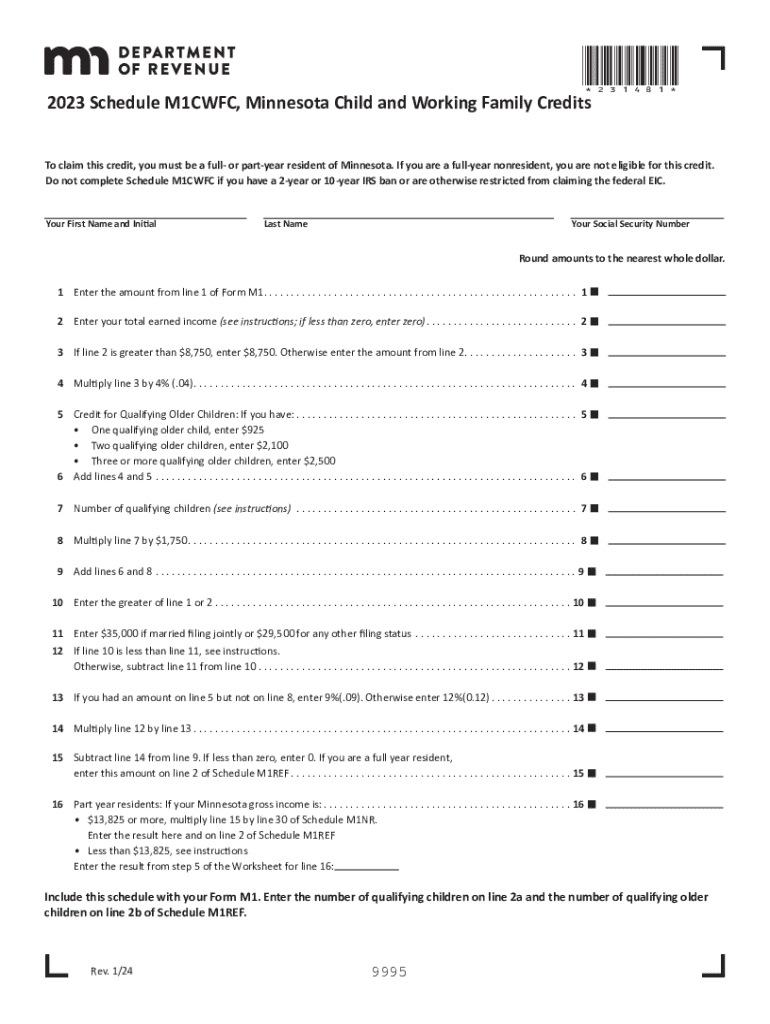







Definition and Meaning
The "2023 M1CWFC, Minnesota Child and Working Family Credits" is a tax credit form specifically designed to benefit residents of Minnesota. The form provides financial relief to eligible taxpayers by allowing them to claim credits based on their earned income and the number of qualifying children. The credits aim to support working families by reducing their overall tax liability, thereby increasing their disposable income. These credits are a critical component of Minnesota's tax system, promoting economic stability for families with dependent children.
Eligibility Criteria
Eligibility for the 2023 M1CWFC requires meeting specific conditions related to residency, income, and family composition. The primary requirements include:
- Residency Status: Applicants must be residents of Minnesota.
- Income Limits: There are income thresholds that vary based on filing status and the number of qualifying children. These limits ensure the credits target low to moderate-income families.
- Qualifying Children: The child must meet certain criteria concerning age, relationship to the applicant, and residency requirements.
Identifying whether an individual qualifies involves a detailed review of their financial status and family situation to ensure compliance with the criteria set by the state.


Steps to Complete the 2023 M1CWFC
Filling out the 2023 M1CWFC form involves several crucial steps:
- Gather Required Documents: Collect income statements, Social Security numbers, and documentation for qualifying children.
- Calculate Earned Income: Accurately report earned income, considering wages, tips, and other earnings.
- Determine Credits Based on Children: Input the number of qualifying children and calculate corresponding credits.
- Complete Each Section Carefully: Ensure all fields are filled out accurately to avoid errors that could delay processing.
- Review for Accuracy: Double-check the form to prevent mistakes in calculations and entries.
Completing these steps attentively increases the likelihood of receiving the proper credit amount.
Key Elements of the 2023 M1CWFC
The 2023 M1CWFC form includes several core components to streamline the application process:
- Personal Information Section: Consists of personal and contact information.
- Income Reporting: Details related to earned income and other income sources.
- Credits Calculation: Specific line items that allow for calculating the credit amount based on earned income and qualifying children.
- Signature and Submission Section: Confirmation of the provided information's accuracy and submission options.
Each element serves a unique purpose, contributing to a comprehensive tax credit application.
Calculation of Credits
The calculation of credits on the M1CWFC form is crucial to determine the exact benefit amount. This involves considering:
- Earned Income Levels: The form outlines how different income brackets impact credit calculations.
- Number of Qualifying Children: Credits increase with the number of children that meet the eligibility criteria.
- Phase-Out Thresholds: Understand how increased income levels might reduce the credit amount available.
It's essential to correctly compute these factors to ensure maximum eligible credits.
Filing Deadlines and Important Dates
Adhering to filing deadlines is vital for successfully claiming the 2023 M1CWFC:
- Regular Filing Deadline: Typically aligns with the federal tax filing deadline, which is April 15, unless otherwise extended by state-specific announcements.
- Extension Options: Taxpayers may apply for extensions if needed, but should understand the implications for receiving credits.
- Late Penalties: Late submissions can result in penalties, potentially impacting credit eligibility.
Meeting deadlines ensures that applicants receive the credits timely without incurring unnecessary penalties.
Required Documents
Successfully applying for the 2023 M1CWFC necessitates the preparation and submission of several documents:
- Income Documentation: Such as W-2s or 1099 forms;
- Proof of Residency: This may include utility bills or rental agreements;
- Verification of Qualifying Children: Birth certificates or school records.
Careful preparation of these documents facilitates a smoother application process, reducing the likelihood of delays or denials.
Penalties for Non-Compliance
Failure to comply with the rules governing the 2023 M1CWFC can lead to the following sanctions:
- Monetary Penalties: Fines for fraudulent claims or inaccuracies;
- Future Disqualification: Loss of eligibility for future credits due to non-compliance;
- Audits: Increased likelihood of audits due to discrepancies in reporting or documentation.
Taxpayers are advised to follow guidelines meticulously to ensure compliance and avoid adverse outcomes.
Examples of Using the 2023 M1CWFC
To provide context on the impact of the M1CWFC form, consider these scenarios:
- A Single Parent with Two Children: Earns $35,000 annually and qualifies for substantial tax credits, lowering the tax burden significantly.
- Married Couple with Three Children: Income of $50,000 leads to maximized credits upon meeting specific criteria, enhancing their financial stability.
- Self-employed Individual: Must accurately track income and qualified expenses to leverage the credit optimally.
These examples demonstrate how diverse taxpayer situations can still gain substantial benefits from the M1CWFC, emphasizing the importance of accurate form completion and submission.




