




01. Edit your form online
Type text, add images, blackout confidential details, add comments, highlights and more.

Type text, add images, blackout confidential details, add comments, highlights and more.

Draw your signature, type it, upload its image, or use your mobile device as a signature pad.

Send it via email, link, or fax. You can also download it, export it or print it out.
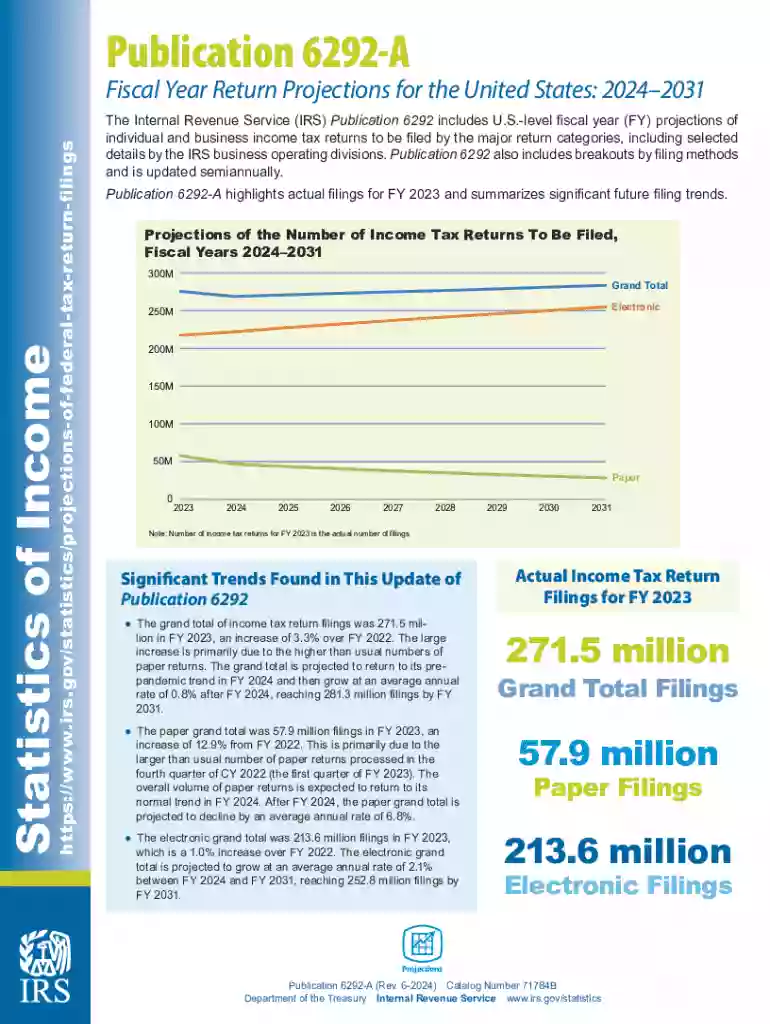
Publication 6292-A, revision 6-2024, details fiscal year return projections for the United States, providing essential insights into federal income tax return filings from fiscal years 2024 to 2031. This publication is a critical tool for understanding tax filing trends and helps stakeholders anticipate and plan for future growth in tax filings. The projections include a comprehensive analysis of both paper and electronic filings, offering predictions on the return to pre-pandemic trends with an average annual growth rate of 0.8%.
Understanding and utilizing Publication 6292-A effectively involves several steps. Users can explore the publication to align their tax strategies with projected trends. The document's projections can assist businesses in planning for resource allocation during peak filing periods. Tax professionals might analyze the data to forecast workload and adjust staffing. Additionally, financial planners can leverage these insights to advise clients on expected changes in filing requirements.
Securing a copy of Publication 6292-A can be accomplished through several methods. It is available directly from the IRS website, where the most recent version is accessible for download. Alternatively, tax professionals and businesses can request a physical copy by contacting the IRS.
Publication 6292-A covers several critical components that are vital for understanding fiscal year return projections. These elements include historical filing data, growth rate projections, the distribution of paper and electronic filings, and predictions for future filing patterns. It provides a detailed analysis of return types, giving users a broad understanding of federal income tax return trends.
Publication 6292-A is used by a diverse group of stakeholders, including tax professionals, government agencies, business owners, and policymakers. Tax preparers utilize this data to gauge future workloads, while government agencies may analyze it to project tax revenue. Businesses rely on these insights to optimize their financial planning based on anticipated tax return trends.


Real-world scenarios illustrate the practical application of Publication 6292-A. A tax consultancy might use the publication's projections to enhance staffing during anticipated filing surges. Similarly, software companies developing tax-filing solutions can tailor their offerings based on expected shifts towards electronic filings as outlined in the document.
IRS guidelines offer additional context for interpreting and implementing the insights from Publication 6292-A. These guidelines advise taxpayers on compliance requirements linked to projections and provide instructions on adapting tax filing practices accordingly.
Understanding the key filing deadlines and important dates in relation to Publication 6292-A is crucial for maintaining compliance. The projections help users anticipate high filing activity periods, allowing them to prepare accordingly. Familiarizing oneself with the IRS calendar ensures timely submission of returns and aligns with the projected filing trends.
We've got more versions of the Publication 6292-A (Rev 6-2024) Fiscal Year Return Projections for the United States form. Select the right Publication 6292-A (Rev 6-2024) Fiscal Year Return Projections for the United States version from the list and start editing it straight away!
At DocHub, your data security is our priority. We follow HIPAA, SOC2, GDPR, and other standards, so you can work on your documents with confidence.




by V Casado-Prez 2025 Cited by 3 Water scarcity is a perennial problem with dire consequences for the United States and governments around the world. A lack of adequate water
The estimated number of people age 65 and older with Alzheimers dementia comes from an updated study using the latest data from the 2024 population projectionsRead more


