




01. Edit your form online
Type text, add images, blackout confidential details, add comments, highlights and more.

Type text, add images, blackout confidential details, add comments, highlights and more.

Draw your signature, type it, upload its image, or use your mobile device as a signature pad.

Send it via email, link, or fax. You can also download it, export it or print it out.
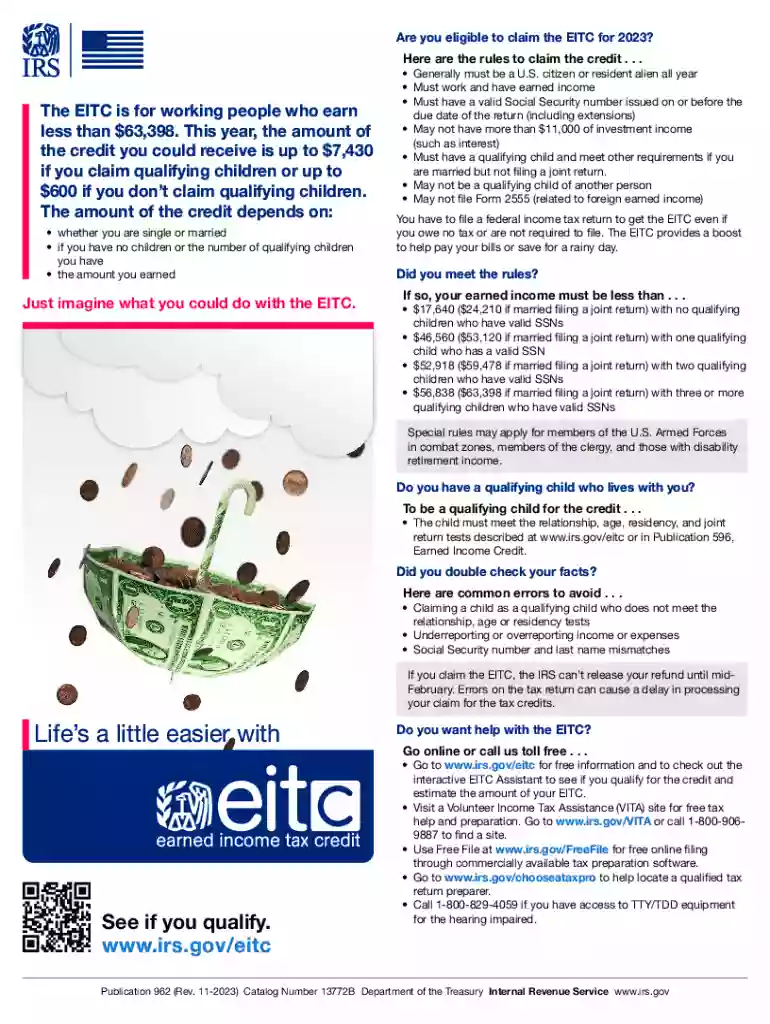
The Earned Income Tax Credit (EITC) is a federal tax credit designed to benefit low- to moderate-income working individuals and families, particularly those with children. Its main aim is to incentivize work by providing financial relief to eligible filers, thereby reducing poverty levels. The EITC can lower the amount of tax owed or lead to a refund. It plays a critical role in the U.S. tax system by supporting those with lower earnings, helping to offset some part of payroll taxes, and boosting overall income.
Qualification for the EITC depends on several factors, including earned income, adjusted gross income (AGI), and investment income. For 2023, individuals earning less than $63,398 are eligible. Specific thresholds vary based on marital status and the number of qualifying children. Other requirements include being a U.S. citizen or resident alien for the entire year, having a valid Social Security number, and not being claimed as a dependent or qualifying child of another person. Additionally, for those without children, additional criteria such as age limits apply.


To claim the EITC, follow these steps:
Key documents include:
The IRS provides extensive guidelines to help claimants accurately file for the EITC. These include instructions on completing necessary forms, definitions of key terms such as "qualifying child," and methods for amending past tax returns if errors are discovered. The IRS emphasizes accuracy and honesty in reporting income to avoid delays or denials.
Consider a single mother with two children earning $25,000 annually. She can potentially qualify for the maximum EITC, significantly boosting her income. In contrast, a married couple without children earning the same amount might receive a lesser credit but still benefit from reduced tax liabilities. These examples illustrate the EITC’s flexibility, providing varying levels of assistance based on specific family and income circumstances.
For the EITC, aligning with the federal tax filing deadline, typically April 15, is crucial. Filing earlier can potentially lead to an early refund. If extending a return, the deadline usually extends to mid-October, but timely filing without procrastination is encouraged to expedite processing and refund distribution.
Submitting a complete and accurate tax return is the first step in applying for the EITC. The IRS requires approximately three weeks to process electronically filed returns but may take longer if errors or additional reviews are necessary. Paper returns often take longer, making electronic submission preferable for quicker results.
Common mistakes that can hinder EITC processing include incorrect Social Security numbers, filing status errors, and miscalculations of income. Double-check all entries, and utilize available IRS resources or tax software to minimize errors. Those uncertain about their ability to complete the process accurately may benefit from professional tax preparation services.
We've got more versions of the What is the Earned Income Tax Credit (EITC)? form. Select the right What is the Earned Income Tax Credit (EITC)? version from the list and start editing it straight away!
At DocHub, your data security is our priority. We follow HIPAA, SOC2, GDPR, and other standards, so you can work on your documents with confidence.



The Earned Income Credit (EITC) is a tax credit for workers who earn low or moderate incomes. There two types of Earned Income Tax Credits: a federal credit
Tell us about yourself. Your responses will help us determine whether you qualify for the Earned Income Tax Credit (EITC). Select the tax year you wouldRead more


