
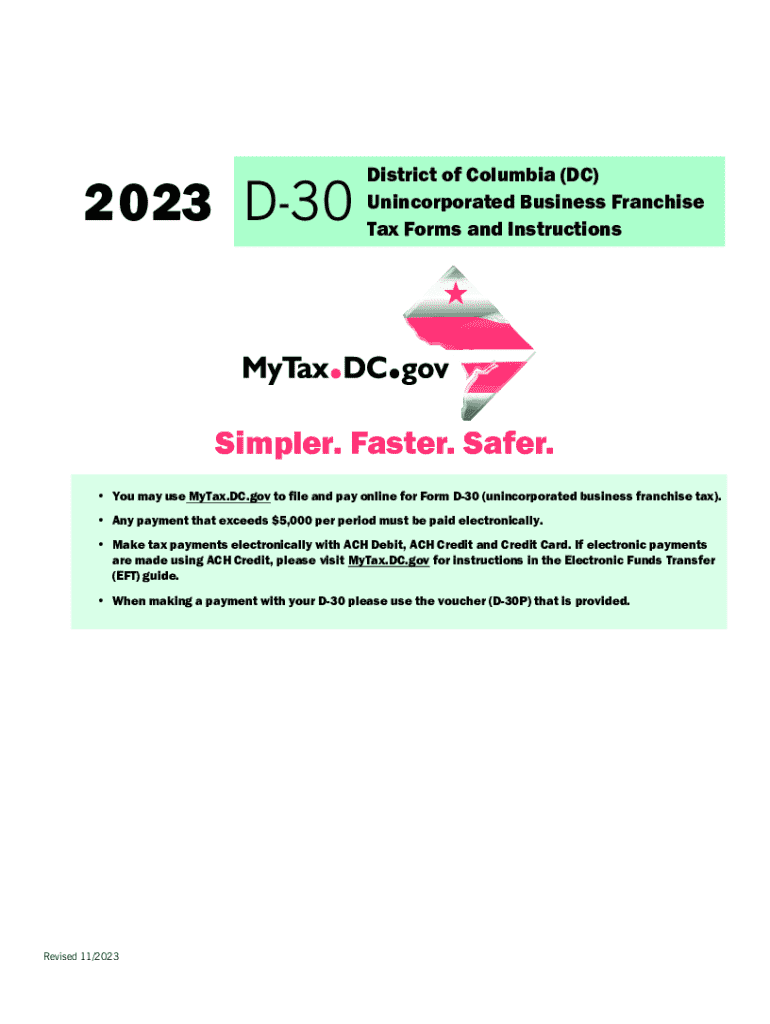







Overview of Form D-30
Form D-30 is utilized for the Unincorporated Business Franchise Tax in the District of Columbia. It applies to businesses that operate as unincorporated entities and have gross income derived from business operations within the District. This form enables the calculation and payment of the necessary franchise tax, ensuring these businesses meet their tax obligations.
Filing Process for Form D-30 Online
-
Eligibility Check: Ensure your business qualifies for filing Form D-30 by verifying it operates without incorporation within the District of Columbia.
-
Visit Official Site: Access the DC Office of Tax and Revenue's website to find the section for online business tax filings.
-
Create an Account: If you haven't already, register for an online account to facilitate the electronic submission of the form.
-
Form Completion: Fill out the necessary sections of Form D-30, providing information on business income, deductions, and tax credits.
-
Review and Submit: Double-check all details for accuracy before submitting the form. Successful submission will generate a confirmation receipt.
Steps to Complete Form D-30
-
Accumulate Financial Data: Gather all required financial statements, including income and expense records for the tax period in question.
-
Calculate Tax Liability: Use the guide provided by the DC tax authority to accurately calculate your business's tax obligation.
-
Input Accurate Information: Enter all requested information, ensuring figures and personal/business identifiers are correct.
-
Digital Submission: Use the online portal to submit your completed Form D-30. Keep a digital or printed copy of your submission for future reference.
Important Dates and Deadlines
-
Filing Deadline: Ensure Form D-30 is filed by April 15th, 2024, for the tax year 2023.
-
Estimated Tax Payments: Schedule estimated payments to avoid penalties if your business is expected to have a significant tax liability.
-
Extensions: If necessary, apply for an extension to prevent late filing penalties.
Benefits of Online Filing
-
Efficiency: Filing online expedites the process, reducing the time needed for postal delivery and manual handling.
-
Convenience: Allows for tax filing from any location with internet access, offering flexibility to busy business owners.
-
Security: Online systems use encryption to protect sensitive tax information, ensuring compliance with privacy regulations.
Required Documentation
-
Business Financial Records: Include detailed income and expense records, balance sheets, and previous tax returns if applicable.
-
Identification Numbers: Provide the business's employer identification number (EIN) or social security number (SSN) if not applicable.
-
Tax Credit Documentation: Maintain any relevant certificates or documentation to support tax credits claimed.
Penalties for Non-Compliance
-
Late Filing Penalties: Failing to file by the deadline may result in penalties and interest on overdue taxes.
-
Underpayment Penalties: If estimated tax payments were insufficient, additional penalties could apply.
-
Inaccurate Information: Deliberate misinformation can lead to audits and additional financial penalties imposed by tax authorities.
Software Compatibility
-
Supported Platforms: Many tax preparation software, including TurboTax and QuickBooks, provide supportive calculations for Form D-30.
-
Integration Benefits: Automated financial data imports simplify form completion and minimize errors due to manual data entry.
Business Types that Benefit Most
-
Small Businesses: Particularly those in sole proprietorships or partnerships that operate without corporate structures.
-
Local Enterprises: Businesses deriving income predominantly from operations within the District of Columbia.
-
Service Providers: Companies in services, consulting, or freelancing sectors often find this form applicable.
By incorporating these comprehensive blocks, businesses and tax professionals can effectively navigate the requirements and processes associated with filing Form D-30 online.


