Form-ct-706-709-ext-fillable0624-final 2026

Get Form
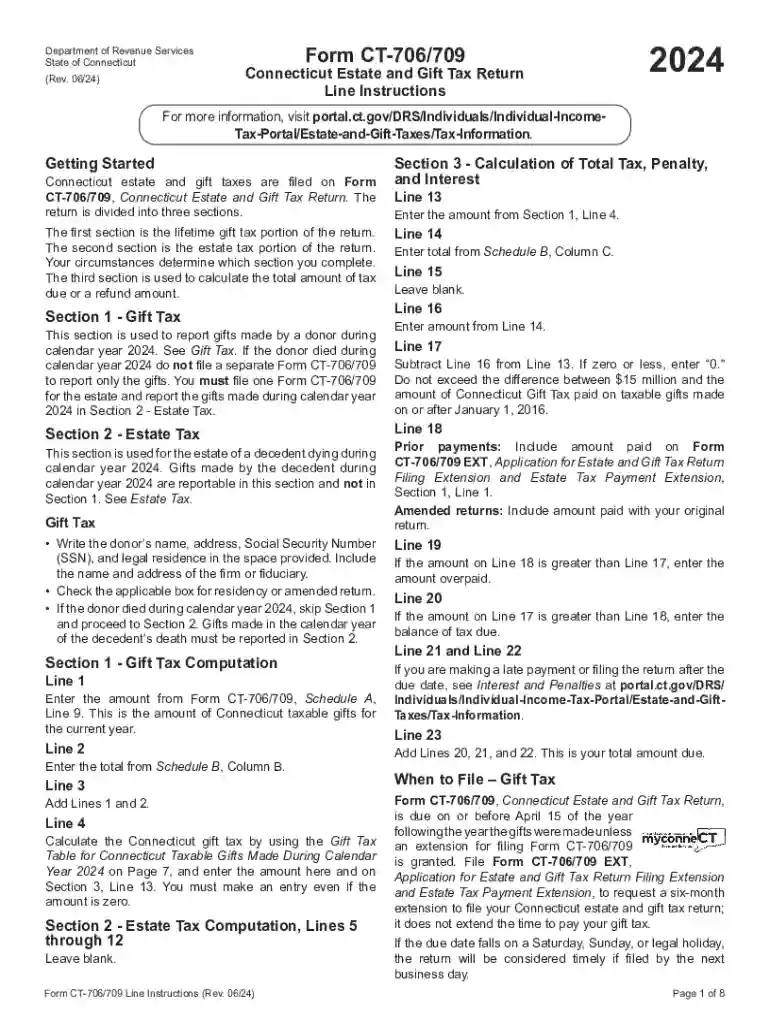
form-ct-706-709-ext-fillable0624-final Preview on Page 1

Here's how it works

01. Edit your form online
Type text, add images, blackout confidential details, add comments, highlights and more.

02. Sign it in a few clicks
Draw your signature, type it, upload its image, or use your mobile device as a signature pad.

03. Share your form with others
Send it via email, link, or fax. You can also download it, export it or print it out.

Definition & Meaning

The form-ct-706-709-ext-fillable0624-final is a specific extension form related to the Connecticut Estate and Gift Tax Returns. This form serves as an official request for an extension of time to file these taxes, providing taxpayers with additional time to gather necessary documents and submit accurate returns. It is primarily used by individuals and entities responsible for reporting lifetime gifts and estate taxes within the state of Connecticut.

How to Use the Form-CT-706/709-Ext-Fillable0624-Final

To use the form-ct-706-709-ext-fillable0624-final effectively, taxpayers must download the fillable PDF from an authorized source such as an official state website or a reputable document management platform like DocHub. Once obtained, the form should be opened using a compatible PDF editor to ensure all fields can be completed accurately. Users can fill out the required sections directly on their computer or device, ensuring that all necessary information is provided before submitting the form to the appropriate state tax authorities.

Steps to Complete the Form-CT-706/709-Ext-Fillable0624-Final

  1. Download the Form: Obtain the form-ct-706-709-ext-fillable0624-final from a reliable source.
  2. Open Your PDF Editor: Use a document management tool like DocHub to access the fillable features of the form.
  3. Enter Personal Information: Fill out personal details including name, address, and taxpayer identification number.
  4. Provide Tax Details: Include relevant tax period details, such as year and type of tax return you are requesting an extension for.
  5. Select Extension Period: Indicate the desired length of the extension, if an option is available.
  6. Review and Validate: Ensure all entered information is correct and complete.
  7. Submit the Form: Send the completed form to the indicated state department via mail or electronic submission.

Key Elements of the Form-CT-706/709-Ext-Fillable0624-Final

  • Personal and Contact Information: Sections requiring full legal name, address, and identification numbers for tracking purposes.
  • Tax Information: Fields related to the type of taxes being reported, including specific periods and details about the estate or gifts.
  • Signature and Date: Areas where the applicant must provide a signature to authenticate the request legally.
  • Submission Instructions: Clear guidelines on where and how to send the form upon its completion.

Filing Deadlines / Important Dates

The form must be filed on or before the original due date of the estate and gift tax return to ensure the extension request is granted. This generally corresponds with the state of Connecticut's regular tax deadlines, typically set in the middle of April each year. Filing ahead of time is advisable to rectify any potential errors before the submission.

Who Typically Uses the Form-CT-706/709-Ext-Fillable0624-Final

This form is most commonly used by estate administrators, legal representatives, and taxpayers responsible for managing estate and gift taxes in Connecticut. It is especially pivotal for those who require additional time to compile financial records, appraisals, and other pertinent documentation that are vital for completing the main tax return accurately.


decoration image ratings of Dochub

IRS Guidelines

Although the form-ct-706-709-ext-fillable0624-final pertains specifically to Connecticut taxes, it must abide by broader IRS regulations concerning tax extensions. Taxpayers seeking state tax extensions must ensure harmony between state-specific filing requirements and applicable federal guidelines, especially when involved estates encompass complex financial elements subject to federal tax laws.

Penalties for Non-Compliance

Failure to submit the form in a timely manner can result in penalties, including fines and interest on the owed tax amount. The Connecticut Department of Revenue Services enforces strict adherence to submission deadlines, and taxpayers are advised to file both the extension form and the eventual tax return promptly to avoid these financial repercussions.

be ready to get more

Complete this form in 5 minutes or less

Get form

Got questions?

We have answers to the most popular questions from our customers. If you can't find an answer to your question, please contact us.
Contact us
Do all estates have to file Form 706? No, not all estates need to file Form 706. Only estates with gross assets and prior taxable gifts exceeding the annually determined exemption amount are required to file this form. For 2023, this threshold is set at $12.92 million, or $13.61 million in 2024.
What is the Average Cost of Filing Taxes by Form and Service Tax FormCost per FormAverage Hourly Fees for Filing Tax Form 990 (Exempt Organization) $735 $171.48 Form 1120-S (S Corporation) $903 $179.81 Form 1120 (Corporation) $913 $181.57 Form 706 (Estate) $1,289 $188.6310 more rows Jul 10, 2025
Modernized e-File (MeF) for gift taxes now offers a secure and accurate way to file the Form 709, United States Gift (and Generation-Skipping Transfer) Tax Return and Form 709-NA, United States Gift (and Generation-Skipping Transfer) Tax Return of Nonresident Not a Citizen of the United States.
You must file a gift tax return if you made any gift to your spouse of a terminable interest that does not meet the exception described in Life estate with power of appointment, later, or if your spouse is not a U.S. citizen and the total gifts you made to your spouse during the year exceed $185,000.
Most relatively simple estates (cash, publicly traded securities, small amounts of other easily valued assets, and no special deductions or elections, or jointly held property) do not require the filing of an estate tax return.

Security and compliance

At DocHub, your data security is our priority. We follow HIPAA, SOC2, GDPR, and other standards, so you can work on your documents with confidence.
Learn more
ccpa2
pci-dss
gdpr-compliance
hipaa
soc-compliance
be ready to get more

Complete this form in 5 minutes or less

Get form

People also ask

In most cases, the statute of limitations the time in which the IRS can conduct and complete an audit is three years from the filing date.
At our firm, we frequently encounter these errors that can put families at risk: Not filing Form 706 because the estate falls below the exemption threshold. Incomplete or inaccurate asset valuations that trigger IRS audits. Missing critical deadlines for filing or requesting extensions.
Understanding the schedules on two federal forms Form 706 is the Federal Estate Tax Return and Form 709 is the Federal Gift Tax Return as well as the potential pitfalls that can occur in trust administration, is crucial for accurate reporting.