This is NOT a tax bill DO NOT send money or check 2026

Get Form
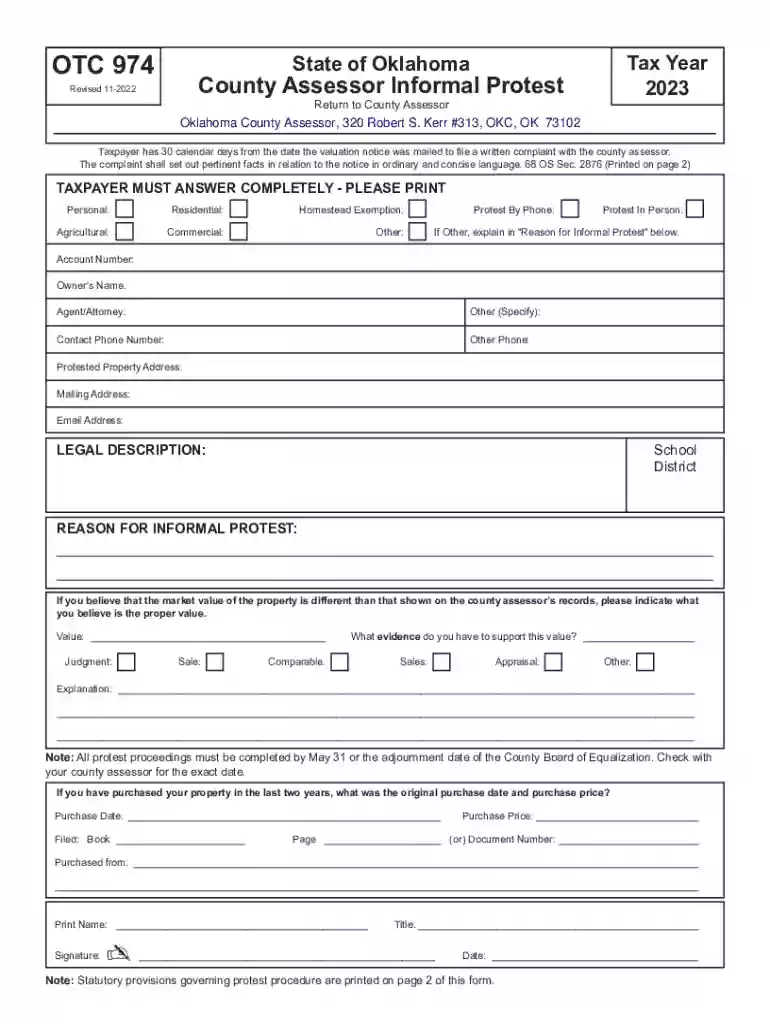
otc 974 Preview on Page 1

Here's how it works

01. Edit your otc 974 online
Type text, add images, blackout confidential details, add comments, highlights and more.

02. Sign it in a few clicks
Draw your signature, type it, upload its image, or use your mobile device as a signature pad.

03. Share your form with others
Send otc 974 form via email, link, or fax. You can also download it, export it or print it out.

Definition & Meaning

The document labeled "This is NOT a tax bill DO NOT send money or check" serves as a notification or informational guide typically sent by a tax authority to inform recipients about certain tax-related matters without requesting immediate payment. This type of form is used to clarify that the information within it should not be misconstrued as a demand for payment. Instead, it aims to communicate details about tax assessments, adjustments, or other relevant changes regarding the recipient’s tax records.

Key Elements of the Form

The central components of a "This is NOT a tax bill DO NOT send money or check" notice usually include:

  • Recipient Information: Identifying details of the taxpayer, such as name and address.
  • Tax Year or Period: The specific timeframe to which the notice refers.
  • Assessment or Changes: Explanation of why the notice is issued, such as changes in property value, tax rate adjustments, or errors in previous documentation.
  • Clarification Statement: A prominent statement emphasizing that no payment is required, often bolded or highlighted for visibility.

These elements help avoid confusion and ensure the recipient understands the purpose of the notice.

How to Use the Form

Understanding the function of a "This is NOT a tax bill DO NOT send money or check" notice is critical:

  1. Review the Details: Carefully read all sections of the document to comprehend the information provided.
  2. Verify Accuracy: Check for correctness in the addressed personal or property details and the specified period.
  3. Contact Appropriate Authority: If discrepancies or questions arise, reach out to the issuing tax authority using the provided contact information.

This process aids in confirming the accuracy of tax records without requiring immediate financial action.

Steps to Complete Any Associated Tasks

Although this document does not involve direct actions, there are steps recipients may need to undertake:

  1. File a Correction Request (if applicable): If you notice errors, prepare to submit corrected information or supporting documents.
  2. Maintain Records: Store the notice with your tax documents for future reference or verification.
  3. Consult a Tax Professional: For complex inquiries, discussing the notice with a tax advisor can provide clarity and direction.

Following these steps ensures proper handling of the information contained within the notice.

Who Typically Uses This Form

The "This is NOT a tax bill DO NOT send money or check" notice is primarily used by:

  • Tax Authorities: Governmental bodies such as the IRS or local tax offices to communicate details without requesting funds.
  • Taxpayers: Individuals who need clarification on their tax standing but are not required to remit payment.

Taxpayers across various income brackets and tax statuses may receive this form under differing circumstances.

Examples of Using This Form

Several scenarios exemplify how this form might be utilized:

  • Property Assessment Notices: Local assessors may issue this sort of notice to inform property owners of updated valuations without demanding payment.
  • Income Tax Adjustments: The IRS could send a notice explaining an amended tax return without requiring immediate settlement of any amount.
  • Educational Institutions: Schools or universities might notify about tax credits applicable to tuition but not directly charge the taxpayer.

Such examples highlight the diverse applications of this document.

Legal Use of the Form

The legal function of the "This is NOT a tax bill DO NOT send money or check" form:

  • Clarification: It legally informs recipients about tax status or updates without imposing financial pressure.
  • Compliance with Notices: Helps tax authorities maintain transparency and accuracy in taxpayer communications.

While legally binding for information, this notice typically does not require any monetary response.

State-Specific Rules for the Form

Each state may have unique rules or procedures regarding these notices:

  • Varying Terminology: Different states might use distinct terms for similar types of notifications.
  • Regulatory Compliance: State laws could dictate additional content or disclaimers in such notices.
  • Response Protocols: Depending on local requirements, additional steps might be necessary if the notice details discrepancies.

Understanding these variations is essential for accurate interpretation and response to the form.

be ready to get more

Complete this form in 5 minutes or less

Get form

Got questions?

We have answers to the most popular questions from our customers. If you can't find an answer to your question, please contact us.
Contact us
During its processing, the IRS checks your tax return for mathematical accuracy. When processing is complete, if you owe any tax, penalty, or interest, you will receive a bill. Generally, interest accrues on any unpaid tax from the due date of the return (without any extensions) until the date of payment in full.
Though all companies will issue you a 1099-K form once you earn or receive $600, you only have to pay tax if its income from customers or clients.
Fundamentals of the $600 Rule Under the latest tax laws, such a threshold has been drastically reduced to $5000 in 2024 and $2500 in 2025. The plan for 2026 is that if an individual receives $600 or more in payments through eBay, the platform is required to issue a Form 1099-K and report all the earnings to the IRS.
Initially included in the American Rescue Plan Act of 2021, the lower 1099-K threshold was meant to close tax gaps by flagging more digital income. It required platforms to report any user earning $600 or more, regardless of how many transactions they had.
Deduction for Seniors (Sec. 70103) New deduction: Effective for 2025 through 2028, individuals who are age 65 and older may claim an additional deduction of $6,000. This new deduction is in addition to the current additional standard deduction for seniors under existing law.

Security and compliance

At DocHub, your data security is our priority. We follow HIPAA, SOC2, GDPR, and other standards, so you can work on your documents with confidence.
Learn more
ccpa2
pci-dss
gdpr-compliance
hipaa
soc-compliance
be ready to get more

Complete this form in 5 minutes or less

Get form

People also ask

The IRS generally has 10 years from the assessment date to collect unpaid taxes from you. The IRS cant extend this 10-year period unless you agree to extend the period as part of an installment agreement to pay your tax debt or the IRS obtains a court judgment.
In most cases, if you dont pay your owed taxes on time, youll accrue interest on any unpaid tax from the tax returns due date until the payment date. The IRS interest rate is the federal short-term rate plus 3%. The IRS states the rate is set every quarter and interest compounds daily.

Related links