




01. Edit your form online
Type text, add images, blackout confidential details, add comments, highlights and more.

Type text, add images, blackout confidential details, add comments, highlights and more.

Draw your signature, type it, upload its image, or use your mobile device as a signature pad.

Send it via email, link, or fax. You can also download it, export it or print it out.
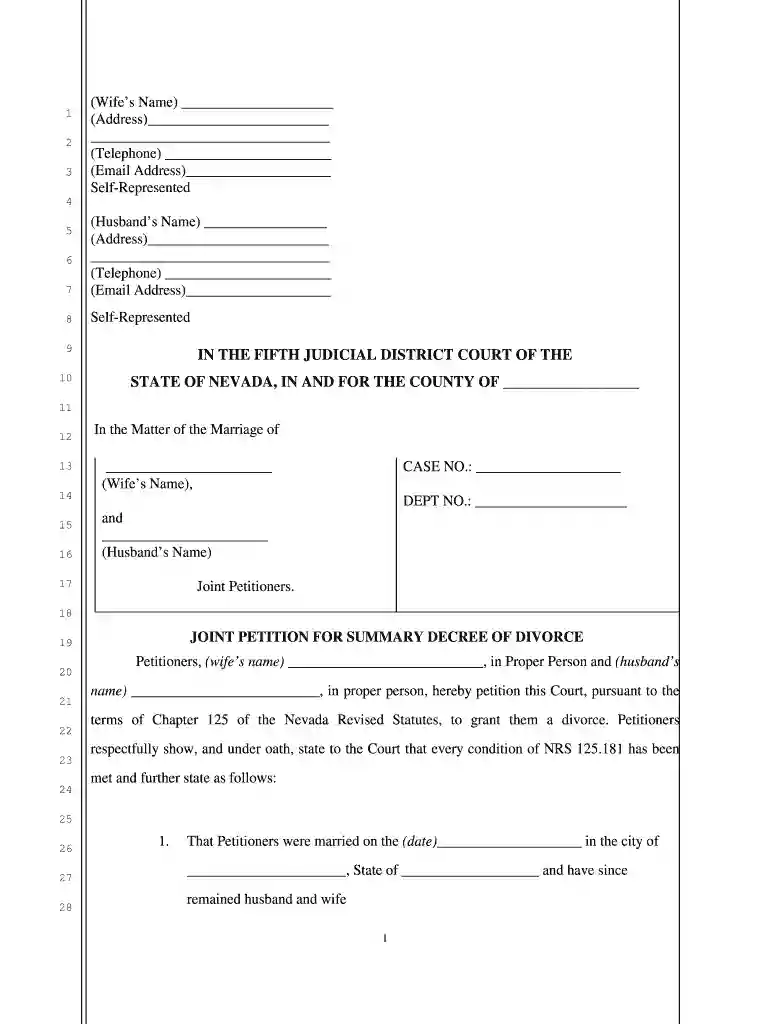
The "Joint Petition for Summary Decree of Divorce" is a legal document filed by married partners seeking a mutual agreement to end their marriage. Typically used in scenarios where both parties consent to divorce, this petition indicates that the couple believes their marriage is irretrievably broken due to incompatibility. This form is generally filed when there are no disputes over child custody, property division, or spousal support, thereby facilitating a streamlined judicial process. The document is primarily used in the Fifth Judicial District Court of Nevada and contains standardized sections for personal information, residency, asset division, and any requisite waivers.
Using the "Joint Petition for Summary Decree of Divorce" involves several key steps to ensure all legal requirements are met. Start by:
Gathering Information: Collect relevant personal details such as names, addresses, phone numbers, and email addresses for both parties. Confirm that all information is accurate to avoid potential delays.
Completing Residency Information: Verify that you meet Nevada’s residency requirements, which typically mandate at least one party has lived in the state for a minimum of six weeks.
Detailing Division of Assets and Debts: Clearly outline agreements regarding property and debt division. Both parties should mutually agree on how their assets and liabilities will be split.
Spousal Support Agreements: If applicable, detail any agreed-upon terms for spousal support. This is an optional section if both parties are financially independent.
Requesting Name Changes: Include any requests for name changes, indicating which party wishes to revert to a previous name, if applicable.
Filling out the "Joint Petition for Summary Decree of Divorce" involves several detailed actions:
Personal Section: Begin with filling in personal and contact information accurately.
Residency Declaration: Complete the residency section by confirming that you meet the state’s legal residency requirements for filing.
Incompatibility Agreement: Clearly state reasons for divorce, citing irreconcilable differences as the primary cause.
Asset and Debt Division: Use clear, concise language to describe how you plan to divide assets and debts. List each item and its agreed division.
Spousal Support Clauses: Specify if there will be any spousal support, detailing the amount and duration agreed upon.
Signatures and Notarization: Both parties must sign the document in front of a notary public to authenticate the petition.
Choosing the "Joint Petition for Summary Decree of Divorce" offers several benefits:
Key elements of the "Joint Petition for Summary Decree of Divorce" include:
The "Joint Petition for Summary Decree of Divorce" is legally binding and recognizes both parties’ agreement to dissolve their marriage under the laws governing Nevada. It must conform to local jurisdictional guidelines and be filed correctly to avoid dismissal or delays. The document, once filed, is reviewed by the court, where a judge issues the final decree if all stipulations are satisfactorily met.
In Nevada, significant rules impact the use of the "Joint Petition for Summary Decree of Divorce":
Consider this example to better understand the use of the "Joint Petition for Summary Decree of Divorce":
We've got more versions of the 1 2 3 (Wifes Name) (Address) (Telephone) (Email Address) SelfRepresented 4 7 (Husbands Name) (Addres form. Select the right 1 2 3 (Wifes Name) (Address) (Telephone) (Email Address) SelfRepresented 4 7 (Husbands Name) (Addres version from the list and start editing it straight away!
| Versions | Form popularity | Fillable & printable |
|---|---|---|
| 2013 | 4 Satisfied (39 Votes) |
At DocHub, your data security is our priority. We follow HIPAA, SOC2, GDPR, and other standards, so you can work on your documents with confidence.



Mar 27, 2026 This Court Forms page is only somewhat searchable. However if you have located a form number from this guide, you can find both a PDF and a WordRead more
Parties may email documents, either to open a new case or to submit in an existing case, to ProSe@nysd.uscourts.gov . to self-represented litigants


