Affidavit for Lawful Presence Verification 2026

Get Form
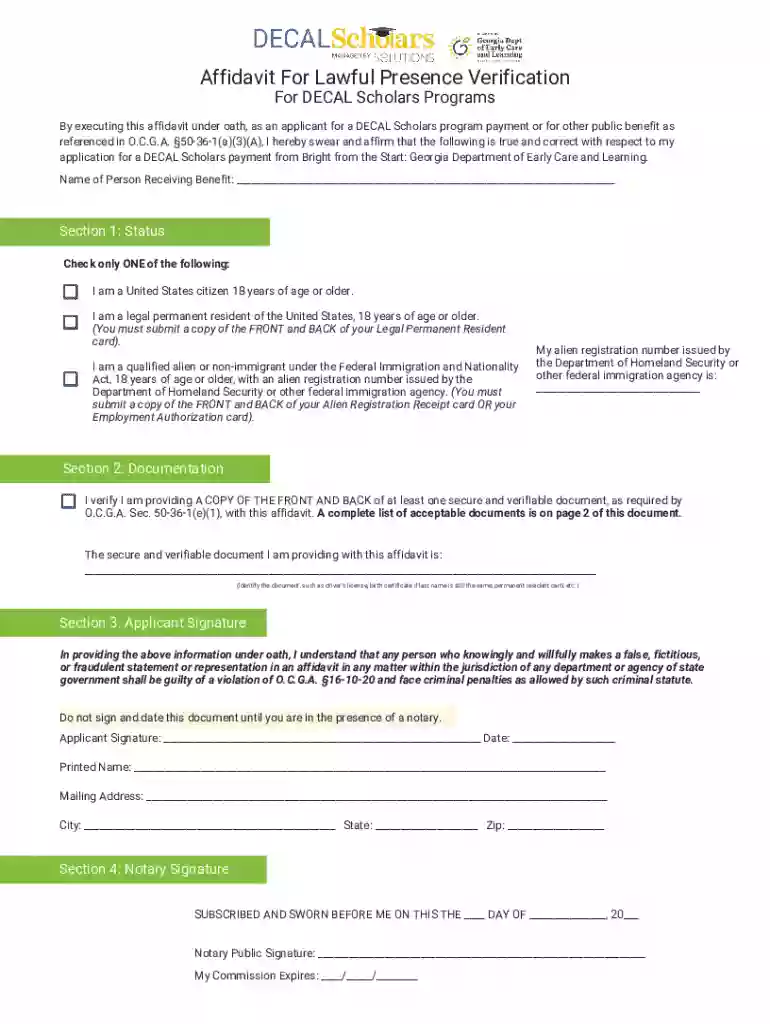
Affidavit for Lawful Presence Verification Preview on Page 1

Here's how it works

01. Edit your form online
Type text, add images, blackout confidential details, add comments, highlights and more.

02. Sign it in a few clicks
Draw your signature, type it, upload its image, or use your mobile device as a signature pad.

03. Share your form with others
Send it via email, link, or fax. You can also download it, export it or print it out.

Definition & Meaning

An "Affidavit for Lawful Presence Verification" is a legal document utilized to confirm an individual's lawful presence within the United States. Applicants, specifically those seeking benefits from programs like the DECAL Scholars program administered by the Georgia Department of Early Care and Learning, use this document to affirm their citizenship or immigration status. The affidavit requires individuals to provide sworn statements under oath regarding their identity and lawful presence, supported by verifiable documents.

Importance of Lawful Presence Verification

Verifying lawful presence is crucial because it ensures that only eligible individuals receive certain benefits, rights, or services. This process helps maintain the integrity of compliance with applicable immigration laws and program-specific requirements. Various U.S. government programs and services necessitate such verification to ensure that resources are distributed to those who are legally eligible.

Required Documents

For the "Affidavit for Lawful Presence Verification," applicants must provide specific documents as proof of identity and lawful status. Acceptable secure and verifiable documents may include:

  • U.S. Passport or a Certificate of Naturalization
  • Permanent Resident Card or Alien Registration Receipt Card
  • Valid Employment Authorization Document
  • Foreign Passport with a U.S. Visa
  • Driver's License issued by a U.S. state or territory

These documents serve to validate the individual’s claims in the affidavit and are indispensable for substantiating their legal standing.

Steps to Complete the Affidavit for Lawful Presence Verification

Completing the affidavit involves several critical steps:

  1. Gather Supporting Documents: Collect all necessary documents that prove your lawful presence and identity.
  2. Fill Out the Form: Enter your personal information, such as name, address, and citizenship or immigration status.
  3. Affirm Under Oath: Sign the affidavit in the presence of a notary public, affirming your statements are true and correct.
  4. Submit the Affidavit: Depending on the program, submit the completed affidavit along with supporting documents either online, via mail, or in person.

Each step must be executed with accuracy and thoroughness to ensure the affidavit is valid and accepted by the relevant authorities.

How to Obtain the Affidavit for Lawful Presence Verification

Accessing the affidavit varies based on the issuing agency. Generally, it can be acquired through:

  • Governing body websites associated with the specific benefit or program.
  • Local government offices or agencies.
  • Legal aid organizations providing assistance with immigration-related paperwork.

In many cases, online platforms provide downloadable forms that can be printed and filled out, offering a convenient starting point for applicants.

Key Elements of the Affidavit for Lawful Presence Verification

The affidavit encompasses several key elements:

  • Applicant Information: Includes name, address, and other identifying details.
  • Legal Status Declaration: States the individual’s citizenship or immigration status.
  • Supporting Documents: Lists and verifies accompanying documentation.
  • Oath and Signature: Requires the individual to swear the truthfulness of their statements, verified by a notary public.

These components ensure the affidavit fully complies with legal standards and is thorough enough to support the applicant’s claims.

Who Typically Uses the Affidavit for Lawful Presence Verification

This affidavit is primarily used by individuals applying for public benefits or services restricted to lawful residents. This includes:

  • Applicants for educational scholarships and grants.
  • Individuals seeking employment benefits.
  • Participants in government assistance programs.
  • Business owners applying for licenses or permits requiring proof of lawful presence.

These groups rely on affidavits to establish eligibility for various programs and services that mandate legal residency.


decoration image ratings of Dochub

Legal Use of the Affidavit for Lawful Presence Verification

The affidavit holds significant legal importance in affirming lawful residency. Its primary legal functions include:

  • Compliance Assurance: Confirms applicants meet the legal criteria for accessing specific benefits or programs.
  • Documentation of Status: Serves as a formal record of residence status and citizenship for legal proceedings.
  • Verification Requirement: Used by agencies and organizations to verify applicant eligibility.

Legal compliance through these affidavits helps maintain program integrity and adherence to immigration policies.

State-Specific Rules for the Affidavit for Lawful Presence Verification

While the basic purpose of the affidavit remains the same, certain states may have additional rules or variations. These may include:

  • Unique Document Requirements: Certain states might require extra documentation or specific procedural follows.
  • Notarization Rules: Variations in the notarization process might exist, impacting how affidavits are finalized.
  • Submission Guidelines: Different states may have distinct processes for submitting affidavits.

Understanding these state-specific nuances is crucial for compliant and effective affidavit submission to the appropriate authorities.

State-by-State Differences

Diverse regulations exist among states for lawful presence verification. These include:

  • Document Acceptance Lists: States might have varying lists of acceptable documents to verify identity.
  • Administrative Processing: Differences in processing timelines and methods may occur.
  • Specific Programs and Benefits: States differ in programs necessitating a lawful presence affidavit.

Applicants must be aware of these state-specific disparities to ensure proper compliance and successful affidavit acceptance.

be ready to get more

Complete this form in 5 minutes or less

Get form

Got questions?

We have answers to the most popular questions from our customers. If you can't find an answer to your question, please contact us.
Contact us
Photo identification; 2. A Deed, Mortgage Statement, or Lease/Rental Agreement (or current HUD Certificate of Compliance/Annual Renewal Notice) in the owner or primary renters name and showing residence property address; 3. Georgia Power Bill (current within the last 30 days); AND 4.
Permanent Resident Card or Green Card (I-551). Temporary I-551 stamp on form I-94/I-94A or on a foreign passport. Machine Readable Immigrant Visa with temporary I-551 language.
The affidavit of lawful presence is a document that is necessary for all real estate transactions to confirm ones actual, legal presence inside the United States. It may contain essential information identifying a person, such as a name and date of birth, in addition to an attestation of lawful presence in the state.
Lawful presence within the United States may be verified through the Systematic Alien Verification for Entitlements program operated by the U. S. Department of Homeland Security, or by other verification with the U. S. Department of Homeland Security pursuant to 8 U.S.C. 1373(c).
You must submit copies of the front and back of your Permanent Resident Card. Certificate of Citizenship (USCIS form N-560 or N-561). Department of State Certificate of Birth Abroad or Certification of Report of Birth Abroad. Current military ID (for service members only, not dependents).

Security and compliance

At DocHub, your data security is our priority. We follow HIPAA, SOC2, GDPR, and other standards, so you can work on your documents with confidence.
Learn more
ccpa2
pci-dss
gdpr-compliance
hipaa
soc-compliance

People also ask

Lawful Presence Verification (LPV) verifies that the student is legally in the country. It is required of every student who is classified as a Resident (in-state) student and/or receiving an out-of-state tuition waiver in ance with BOR Policy 4.3.
In all cases, a document with your name and birth date has been issued to you and proves your legal presence in the U.S. Certain documents issued by the U.S. Citizenship and Immigration Services (USCIS), a component of the Department of Homeland Security (DHS), state how long the bearer may legally be present in the

Related links