Renunciation property 2026

Get Form
inheritance disclaimer form Preview on Page 1

Here's how it works

01. Edit your inheritance disclaimer form online
Type text, add images, blackout confidential details, add comments, highlights and more.
02. Sign it in a few clicks
Draw your signature, type it, upload its image, or use your mobile device as a signature pad.
03. Share your form with others
Send inheritance form via email, link, or fax. You can also download it, export it or print it out.

How to use or fill out renunciation property with our platform

Form edit decoration
9.5
Ease of Setup
DocHub User Ratings on G2
9.0
Ease of Use
DocHub User Ratings on G2
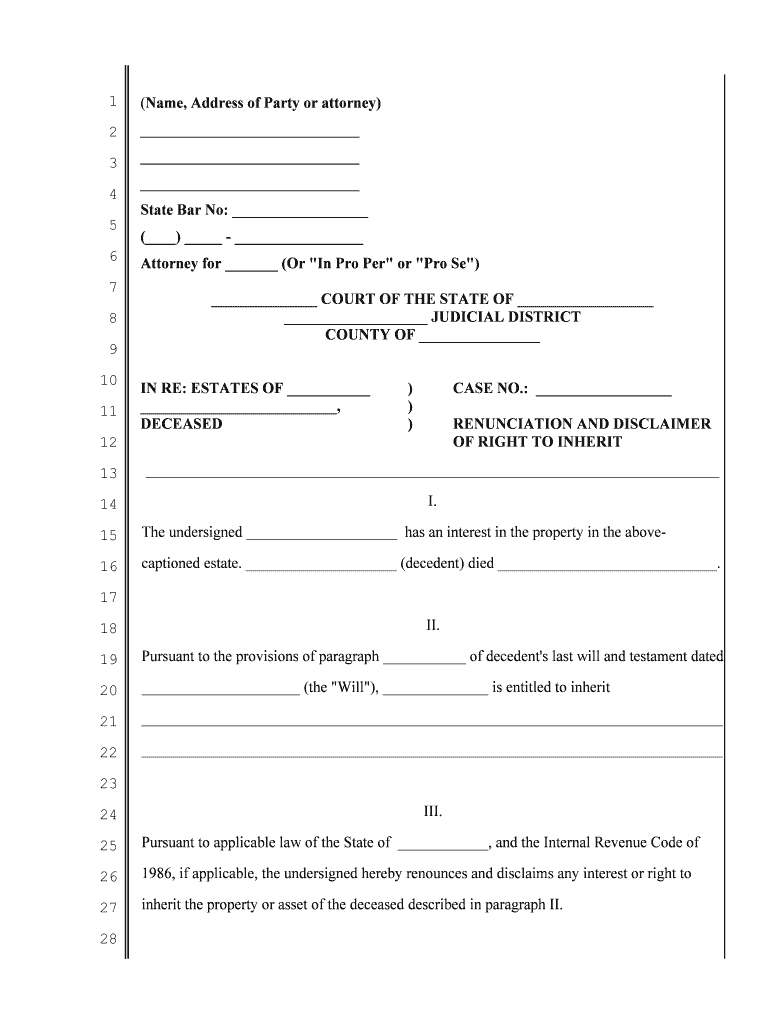
  1. Click ‘Get Form’ to open the renunciation property document in the editor.
  2. Begin by entering your name and address, or that of your attorney, in the designated fields at the top of the form.
  3. Fill in the State Bar number if applicable, along with your contact number. Specify whether you are representing yourself ('In Pro Per' or 'Pro Se').
  4. In the section labeled 'IN RE: ESTATES OF', provide the name of the deceased and case number as required.
  5. Complete Section I by stating your interest in the property and noting the date of death of the decedent.
  6. In Section II, refer to the specific paragraph from the decedent's will that entitles you to inherit, detailing any relevant information about what you would inherit.
  7. Section III requires you to formally renounce any claim to inherit. Ensure this is clearly stated as per applicable laws.
  8. Finalize by signing and dating at the bottom of the form. If necessary, have it notarized as indicated in Section IV.

Start using our platform today for free to complete your renunciation property form effortlessly!

be ready to get more

Complete this form in 5 minutes or less

Get form

Got questions?

We have answers to the most popular questions from our customers. If you can't find an answer to your question, please contact us.
Contact us
Renunciation, sometimes called disclaimer, is the act of refusing to accept property or an interest passed to you in an estate. While it may sound counterintuitive to give up assets, there are good reasons to do so.
Renunciation refers to the rejection of something, typically a belief, a claim, or a course of action. It involves giving up or abandoning a right, title, possession, or a relationship, often voluntarily. For example, renunciation of citizenship means formally giving up ones nationality.
Renunciation comes into play when someone decides to give up the right to inherit property or an interest in that property. This topic can become complicated quickly, since renunciation interacts with tax laws, trust laws, and the rules for distributing a decedents assets.

Security and compliance

At DocHub, your data security is our priority. We follow HIPAA, SOC2, GDPR, and other standards, so you can work on your documents with confidence.

Learn more
ccpa2
pci-dss
gdpr-compliance
hipaa
soc-compliance
be ready to get more

Complete this form in 5 minutes or less

Get form