







Definition and Meaning
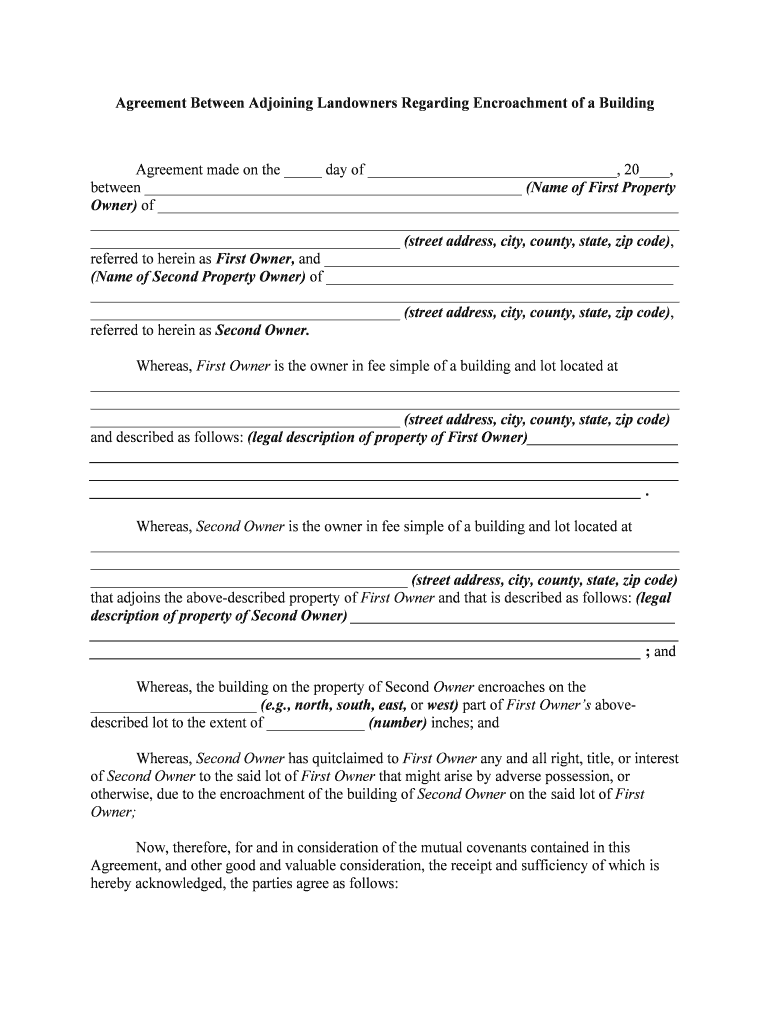
An encroachment agreement is a legal document between two adjoining property owners, where the structure owned by the second party extends onto the land of the first party. This agreement legally acknowledges the intrusion and grants the right to maintain the encroaching structure. Such agreements often contain provisions that bind both parties and any successors, ensuring that obligations are upheld regardless of ownership changes. The document remains valid as long as the structure continues to encroach.
Key Elements of the Encroachment Agreement
An encroachment agreement typically consists of several fundamental components:
- Identification of Parties: Clearly defines the first and second owners involved in the agreement.
- Property Description: Provides detailed descriptions of the properties involved, including addresses and any relevant legal descriptions.
- Encroachment Details: Specifies the nature of the encroachment, such as the type of structure and extent of intrusion.
- Rights and Obligations: Outlines the rights given to the second owner and any obligations both parties must adhere to, like maintenance or liability clauses.
- Mutual Covenants: Lists mutual promises or conditions both parties agree to comply with, which might include indemnification clauses and termination conditions.
- Duration and Termination: Defines the period the agreement remains in effect and under what circumstances it might be terminated.
Steps to Complete the Encroachment Agreement
Completing an encroachment agreement involves several precise steps:
- Preliminary Discussion: Engage with the adjoining property owner to discuss the need for the agreement and preliminary terms.
- Survey and Inspection: Conduct a professional property survey and inspection to document the encroachment accurately.
- Legal Consultation: Consult a legal professional to ensure compliance with local laws and regulations.
- Drafting of the Agreement: Use a standard template or have a lawyer draft the agreement, including all necessary legal language.
- Review and Negotiation: Review terms with both parties and negotiate if necessary to ensure mutual agreement.
- Signing: Have both parties sign the document in front of a notary public for legal acknowledgment.
Legal Use of the Encroachment Agreement
The encroachment agreement serves multiple legal functions:
- Conflict Resolution: It helps resolve property disputes without court intervention, fostering neighborly cooperation.
- Property Use Confirmation: Confirms the legal use of the encroached land by the second owner, protecting against future disputes.
- Title Improvement: Can improve property titles by clarifying legal encumbrances and the permitted use of land.
Important Terms Related to the Encroachment Agreement
Understanding specific terms is vital for effective usage of the agreement:
- Easement: A legal right to use another's land for a specific limited purpose, often related to the encroachment.
- License: A temporary and revocable permission to use someone's property.
- Indemnification: A clause where one party agrees to compensate the other for certain damages or losses.
State-Specific Rules for the Encroachment Agreement
While encroachment agreements are generally consistent, certain rules vary by state:
- Statutory Requirements: Some states may require specific language or clauses to be included.
- Notarization and Recording: Differences in requirements for notarization and official recording of the agreement exist.
- Property Laws: Varying interpretations of property rights and how they are enforced in cases of encroachment.
Examples of Using the Encroachment Agreement
Practical examples highlight the agreement's applicability:
- Garden Structures: An agreement between homeowners when a fence or garden shed extends over a boundary.
- Commercial Properties: Businesses with buildings slightly overlapping another commercial lot's boundary leverage such agreements to avoid disputes.
- Urban Developments: Used in urban areas where buildings share walls or airspace, requiring specific encroachment understandings.
Who Typically Uses the Encroachment Agreement
The encroachment agreement is a vital tool for various entities:
- Residential Property Owners: Homeowners needing resolution over boundary disputes.
- Commercial Land Developers: Developers requiring legal security over minor property boundary issues for larger projects.
- Local Governments: Municipalities managing public land that interacts with private property boundaries.


Examples of Using the Encroachment Agreement
The practical application showcases the diversity of scenarios suitable for such agreements:
- Urban Expansion: City developers frequently engage in negotiations over space where structures need legitimized encroachment.
- Rural Properties: Farmers might use these agreements concerning fence lines or outbuilding placements that could impinge on neighboring farmland.




