




01. Edit your form av9 online
Type text, add images, blackout confidential details, add comments, highlights and more.

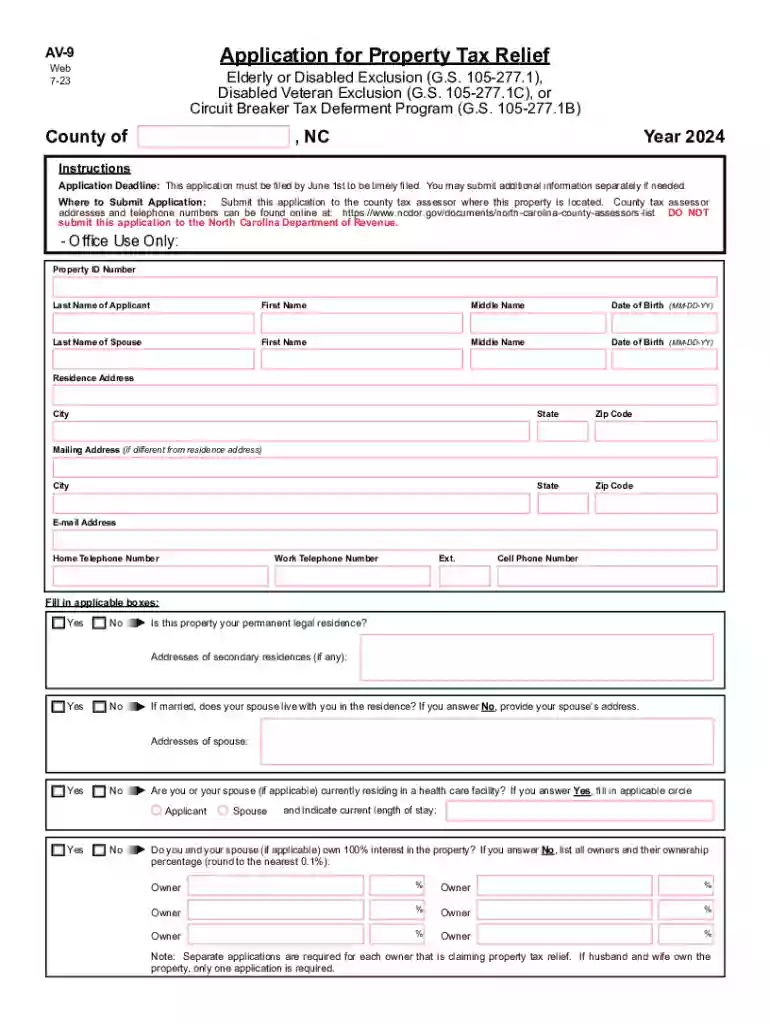
Type text, add images, blackout confidential details, add comments, highlights and more.

Draw your signature, type it, upload its image, or use your mobile device as a signature pad.

Send form av 9 via email, link, or fax. You can also download it, export it or print it out.
The Application for Property Tax Relief is a document used by eligible individuals to seek reductions or deferments in their property tax obligations. This form is typically utilized by elderly or disabled individuals, disabled veterans, and those eligible under specific state programs like the Circuit Breaker Tax Deferment Program. The application serves as a formal request to assess an applicant's eligibility based on factors such as income, residency, and specific program requirements. Understanding its purpose is crucial in determining whether this application can provide financial relief on property taxes.
Eligibility is fundamental to the application process for property tax relief. Generally, applicants must meet specific criteria, including age, disability status, veteran status, income thresholds, and residency requirements. In North Carolina, for example, the application is targeted at elderly individuals above a certain age, disabled persons, and disabled veterans. Additionally, there are income limits that applicants must adhere to, which are subject to annual changes. Residency is another critical factor, as applicants must typically reside and own property in the area where they seek relief. Each owner of the property must file separately if applicable, ensuring that all individuals seeking relief provide complete and accurate information.


Acquiring the Application for Property Tax Relief can be done through various channels. Most commonly, forms are available online via state or county government websites, where applicants can download and print them. Alternatively, paper forms may be obtained by visiting local tax offices or by requesting them through mail, depending on the practices of the specific jurisdiction. Some states may also offer interactive online applications, streamlining the process and allowing for digital submission. Familiarity with these obtaining methods ensures that applicants have access to the necessary documentation to begin the application process.
The process of completing the application involves several detailed steps:
Gather Personal Information: Collect necessary personal data such as Social Security numbers, dates of birth, and proof of residence.
Provide Income Details: Document all sources of income, including pensions, social security, and any other financial resources.
Determine Program Eligibility: Use guides provided by the tax office to ascertain which relief programs match your circumstances.
Complete Required Sections: Follow instructions carefully to fill out sections related to eligibility and personal data.
Submit Additional Documentation: Attach supporting documents proving age, disability status, or veteran status as required.
Review and Sign: Double-check all entered information for accuracy and completeness before signing the form.
Submit the Application: Choose the appropriate submission method, such as online submission, mailing, or in-person drop-off.
Following these steps meticulously can enhance the likelihood of a successful application outcome.
Understanding key terminology is essential when dealing with property tax relief applications:
Deferment: A postponement of tax payments, typically with conditions regarding when taxes must be paid.
Eligible Applicant: A person who meets all criteria set forth by the tax relief program.
Gross Income: The total income received before any deductions, relevant in determining eligibility.
Primary Residence: The main dwelling where the applicant lives, which is pertinent when assessing residency status.
These terms frequently arise in forms and instructions, and a clear understanding enhances the application process's efficiency.
Applicants must be aware of key deadlines to ensure timely submission of their application. In many jurisdictions, the deadline to file for property tax relief is June 1st. Missing this deadline can result in denial of relief for the current tax year. It is beneficial to plan ahead and gather all necessary documentation well before the cutoff date. Additionally, keeping track of any state-issued updates or changes to filing dates is necessary, as adjustments can occur based on legislative changes or administrative updates.
Applicants have several options for submitting their completed application for property tax relief:
Online Submission: Offers the convenience of submitting forms digitally through designated portals, reducing the need for physical paperwork.
Mail Submission: Requires sending the completed application and any additional documents to the specified address by mail, which includes considering mailing times to meet deadlines.
In-Person Submission: Entails delivering forms directly to the local tax office, which allows for immediate confirmation of receipt.
Each method has its advantages and choosing the right one often depends on personal preference, access to technology, and proximity to relevant tax offices.
After submission, the application undergoes a review process where officials verify eligibility and accuracy. This review can vary in duration, typically ranging from a few weeks to several months, depending on the volume of applications and state resources. Applicants might receive notifications if additional information is required. Once approved, applicants are informed of their relief status and any applicable reductions or deferments. Understanding this timeline and maintaining communication with the relevant tax authorities can provide insights into the progress and expected decisions regarding the relief application.
We've got more versions of the form av9 form. Select the right form av9 version from the list and start editing it straight away!
At DocHub, your data security is our priority. We follow HIPAA, SOC2, GDPR, and other standards, so you can work on your documents with confidence.





Property Tax Relief Forms and Instructions. Application for Property Tax Relief (Seniors/Social Security/Railroad. Property Tax Relief Forms and Instructions
This application is for use by organizations who wish to apply for exemption from the District of Columbia real property tax.


