




01. Edit your form online
Type text, add images, blackout confidential details, add comments, highlights and more.

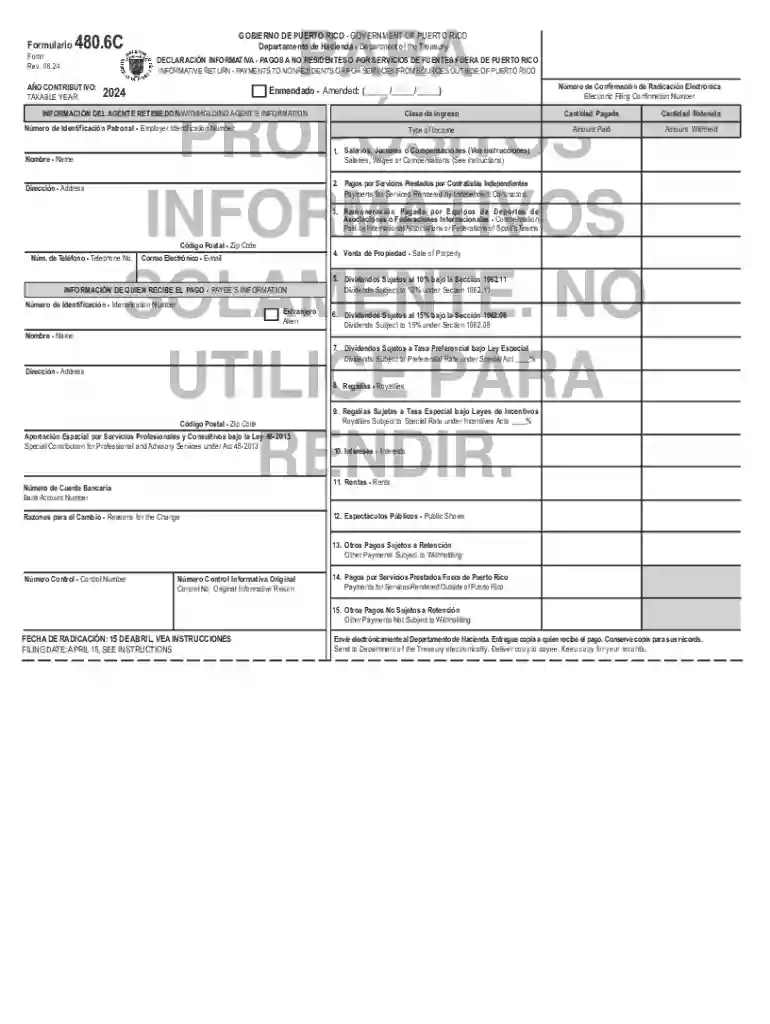
Type text, add images, blackout confidential details, add comments, highlights and more.

Draw your signature, type it, upload its image, or use your mobile device as a signature pad.

Send it via email, link, or fax. You can also download it, export it or print it out.
The "Cambios y Nuevos Formularios de Retención de Salarios y" refers to the updates and newly introduced forms that govern the withholding of wages in compliance with tax regulations in the United States. These forms are critical for employers to ensure that the correct amount of taxes is withheld from employees' salaries based on current rules and adjustments. Understanding these changes is crucial for accurate payroll management and tax compliance.
Employers should use these forms to adjust the withholding amounts deducted from their employees' paychecks. Each form provides specific instructions on how to calculate withholdings, taking into account factors such as the employee's filing status, number of allowances, and additional income or tax credits. Proper utilization of these forms helps in preventing both under-withholding and over-withholding, ensuring compliance with federal tax laws.
These forms can be accessed through the official Internal Revenue Service (IRS) website. Employers and employees can download the forms in digital format, ensuring they have the most up-to-date version. Additionally, they can request physical copies via mail or acquire them from authorized tax preparation services.
Filling out the updated withholding forms requires careful attention to detail. Employers and employees must fill out each section accurately to ensure correctness in tax withholding.
Primarily, employers and payroll administrators are the main users of these withholding forms. They ensure that employee salaries are correctly processed in line with the current tax regulations. Employees also use these forms to communicate changes in their financial situation that might affect withholding amounts.



To complete these forms accurately, specific documents and information are necessary. These documents support the disclosure of financial status and ensure completeness in the filing process.
Adhering to filing deadlines is crucial to avoid penalties and ensure compliance with federal tax law. The deadline for submitting these forms typically aligns with the start of the fiscal year or as changes occur in an individual's tax situation.
Failure to submit these forms accurately and timely can result in penalties. Both the employer and employee could face consequences, such as fines or increased scrutiny from the IRS.
We've got more versions of the Cambios y Nuevos Formularios de Retencin de Salarios y form. Select the right Cambios y Nuevos Formularios de Retencin de Salarios y version from the list and start editing it straight away!
At DocHub, your data security is our priority. We follow HIPAA, SOC2, GDPR, and other standards, so you can work on your documents with confidence.

Coincide su nombre completo y su nmero de Seguro Social con la informacin en su tarjeta? De no ser as, para asegurarse de que se le acrediten.Read more
Nuestros empleados pueden enviar o cambiar sus formularios W-4 en lnea. Escuch TAX-FORM (800-829-3676). Comprobante de Salarios y Retencin de Impuestos,
servicios en los Estados Unidos para un empleador a cambio de salario u otra remuneracin. Las fechas de liquidacin de empleados y las fechas de retencin de


