




01. Edit your form online
Type text, add images, blackout confidential details, add comments, highlights and more.

Type text, add images, blackout confidential details, add comments, highlights and more.

Draw your signature, type it, upload its image, or use your mobile device as a signature pad.

Send it via email, link, or fax. You can also download it, export it or print it out.
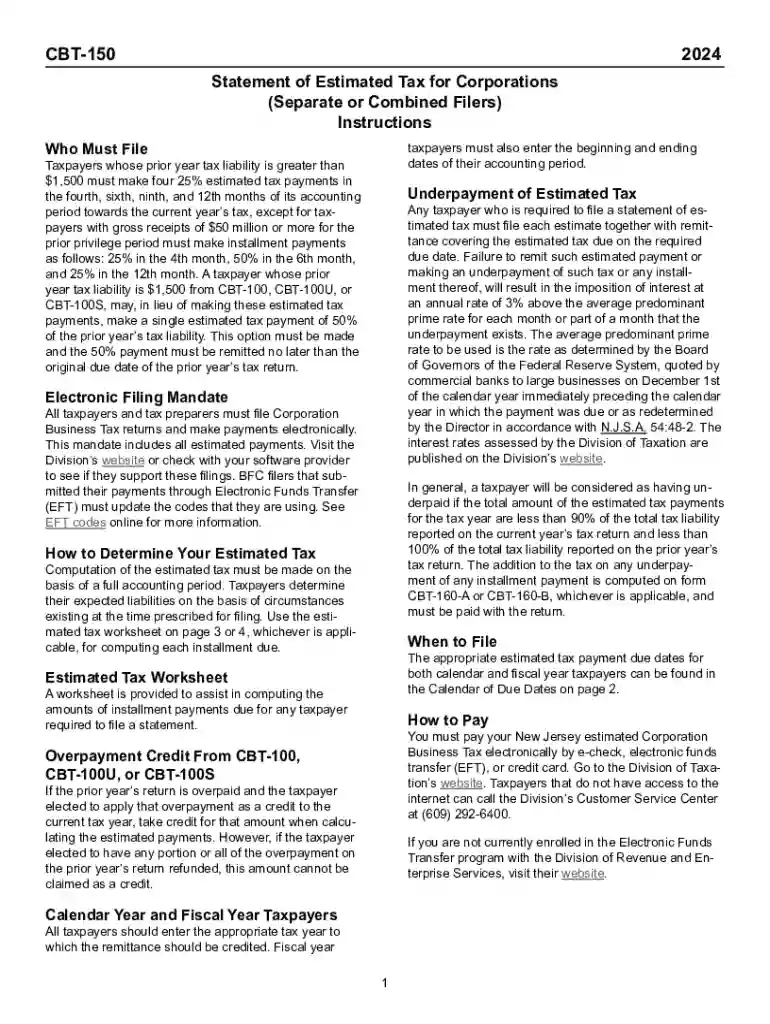
The CBT-150 form is a critical document for corporations operating in New Jersey to report and pay estimated taxes. Primarily, it serves to outline the guidelines for making estimated tax payments throughout the fiscal year, ensuring corporations meet their tax obligations without underpayment issues. It's designed to help businesses assess their expected tax liabilities and schedule payments accordingly, thus avoiding potential penalties for late or insufficient payments. With clear instructions, the form assists corporations in navigating tax complexities efficiently.
Corporations utilize the CBT-150 to calculate and submit their estimated tax payments to New Jersey’s Division of Taxation. Users must input accurate revenue and expense projections based on their previous year’s tax returns. These calculations help establish a payment schedule that complies with state regulations. Corporations should carefully follow the form’s guidelines to avoid discrepancies, as incorrect entries may result in non-compliance issues. Adhering to CBT-150 stipulations ensures that tax liabilities are managed proactively, providing financial predictability.
Gather Financial Information:
Complete the Payment Schedule:
Submit Payments:
Review and Finalize:
The CBT-150 outlines specific deadlines for each installment payment. Typically, payments are made quarterly:
Corporations must adhere to these dates to avoid late payment penalties. A calendar feature in the form helps track these important deadlines, ensuring timely compliance.
Failure to comply with CBT-150’s guidelines can result in significant penalties:
It's crucial for corporations to understand these potential financial repercussions and ensure diligent compliance with the CBT-150 requirements.
The form is legally binding and serves as an official document for the New Jersey Division of Taxation. Corporations are required to use the CBT-150 to declare their estimated taxes accurately. Ensuring correct and honest use of the form upholds corporate integrity and avoids legal confrontations with state authorities. Proper use also facilitates smoother tax auditing processes, should they arise.
Each of these components is integral for accurately reporting and remitting estimated taxes, thus avoiding pitfalls commonly associated with tax filing.
Consider a corporation that derives significant seasonal income fluctuations. Such a company might use past financial data to predict high-revenue months and adjust installment payments using the CBT-150 accordingly. In another scenario, a tech startup expecting increased revenue due to a new product launch might revise its estimated payments midway through the fiscal year. By using scenarios like these, businesses can adeptly adapt to changing financial landscapes, ensuring taxes are properly estimated and paid.
We've got more versions of the Cbt-150 form. Select the right Cbt-150 version from the list and start editing it straight away!
At DocHub, your data security is our priority. We follow HIPAA, SOC2, GDPR, and other standards, so you can work on your documents with confidence.




CB221 and CB222 breakers are designed to fit ATC style fuse panels. aftermarket.These devices comply with SAE standard J553. CB227 complies with SAE J553 and
Apr 15, 2026 In general, all Corporation Business Tax (CBT) returns and payments, whether self-prepared or prepared by a tax professional, must be submittedRead more
$150 a practitioner and patient in a therapy session. This workshop provides an introduction to cognitive behavioral therapy (CBT) $150 Format: Live


