




01. Edit your form online
Type text, add images, blackout confidential details, add comments, highlights and more.

Type text, add images, blackout confidential details, add comments, highlights and more.

Draw your signature, type it, upload its image, or use your mobile device as a signature pad.

Send it via email, link, or fax. You can also download it, export it or print it out.
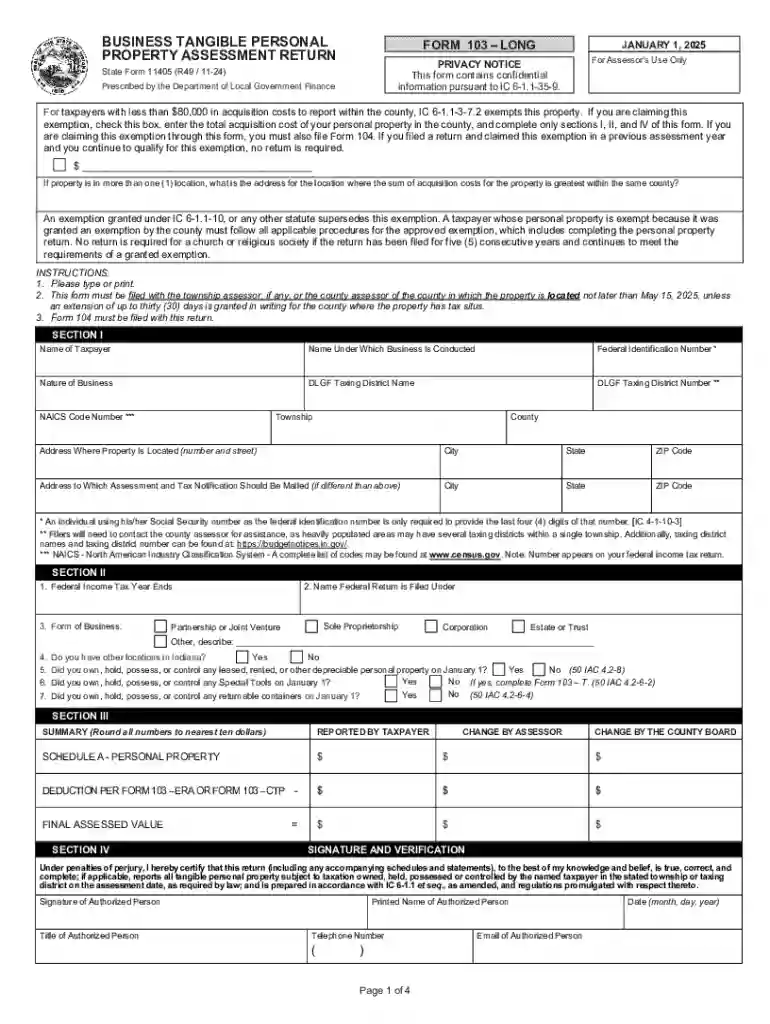
The Business Tangible Personal Property Assessment is a tax form used by businesses to report all tangible personal property owned or leased within a specific jurisdiction for taxation purposes. This form is crucial for determining the tax obligations tied to tangible assets such as machinery, equipment, and furnishings. The term "tangible personal property" refers to physical items that are not real estate but are used in business operations.
Businesses must use this form to accurately report and assess the value of their tangible personal property. The form serves as a declaration of the property's value for tax assessment purposes.
To acquire this form, contact the local tax assessor's office or visit their website. Many jurisdictions offer downloadable versions or allow forms to be filled out online.
Completing the form involves several essential steps and requires careful attention to detail.
Gather Necessary Documents:
Accurate Documentation:
Follow Local Guidelines:
Submission:
Filing this form is not just a legal obligation; it also benefits the business in several ways.
This form is typically utilized by business entities that own or lease tangible assets, including:


Understanding key terms used in this form is crucial for accurate completion.
Rules and regulations governing the assessment may vary significantly from state to state.
Understanding these state-specific nuances is critical to ensure compliance. Make sure to consult your local tax authority for guidance customized to your business’s location.
We've got more versions of the BUSINESS TANGIBLE PERSONAL PROPERTY ASSESSMENT form. Select the right BUSINESS TANGIBLE PERSONAL PROPERTY ASSESSMENT version from the list and start editing it straight away!
| Versions | Form popularity | Fillable & printable |
|---|---|---|
| 2024 | 4.9 Satisfied (47 Votes) | |
| 2022 | 4.9 Satisfied (57 Votes) | |
| 2021 | 4.8 Satisfied (45 Votes) | |
| 2020 | 4.3 Satisfied (125 Votes) | |
| 2019 | 4.3 Satisfied (273 Votes) | |
| 2018 | 4.2 Satisfied (128 Votes) | |
| 2017 | 4.2 Satisfied (53 Votes) | |
| 2015 | 4.4 Satisfied (201 Votes) | |
| 2014 | 4.2 Satisfied (73 Votes) | |
| 2007 | 4.3 Satisfied (72 Votes) |
At DocHub, your data security is our priority. We follow HIPAA, SOC2, GDPR, and other standards, so you can work on your documents with confidence.



Generally, an item is assessed at 85% percent of its original cost in the year acquired; thereafter, the percentage decreases by 10% percent increments. AfterRead more
It is the duty of the taxpayer to list fully the tangible personal property used, or held for use, in the taxpayers business or profession on the schedule,


