




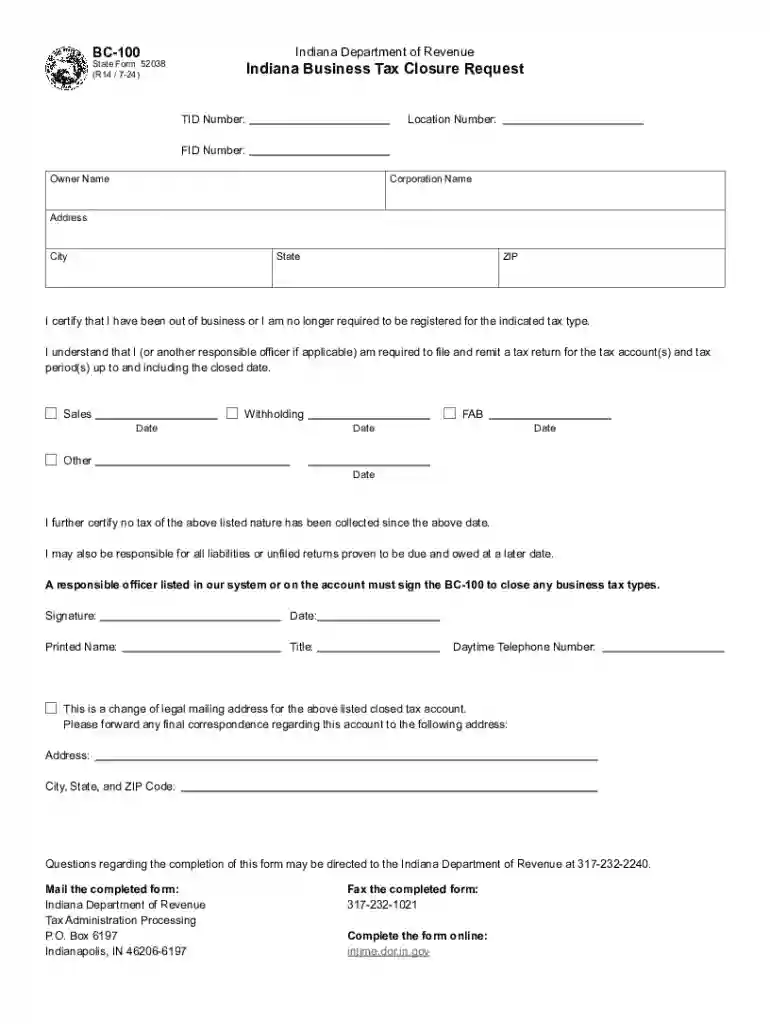
01. Edit your indiana bc 100 online
Type text, add images, blackout confidential details, add comments, highlights and more.

Type text, add images, blackout confidential details, add comments, highlights and more.

Draw your signature, type it, upload its image, or use your mobile device as a signature pad.

Send bc 100 pdf via email, link, or fax. You can also download it, export it or print it out.
The BC-100, Indiana Business Tax Closure Request, is a critical form utilized by businesses in Indiana seeking to officially close their state tax accounts with the Indiana Department of Revenue. This document signifies that a business is ceasing operations or is no longer liable for specific tax registrations. By submitting this form, businesses certify their inoperative status and request formal closure of their tax obligations under the state's jurisdiction. This process is essential to ensure that businesses fulfill their statutory responsibilities and avoid unnecessary tax liabilities.
Using the BC-100 form involves several steps designed to streamline the closure process. Firstly, businesses need to accurately fill out the form, providing essential details such as business identification numbers and ownership information. It's crucial to follow the instructions provided with the form to ensure all necessary sections are completed. Once the form is filled, businesses can submit it either through mail, fax, or an online portal, depending on what is most convenient or available. Following submission, businesses should keep a copy for their records and monitor the transaction for confirmation of closure.
This form is predominantly used by business entities operating in Indiana that are looking to halt their operations or dissolve completely. This includes corporations, limited liability companies (LLCs), partnerships, and sole proprietorships. Any business that no longer needs to register for specific state taxes must file the BC-100 to end its tax obligation. Responsible officers, accountants, or legal representatives typically handle the submission of this form on behalf of the business.


Indiana’s regulations necessitate that businesses undergoing closure follow specific state directives when filing the BC-100. This includes adhering to the timeline specified for submission and correctly completing all form sections to avoid processing issues. Failure to comply may result in ongoing tax liabilities or fines. Consulting with a tax professional familiar with Indiana state laws is advisable for complex cases to ensure all procedures align with legal requirements.
Submitting the BC-100 form can be accomplished in various ways to accommodate different preferences and technological capabilities. Businesses can opt to mail the completed form to the Indiana Department of Revenue, send it via fax, or submit it through an online platform if accessible. Selecting the most efficient method helps ensure timely processing and reduces the risk of filing errors.
Failure to file the BC-100 form when required may result in continued tax liabilities, penalties, or legal actions from the Indiana Department of Revenue. This underscores the importance of adhering to legal closure procedures through proper form submission. Businesses are advised to keep thorough records of all communications and submissions related to the BC-100 to avoid disputes with the state's revenue department.
By understanding and effectively executing the BC-100 process, Indiana businesses can achieve smooth tax account closures and avoid potential financial and legal repercussions.
We've got more versions of the indiana bc 100 form. Select the right indiana bc 100 version from the list and start editing it straight away!
At DocHub, your data security is our priority. We follow HIPAA, SOC2, GDPR, and other standards, so you can work on your documents with confidence.

Use Forms 8804, 8805, and 8813 to pay and report section 1446 withholding tax based on effectively connected taxable income allocable to foreign partners.
317-232-1021 Complete the form online: intime.dor.in.gov. BC-100 to close any business tax types. Indiana Department of Revenue at 317-232-2240.


