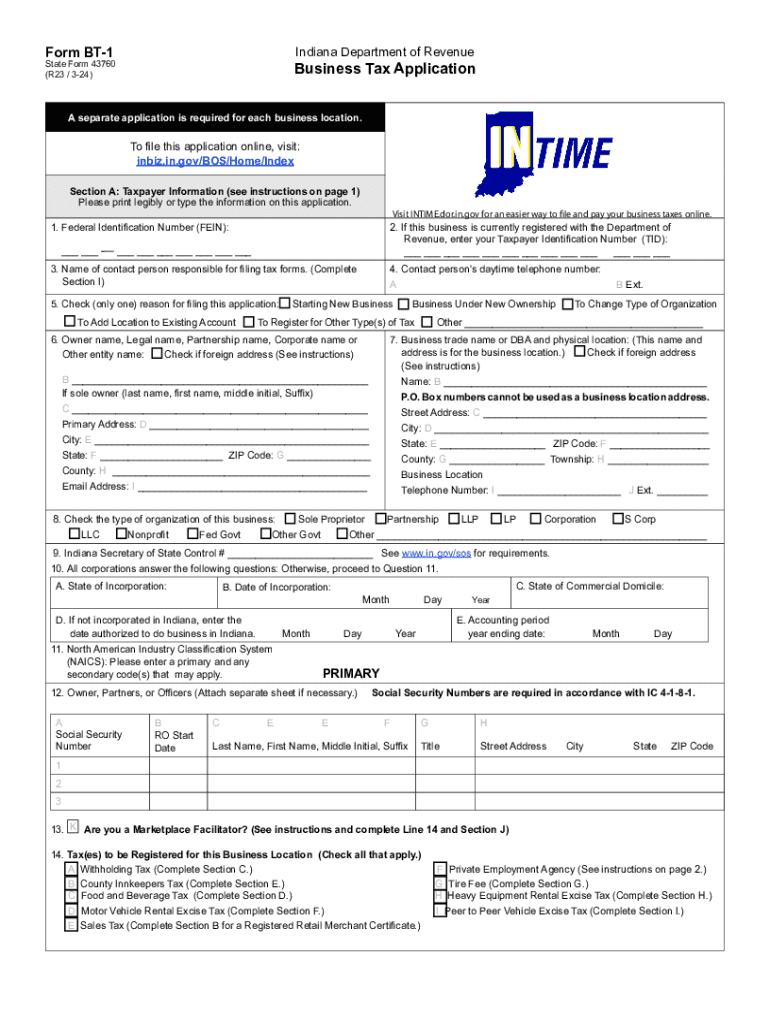







Definition & Meaning
The Indiana Department of Revenue - Business Tax Application, commonly referred to as Form BT-1, is a critical document used by businesses in Indiana to register for various state taxes. This form is essential for businesses seeking to comply with tax obligations such as sales tax, withholding tax, and food and beverage tax. By submitting this application, businesses formalize their intent to collect and remit taxes appropriately, establishing a legal foundation for their financial and tax-related activities within the state.
How to Obtain the Indiana Department of Revenue - Business Tax Application
Securing the Indiana Department of Revenue - Business Tax Application is straightforward. Businesses can access Form BT-1 through several channels to ensure convenience:
- Online Access: The form is available on the Indiana Department of Revenue's official website, providing a seamless digital download option.
- In-Person: Physical copies can be collected from local Indiana Department of Revenue offices for those who prefer traditional methods.
- Third-Party Platforms: Some tax software and business service providers offer access to the form as part of their comprehensive assistance packages.
Whether opting for a digital or paper copy, businesses should ensure they are obtaining the most current version of the application.
Steps to Complete the Indiana Department of Revenue - Business Tax Application
Filling out the Form BT-1 requires attention to detail to ensure accuracy and compliance with state requirements. Follow these steps for a thorough completion:
- Gather Essential Information: Collect all necessary business details, including the Federal Tax ID Number, Indiana Taxpayer Identification Number, and contact information.
- Select Applicable Taxes: Indicate which taxes your business is registering for, such as sales tax or withholding tax.
- Input Business Structure Details: Clearly specify your business entity type, whether LLC, corporation, or partnership.
- Submit Financial Data: Provide relevant financial information that supports your business's tax registration.
- Review and Verify: Double-check all entries for accuracy and completeness to avoid potential delays.
- Submit the Application: Proceed with submission either online for faster processing or via mail as per your chosen method.
By adhering to these steps, businesses can ensure that their application is both complete and compliant with Indiana regulations.
Key Elements of the Indiana Department of Revenue - Business Tax Application
Several core components underpin the structure of Form BT-1, each serving a distinct purpose:
- Business Identification Segment: Captures fundamental details like the business name and address.
- Tax Registration Section: Specifies the types of taxes applicable to your business operations.
- Financial and Ownership Information: Ensures alignment of fiscal responsibilities and legal ownership.
- Declaration of Responsibility: Signatures and declarations affirming the truthfulness and accuracy of the information provided.
Each section demands careful attention to ensure that your business meets the legal obligations required by the state of Indiana.
Required Documents
Completing the Business Tax Application mandates various supporting documents to authenticate the provided information. These documents include:
- Federal Tax ID Documentation: Evidence of your federal tax identification number.
- Business Ownership Proof: Documents verifying your business structure and ownership, such as articles of incorporation or partnership agreements.
- Prior Tax Filing Records: Past tax records may be needed for entities transitioning from other states or those engaging in multi-state operations.
Ensuring the availability and accuracy of these documents will smooth the application process and establish credibility with the tax authorities.
Business Entity Types
Understanding which business structures are relevant to Form BT-1 is important for proper application:
- Limited Liability Company (LLC): Commonly used for its flexibility and liability protection benefits.
- Corporation (C-Corp and S-Corp): Typically chosen for larger businesses with complex share structures.
- Partnerships (General and Limited): Useful for collaborative ventures that share profit and responsibility among partners.
Each type of entity has its own implications for tax registration, dictating specific requirements on the form.
Examples of Using the Indiana Department of Revenue - Business Tax Application
Consider several practical scenarios where Form BT-1 is pivotal:
- New Business Setup: Registering for sales tax collection as a newly incorporated retail store.
- Expanding Business Operations: A restaurant seeking to comply with additional food and beverage tax requirements upon opening a new location.
- Multi-State Operations: A business moving its headquarters to Indiana that needs to update its state tax registrations.
These examples highlight the form's practicality and its integral role in ensuring compliance across various business stages.
Penalties for Non-Compliance
Non-compliance with the tax registration requirements outlined in the Business Tax Application can lead to significant repercussions:
- Fines and Penalties: Financial penalties for failure to register appropriately or remit taxes on time.
- Legal Action: Potential for legal proceedings initiated by the state to enforce compliance.
- Damage to Business Reputation: Long-term credibility issues impacting interactions with customers and partners.
Understanding these consequences underscores the importance of timely and accurate submission of the Indiana Department of Revenue - Business Tax Application.