Type text, add images, blackout confidential details, add comments, highlights and more.
02. Sign it in a few clicks
Draw your signature, type it, upload its image, or use your mobile device as a signature pad.
03. Share your form with others
Send form link via email, link, or fax. You can also download it, export it or print it out.
How to use or fill out Law Enforcement Intake #2 with our platform
Ease of Setup
DocHub User Ratings on G2
Ease of Use
DocHub User Ratings on G2
Click ‘Get Form’ to open it in the editor.
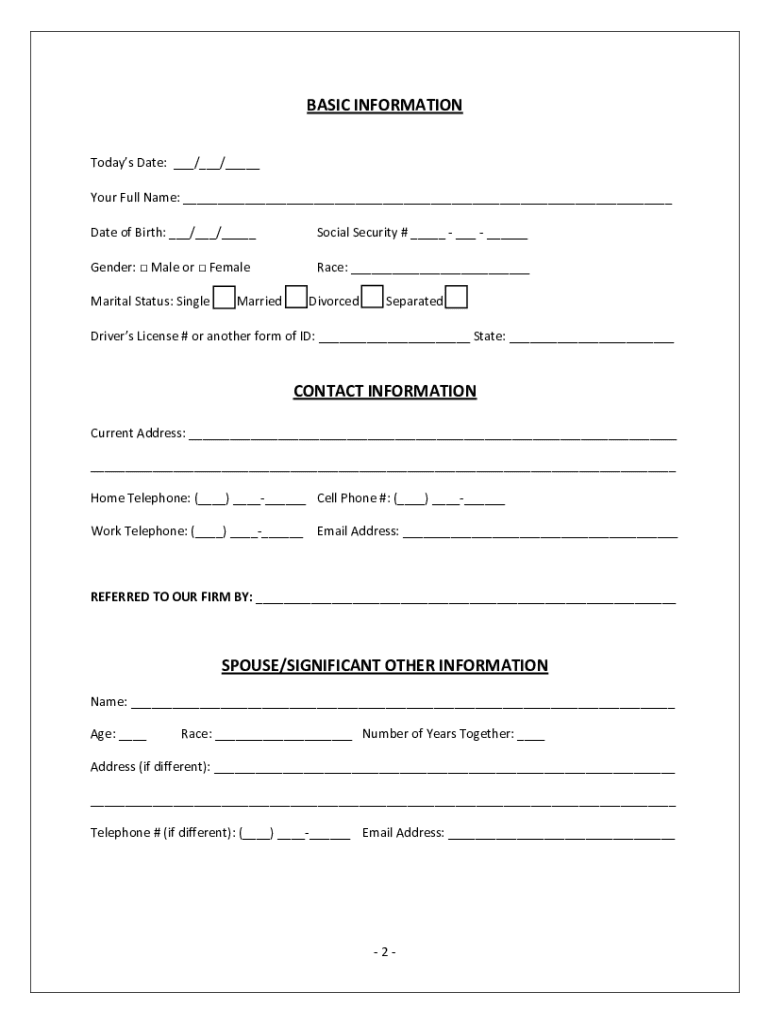
Begin by filling out the 'Basic Information' section. Enter today's date, your full name, date of birth, social security number, gender, race, marital status, and driver's license information.
Proceed to the 'Contact Information' section. Provide your current address, home and cell phone numbers, work telephone number, and email address.
In the 'Spouse/Significant Other Information' section, if applicable, include their name, age, race, years together, and contact details.
Fill out the 'Marriages / Divorces' and 'Children' sections with relevant details about your marital history and children.
Complete the 'Educational History' and 'Most Recent Employment History' sections with accurate information regarding your education and work experience.
In the 'Information Regarding Your Claim', detail the individual or agency involved in your claim along with its basis. Be thorough in describing any wrongful actions.
If currently incarcerated, complete that section with necessary details about your incarceration status.
Answer all questions in the 'Other General Information' section honestly. If any answers are yes, provide explanations on the following page.
Finally, review all entries for accuracy before saving and emailing the completed form to frontdesk@mattoxlaw.com.
Start using our platform today to easily fill out Law Enforcement Intake #2 for free!
Fill out Law Enforcement Intake #2 online It's free
Temple Police Academy physical requirementsTemple Police Academy requirementsAct 120 certificationMontco Police AcademyTemple College Police AcademyPhiladelphia Police Academy applicationWhat do you need to apply to the Police AcademyAct 120 requirements
Security and compliance
At DocHub, your data security is our priority. We follow HIPAA, SOC2, GDPR, and other standards, so you can work on your documents with confidence.
Three. (3) physical profiles tests are required for Law Enforcement cadets and two (2) physical profiles for. Corrections cadets. By their final profile, theRead more
Tecnical Protocol for Implementing Intrinsic Rediation with
Detailed slug testing procedures are presented in the Draft Technical Protocol for Implementing. Intrinsic Remediation with Long-Term Monitoring for NaturalRead more
Cookie consent notice
This site uses cookies to enhance site navigation and personalize your experience.
By using this site you agree to our use of cookies as described in our Privacy Notice.
You can modify your selections by visiting our Cookie and Advertising Notice.