







Definition & Meaning
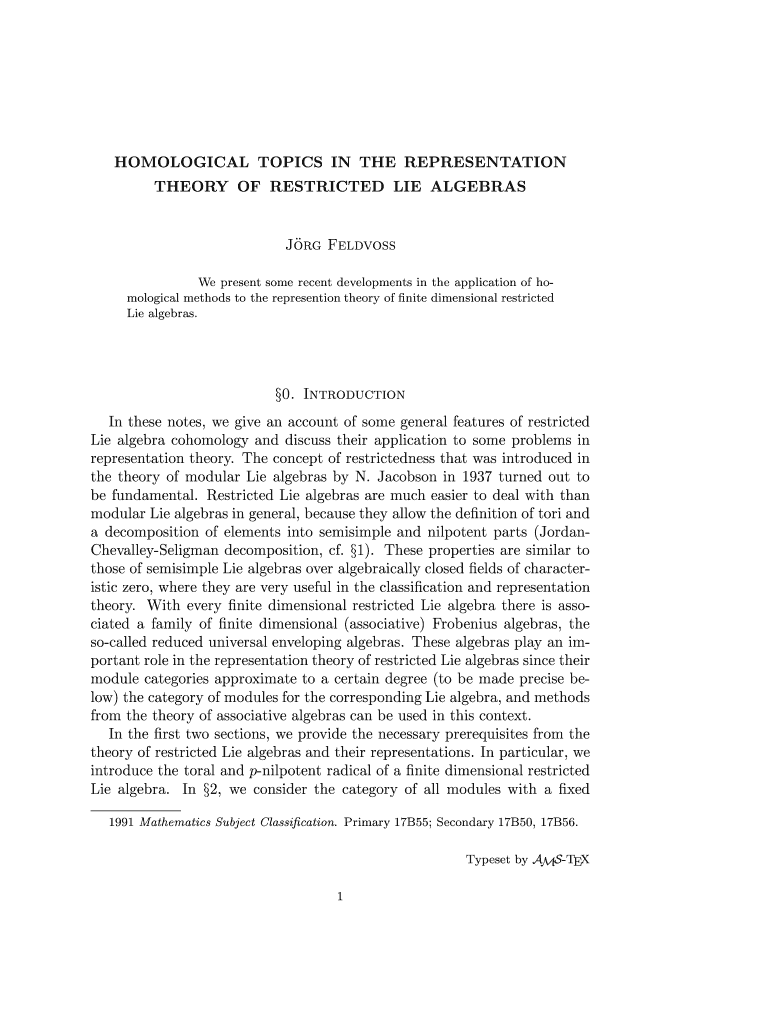
Homological Topics in Representation Theory refers to the study of algebraic structures using homological algebra techniques within the context of representation theory. This area encompasses the exploration of various algebraic objects such as modules, cohomology, and projective resolutions. It aims to understand how these objects can represent elements of different algebraic systems, often focusing on finite-dimensional algebras like Lie algebras. These topics help in discovering relationships between structure and representation, providing a framework for analyzing algebraic equations and transformations.
Key Elements of Homological Topics in Representation Theory
- Cohomology: An essential tool for understanding the extensions and deformations of algebraic structures.
- Module Categories: Representations of algebras as modules provide a means for studying their properties and morphisms.
- Projective Modules: Used for constructing resolutions that help in defining cohomological invariants.
- Support Varieties: Offer insights into the geometric aspects associated with representations and their complexity.
These elements are crucial in connecting high-level theoretical mathematics with practical algebraic computations, enabling deeper insights into algebraic representations.
Steps to Complete a Study in Homological Topics
- Familiarize With Basic Concepts: Start with an understanding of fundamental algebraic concepts such as groups, rings, and modules.
- Study Homological Algebra: Learn about chain complexes, exact sequences, and derived functors, which are vital for working within this field.
- Explore Representation Theory: Focus on understanding how algebraic structures, such as Lie algebras, can be represented by linear transformations.
- Apply Computational Techniques: Use computational tools to analyze cohomological properties and support varieties.
Following these steps can help mathematicians develop a comprehensive understanding and application of homological topics within representation theory.
Who Typically Uses Homological Topics in Representation Theory
These topics are primarily used by mathematicians and theoretical physicists. In mathematics, researchers focused on algebra, geometry, and topology incorporate these concepts into their studies. Theoretical physicists may apply these techniques to quantum mechanics and string theory, where algebraic structures are prevalent. Additionally, computer scientists interested in algebraic methods for solving computational problems might also engage with these topics.
Important Terms Related to Homological Topics
- Exact Sequence: A sequence of modules and morphisms where the image of one morphism equals the kernel of the next.
- Chain Complex: A sequence of abelian groups connected by homomorphisms, with the property that the composition of two consecutive homomorphisms is zero.
- Derived Functor: A construction used to extend the application of functors to derived categories.
- Restricted Lie Algebra: A type of Lie algebra with additional structure allowing a closer examination of representation theory.
Understanding these terms is essential for engaging deeply with homological studies in representation theory.
Examples of Using Homological Topics
Researchers might investigate how cohomology groups can classify extensions of algebraic structures or use projective resolutions to determine invariants of representations. For example, in Lie algebra representation theory, one could examine how the structure of a particular algebra affects its representation by exploring related cohomological dimensions and support varieties. These examples illustrate how homological techniques provide insights into both abstract theory and computational applications.
State-Specific Rules for Homological Topics in the Representation Theory
There aren't state-specific rules since homological topics in representation theory reside predominantly in the academic and theoretical realm. However, studies and implications may differ between institutions depending on academic focus. Nonetheless, approaches to the topic tend to remain uniform across different geographic and institutional settings worldwide.
Why Study Homological Topics in Representation Theory
Studying homological topics within representation theory can unveil a deeper understanding of algebraic structures and their interrelationships. It assists in solving complex problems related to algebraic equations, enhancing both theoretical and applied mathematical fields. Additionally, insights from these studies can lead to advancements in other scientific and engineering domains, especially those dealing with symmetrical structures, like physics.
Software Compatibility and Tools
For mathematicians working in this field, software tools such as SageMath, GAP, Magma, and Macaulay2 can be invaluable. These platforms offer capabilities to perform complex algebraic computations, construct modules, and explore homological properties effectively. Proficiency in using these tools allows researchers to validate theoretical insights with empirical data, facilitating further exploration of homological topics.
Business Entities Benefiting From Homological Studies
While direct business applications may not be evident, industries focusing on cryptography, data encryption, and coding theory can benefit from advancements in representation theory. Insights from homological studies can enhance algorithms and improve the security and efficiency of data encryption processes. These indirect applications highlight the broader economic significance of mathematical innovations in representation theory.
Versions or Alternatives to Homological Studies
In academic circles, variations in the approach to studying homological topics might include focusing on derived categories, triangulated categories, or exploring the intersection with other algebraic theories. These variations can provide alternative perspectives or more focused insights within specific problem domains, further enriching the field of representation theory.




