




01. Edit your form online
Type text, add images, blackout confidential details, add comments, highlights and more.

Type text, add images, blackout confidential details, add comments, highlights and more.

Draw your signature, type it, upload its image, or use your mobile device as a signature pad.

Send it via email, link, or fax. You can also download it, export it or print it out.
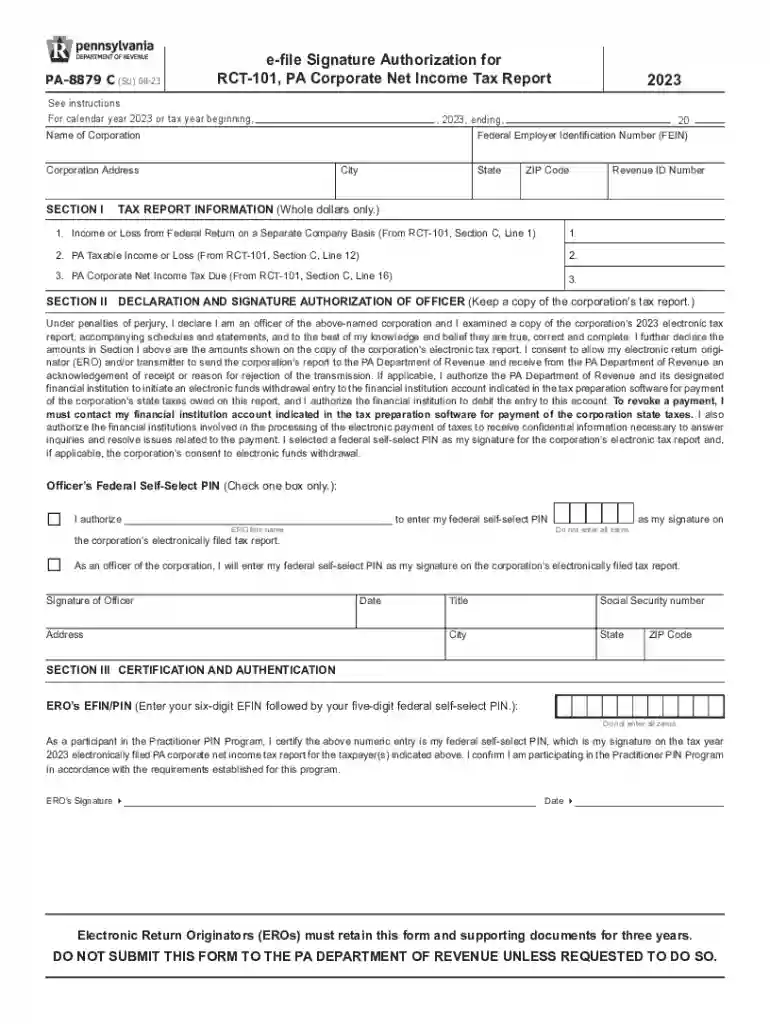
The "2023 e-file Signature Authorization for RCT-101, PA Corporate Net Income Tax Report (PA-8879 C) PA D" is a crucial document used by corporate officers to authorize the electronic submission of their Pennsylvania Corporate Net Income Tax Report, known as the RCT-101. This form serves as an electronic counterpart to the traditional paper signature process, allowing corporate officers to approve the submission through a federal self-select PIN. The primary objective is to streamline the e-filing process by reducing manual paperwork and ensuring compliance with Pennsylvania Department of Revenue guidelines.
To use the PA-8879 C effectively, corporate officers must first provide their consent by entering a self-selected PIN, which acts as a unique identifier for the electronic signature process. Once the PIN is validated, the electronic return originator (ERO) can proceed with the filing of the RCT-101. This form replaces the need for a physical signature, integrating seamlessly with electronic filing systems to improve efficiency and accuracy in corporate tax reporting.
Gather Required Information: Ensure you have all necessary details, including your corporate tax ID, federal self-select PIN, and the completed RCT-101.
Fill Out the Form: Carefully enter your corporate information, including the officer’s name, title, and contact details. Verify that all data is correct before proceeding.
Enter the Self-Select PIN: The corporate officer must provide a unique federal self-select PIN to authorize the form. Ensure this PIN is kept secure and known only to authorized personnel.
Verify and Sign: Double-check all entries for accuracy. Use the PIN to electronically sign the form, validating the officer’s consent for the submission.
Submission: The ERO submits the PA-8879 C along with the RCT-101, ensuring that all electronic filing protocols are followed correctly according to state regulations.
Primarily, the form is used by corporate tax officers and electronic return originators responsible for preparing and submitting the Pennsylvania Corporate Net Income Tax Report. These individuals are typically part of the finance or accounting departments within corporations operating in Pennsylvania, ensuring that all tax-related documents comply with state e-filing requirements.


The PA-8879 C is legally binding when completed correctly, serving as a digital signature equivalent for corporate tax filings. It complies with federal electronic document laws, ensuring that signatures are legally recognized in the state of Pennsylvania. Corporations must retain copies of the completed form for a minimum of three years for auditing and compliance purposes.
The PA-8879 C must be completed and filed in conjunction with the RCT-101 by the corporate tax return deadline set by the Pennsylvania Department of Revenue. This deadline often aligns with federal tax deadlines, typically around mid-to-late April for most corporations. Early preparation and adherence to these deadlines ensure timely and accurate submissions.
To complete the PA-8879 C, corporations need the RCT-101 form, federal self-select PINs, and any relevant corporate identification documents. Ensuring access to accurate financial records is essential for completing the RCT-101 accurately and supporting the data presented within the PA-8879 C.
Failure to submit the PA-8879 C alongside the RCT-101 can result in penalties imposed by the Pennsylvania Department of Revenue. These penalties may include late fees, interest on unpaid taxes, and potentially more severe legal consequences if the oversight results in misreported corporate income. Compliance is crucial to avoid these negative outcomes and ensure accurate corporate tax reporting.
We've got more versions of the 2023 e-file Signature Authorization for RCT-101, PA Corporate Net Income Tax Report (PA-8879 C) PA D form. Select the right 2023 e-file Signature Authorization for RCT-101, PA Corporate Net Income Tax Report (PA-8879 C) PA D version from the list and start editing it straight away!
At DocHub, your data security is our priority. We follow HIPAA, SOC2, GDPR, and other standards, so you can work on your documents with confidence.






Jun 30, 2017 The purpose of that report is to describe the scope of our testing of internal control over financial reporting and compliance and the resultsRead more
A corporate officer who does not use the. PA-8879 C must use the PA-8453 C, PA Corporate Net. Income Tax Declaration for a State e-file Report. You do not needRead more


