01. Edit your form online
Type text, add images, blackout confidential details, add comments, highlights and more.

Type text, add images, blackout confidential details, add comments, highlights and more.

Draw your signature, type it, upload its image, or use your mobile device as a signature pad.

Send it via email, link, or fax. You can also download it, export it or print it out.
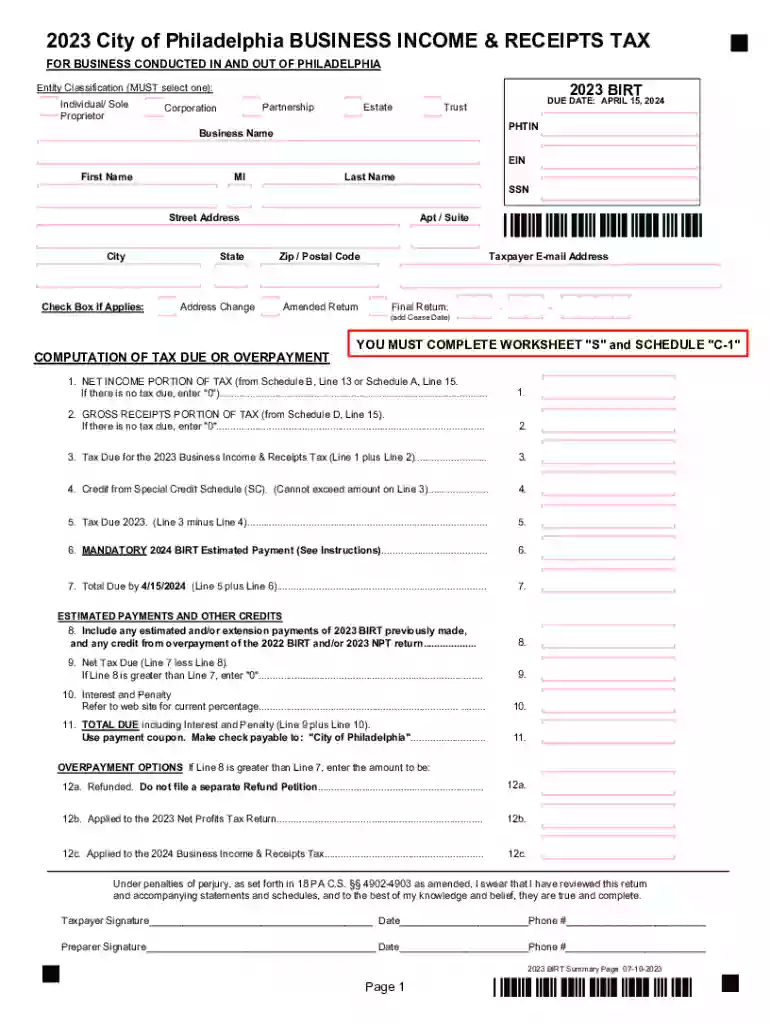
The 2023 City of Philadelphia Business Income and Receipts Tax (BIRT) is a local tax imposed on businesses operating in Philadelphia. It applies to both net income from operations conducted within the city and gross receipts derived from activities performed in Philadelphia. BIRT plays a crucial role in Philadelphia's fiscal structure, ensuring that businesses contribute to the city's economic development and public services.
Businesses need to accurately classify their entity type to comply with BIRT regulations. Common entity types include sole proprietorships, partnerships, and corporations.
Completing the BIRT form requires a systematic approach to gather and report financial data accurately.
Gather Financial Documents: Businesses must collect all pertinent financial records, including balance sheets, income statements, and gross receipts data.
Determine Entity Type: Identify whether the business is a sole proprietorship, partnership, or corporation. This determines the applicable tax schedules and calculations.
Calculate Net Income and Gross Receipts: Use the financial data to compute the net income and gross receipts specific to Philadelphia operations.
Fill Out Schedules: The form includes various schedules (A, B, C-1, D, E) to facilitate accurate reporting. Ensure all schedules are completed based on the business entity and income structure.
Review and File: Carefully review all entries for accuracy and consistency before submitting the form by the due date of April 15, 2024. Filing can be done online or through mail.
The primary users of the BIRT form are business operators within Philadelphia. This includes a diverse range of businesses such as:


Certain business sectors, such as nonprofits or educational institutions, may have special exemptions or considerations under the BIRT framework.
The BIRT filing deadline is April 15, 2024, coinciding with federal tax deadlines. Timely filing is essential to avoid penalties and ensure compliance with local tax regulations.
Understanding key terminology is essential for navigating the BIRT process:
Businesses can choose from multiple submission methods for the BIRT form:
Failing to file the BIRT form accurately or on time can result in significant penalties and interest.
Different business entities have specific reporting requirements under BIRT:
Understanding the implications of business structure on tax obligations is crucial for accurate and compliant filing.
We've got more versions of the 2023 City of Philadelphia BUSINESS INCOME and RECEIPTS TAX form. Select the right 2023 City of Philadelphia BUSINESS INCOME and RECEIPTS TAX version from the list and start editing it straight away!
At DocHub, your data security is our priority. We follow HIPAA, SOC2, GDPR, and other standards, so you can work on your documents with confidence.