Publication 115, County Motor Fuel Tax Publication 115, County Motor Fuel Tax 2026

Get Form
Publication 115, County Motor Fuel Tax Publication 115, County Motor Fuel Tax Preview on Page 1

Here's how it works

01. Edit your form online
Type text, add images, blackout confidential details, add comments, highlights and more.

02. Sign it in a few clicks
Draw your signature, type it, upload its image, or use your mobile device as a signature pad.

03. Share your form with others
Send it via email, link, or fax. You can also download it, export it or print it out.

Definition & Meaning

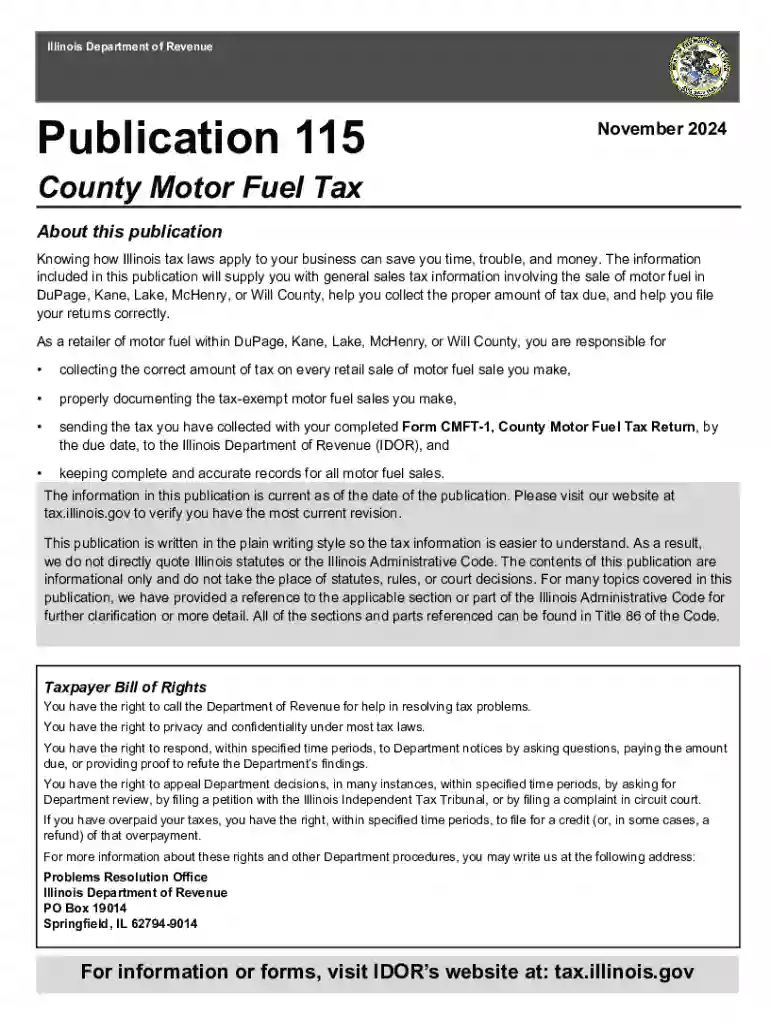
Publication 115, issued by the Illinois Department of Revenue, is an essential document for retailers dealing with motor fuel in specific Illinois counties, namely DuPage, Kane, Lake, McHenry, and Will. This publication outlines the necessary guidelines and requirements for the collection and reporting of the County Motor Fuel Tax. It serves as a comprehensive resource aimed at ensuring compliance with local tax regulations, detailing every aspect of tax operations related to motor fuel sales.

Purpose and Scope

  • Collection and Reporting: Provides instructions on collecting the County Motor Fuel Tax and accurately reporting these collections to the relevant authorities.
  • Target Counties: Specifically applicable to DuPage, Kane, Lake, McHenry, and Will Counties in Illinois.
  • Compliance Resource: Acts as a guide to ensure that retailers follow the correct protocols and avoid penalties.

How to Use the Publication 115

Retailers need to familiarize themselves with Publication 115 to ensure full compliance with Illinois County Motor Fuel Tax requirements.

Steps for Use

  1. Understand Tax Responsibilities: Read the sections detailing retailer responsibilities for tax collection and reporting.
  2. Ensure Proper Registration: Verify that your business is registered appropriately according to the guidance in the publication.
  3. Accurate Record-Keeping: Follow the publication's guidelines on maintaining transparent and correct records for tax purposes.
  4. Meet Filing Deadlines: Be aware of all filing deadlines as outlined in the publication to avoid late fees.

Steps to Complete the Form

Completing the Publication 115 form accurately is crucial to complying with local tax regulations.

Procedure

  1. Review Instructions: Thoroughly read through all sections of the publication to gain a full understanding of what is required.
  2. Compile Necessary Information: Gather all relevant documents and information needed for filling out the form.
  3. Fill Out Required Fields: Complete each section of the document carefully, ensuring all mandatory fields are filled.
  4. Check for Errors: Double-check entries for accuracy to prevent any compliance issues.
  5. Submit Form: Follow the specified submission methods, whether online, via mail, or in person, as indicated in the publication.

Key Elements of the Publication 115

The document provides detailed elements to aid retailers in comprehending and executing their tax responsibilities.

Essential Sections

  • Registration: Details the process for retailer registration.
  • Tax Rates: Specifies current tax rates applicable to motor fuel.
  • Filing Requirements: Outlines the necessary steps for submitting tax returns.
  • Record-Keeping: Emphasizes the importance of thorough record maintenance.
  • Taxpayer Rights: Educates retailers on their rights regarding tax proceedings.

Who Typically Uses the Publication 115

This document is primarily used by various entities involved in selling motor fuel in the specified counties.


decoration image ratings of Dochub

Typical Users

  • Retailers: Businesses that sell motor fuel directly to consumers.
  • Fuel Suppliers: Companies that provide motor fuel to retailers and need to comply with local tax regulations.
  • Accountants and Tax Professionals: Individuals who manage tax compliance for businesses.
  • Legal Advisors: Professionals offering guidance on tax obligations and compliance.

Penalties for Non-Compliance

Failure to adhere to the guidelines in Publication 115 can result in significant consequences.

Consequences

  • Financial Penalties: Fines imposed for late or inaccurate tax reporting.
  • Legal Repercussions: Possible legal action if compliance is not maintained.
  • Business Disruption: Non-compliance could lead to operational interruptions due to regulatory scrutiny.

State-Specific Rules for the Publication 115

Recognizing that tax obligations may vary based on state regulations is crucial for accurate compliance.

Illinois-Specific Details

  • County-Specific Policies: Each of the involved counties may have additional nuances in the application of the tax.
  • State Regulations: Follow the specific state mandates that oversee motor fuel taxation.

Examples of Using the Publication 115

Practical application of Publication 115 can help illustrate its utility across various scenarios.

Use Cases

  • New Retailers: A new business in DuPage County using the publication to understand how to register and report taxes efficiently.
  • Fuel Suppliers: A company that supplies motor fuel across multiple counties referring to the publication to ensure consistent compliance with differing rates and rules.
  • Compliance Check: Routine internal audits conducted by a fuel retailer to ensure ongoing adherence to tax collection and reporting requirements.
be ready to get more

Complete this form in 5 minutes or less

Get form

Got questions?

We have answers to the most popular questions from our customers. If you can't find an answer to your question, please contact us.
Contact us
From July 1, 2021, through June 30, 2022, the rates are as follows: gasoline/gasohol $0.392 per gallon. diesel fuel $0.467 per gallon. liquefied petroleum gas (LPG) $0.467 per gallon.
Exempt are fuels or fuel additives marketed solely for use off-road, such as non-road diesel or fuel additives solely for use in marine engines, and on-road fuels that are not gasoline or diesel, such as E85 or compressed natural gas.
If your business receives fuel tax credits, you can record the amount using a journal entry. The journal entry would involve two categories: A 4-X or 8-X Income category which would be credited. This increases income which amounts to decreasing expense.
You may file a claim for refund by completing and submitting Form RMFT-11-A. If you already have a Motor Fuel Refund account with the Illinois Department of Revenue, you may also submit your claim electronically using MyTax Illinois.
Who Does Not Have to Pay Taxes? You generally dont have to pay taxes if your income is less than the standard deduction or the total of your itemized deductions, if you have a certain number of dependents, if you work abroad and are below the required thresholds, or if youre a qualifying non-profit organization.

Security and compliance

At DocHub, your data security is our priority. We follow HIPAA, SOC2, GDPR, and other standards, so you can work on your documents with confidence.

Learn more
ccpa2
pci-dss
gdpr-compliance
hipaa
soc-compliance

People also ask

Businesses get a refundable credit for fuel used in a specific work-related activity with the Fuel Tax Credit. To qualify, you must: Own or operate a business. Meet certain requirements, such as running a farm or purchasing aviation gasoline.
Off-Road Use: Fuel used solely for off-road purposes, like powering construction equipment, generators, and landscaping machinery, is exempt from the fuel excise tax, which helps reduce operating costs for businesses that use heavy equipment.
In order to qualify for tax-free treatment, the state or local government must purchase the fuel for its own exclusive use. State and local government entities may benefit from Internal Revenue Code Section 4221(a)(4). This section exempts these entities from the Federal motor fuel excise taxes.

Related links