01. Edit your form 100 100s 100w or 100x online
Type text, add images, blackout confidential details, add comments, highlights and more.

Type text, add images, blackout confidential details, add comments, highlights and more.

Draw your signature, type it, upload its image, or use your mobile device as a signature pad.

Send california 100x via email, link, or fax. You can also download it, export it or print it out.
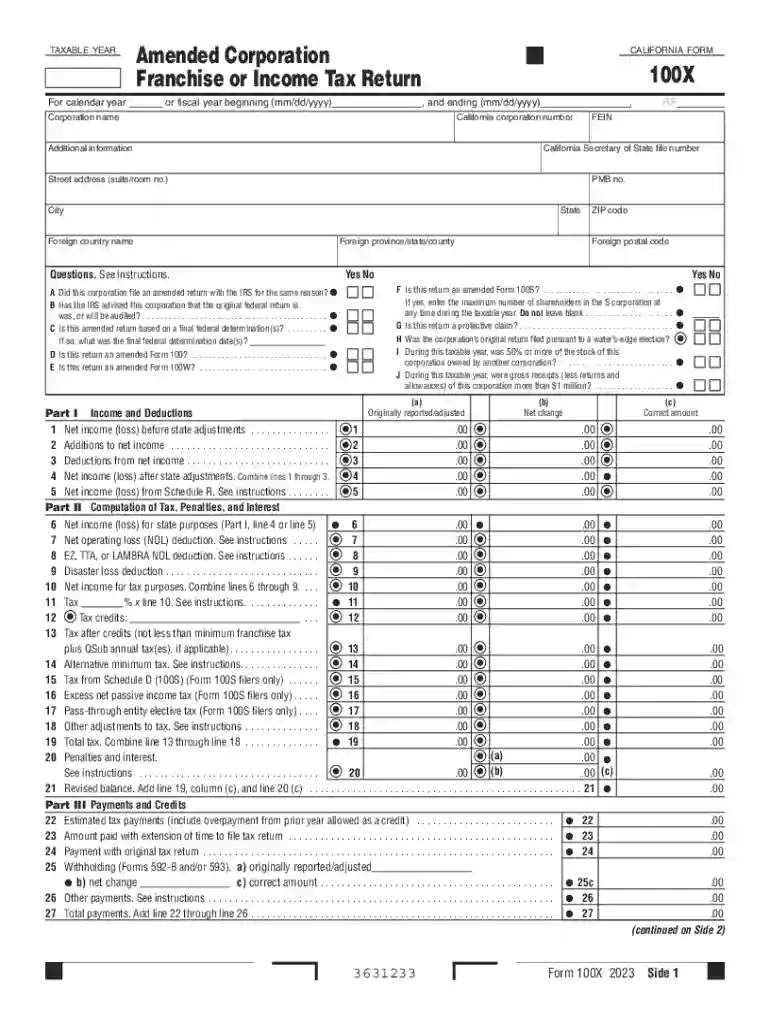
Form 100, 100S, 100W, and 100X are essential documents used for corporate taxation by the California Franchise Tax Board. These forms are utilized based on the corporation type and specific tax circumstances:
These forms are critical for businesses to report income, deductions, tax calculations, and payments due to the state of California. Accurate completion helps ensure compliance with state tax laws and avoids potential penalties.
Before beginning the completion process, gather all necessary documents including:
Include the corporation’s legal name, address, federal employer identification number (FEIN), and California corporation number.
Accurately report the corporation's income, including any specific deductions applicable to your entity.
Utilize the instructions for the specific form to calculate the tax due. Consider tax credits and prepayments in these calculations as applicable.
The return should be signed by corporate officers and tax preparers, confirming the accuracy and completeness of the information provided.
Businesses must ensure that the following documents are ready for submission:
Having all documents orderly and accessible can streamline the filing process and reduce potential errors.
Different business entities in California use these forms based on their corporate structure:
Each form serves a specific purpose, catering to the distinct tax obligations of different business entities.


Essential for associating the return with the correct business entity.
Key sections that document revenue streams and deductions to ascertain taxable income.
Explains how to compute the franchise or income tax owed to California, incorporating any applicable credits or payments already made.
Verifies that return information is accurate under penalty of perjury and prepared by authorized individuals.
Failure to accurately complete and timely file these forms can result in significant penalties, including:
Businesses should prioritize accurate and punctual completion to avoid these consequences.
Corporations must adhere to specific deadlines based on their fiscal year:
Proper planning ensures that these deadlines are met, allowing corporations to prevent unnecessary penalties.
Most convenient method, offering quick processing and confirmation receipt.
Allows for filing with physical copies but requires extra time for delivery and processing by the Franchise Tax Board.
Less common, but possible through specific California Franchise Tax Board locations, should only be used if necessary due to unique circumstances.
Decide on a submission method that best suits your timing, resources, and convenience needs.
Certain entities derive more advantage from specific forms:
Selecting the correct form ensures compliance and maximizes efficiency in tax reporting.
We've got more versions of the form 100 100s 100w or 100x form. Select the right form 100 100s 100w or 100x version from the list and start editing it straight away!
At DocHub, your data security is our priority. We follow HIPAA, SOC2, GDPR, and other standards, so you can work on your documents with confidence.