






Definition & Meaning
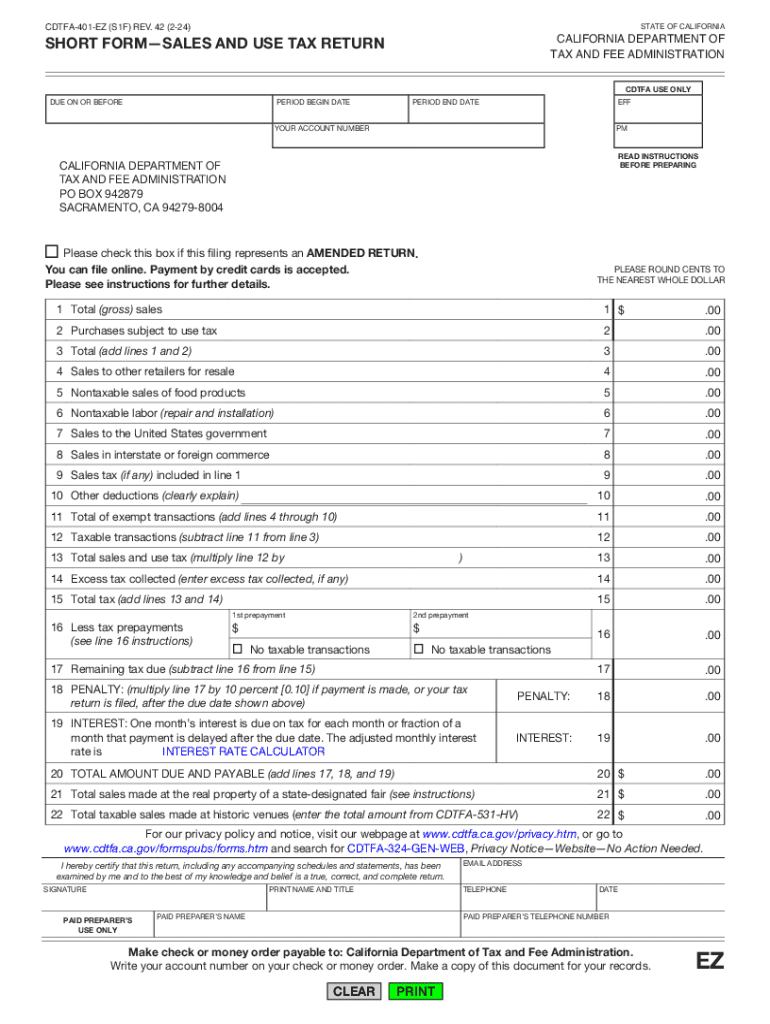
The CDTFA-401-EZ, or Short Form-Sales and Use Tax Return, is a California-based tax document designed for businesses to report sales transactions. This form simplifies the process of declaring total sales, taxable amounts, and applicable exemptions, ultimately determining the tax due. Its primary purpose is to offer a streamlined approach for businesses with straightforward tax requirements, eliminating complex calculations typically needed in more detailed tax forms. Businesses that have comparatively simple operations find the CDTFA-401-EZ useful for maintaining compliance with state tax regulations.
How to Use the CDTFA-401-EZ
Using the CDTFA-401-EZ requires a thorough understanding of your business’s sales activities within California. Begin by gathering information on your total and taxable sales for the period. Ensure you categorize transactions accurately, accounting for any allowable exemptions. The form is then used to detail these amounts, resulting in a calculation of due taxes. Following these steps helps ensure that the CDTFA receives precise accounting, reducing the likelihood of errors and potential penalties.
Steps for Correct Usage
- Compile Sales Data: Gather total gross sales, including all taxable and exempt sales.
- Determine Exemptions: Identify transactions that qualify for tax exemptions, such as sales to resale certificate holders.
- Calculate Taxable Sales: Subtract exempt sales from total sales to determine taxable sales.
- Complete the Form: Enter calculated values accurately in designated sections of the CDTFA-401-EZ.
- Recalculate and Review: Double-check your calculations to ensure accuracy before submission.
Steps to Complete the CDTFA-401-EZ
Completing the CDTFA-401-EZ necessitates precision and a step-by-step approach. Each segment of the form must be filled out accurately to prevent errors:
Detailed Process
- Gather Information: Collect detailed records of your sales activity during the tax period.
- Fill in Total Sales: Input the total sales amount in the appropriate box.
- Document Exempt Sales: Clearly mark exempt sales, citing applicable reasons.
- Calculate and Report Taxable Sales: Deduct exempt sales from total sales to derive taxable sales.
- Estimate Tax Due: Calculate the amount of tax due based on the taxable sales.
- Review and Sign: Go over the completed form to confirm the accuracy of all entries. Sign the form to validate the information provided.
- Submission: Choose your method of submission, whether online or through physical mail, ensuring timely delivery.
Key Elements of the CDTFA-401-EZ
Several critical components form the basis of the CDTFA-401-EZ:
- Total Sales: This section requires the gross amount of all sales made during the reporting period.
- Exemptions: It's crucial to accurately document any exemptions such as resale or non-taxable services.
- Taxable Sales: This value is crucial as it directly impacts the total tax calculated.
- Tax Due: The calculated tax amount derived from taxable sales.
Understanding these sections helps in filling out the form correctly, aligning with tax mandates of the CDTFA.
Who Typically Uses the CDTFA-401-EZ
The CDTFA-401-EZ is particularly designed for small businesses operating within California that engage in straightforward transaction processes. These may include:
- Retailers with minimal inventory varieties: These entities typically experience less complex transactions, making the short form suitable.
- Service-oriented businesses: Those offering non-tangible services that occasionally involve taxable sales.
Such businesses benefit from the simplified nature of the CDTFA-401-EZ, facilitating an easier filing process compared to more extensive tax forms.


Important Terms Related to CDTFA-401-EZ
Understanding key terms related to the CDTFA-401-EZ ensures its correct completion. These include:
- Gross Sales: The aggregate amount from all sales made before deductions.
- Exemptions: Transactions not subjected to tax under specific circumstances.
- Taxable Sales: The portion of gross sales remaining after exemptions, liable for tax.
Being well-versed with these terms supports a smoother tax filing process by clarifying requirements.
Legal Use of the CDTFA-401-EZ
The CDTFA-401-EZ serves as a legal tool for declaring sales and use tax elements in compliance with California state laws. Businesses use it to identify tax liabilities based on specific exemptions and deductions permitted by the state. Adhering to legal requirements ensures businesses maintain compliance with enforced tax regulations, minimizing risks associated with non-compliance such as penalties and interest from delayed or inaccurate submissions.
Penalties for Non-Compliance
Failure to accurately complete or submit the CDTFA-401-EZ within its deadlines may result in penalties. California law stipulates fines for late filings or underpayment of taxes due as follows:
- Penalty for Late Submission: A percentage of the unpaid taxes will be assessed as a penalty for late filing.
- Interest on Unpaid Taxes: An accrued interest on overdue amounts increases the longer they remain unpaid.
Understanding these repercussions emphasizes the importance of timely and precise submissions, encouraging businesses to prioritize their tax obligations effectively.
Filing Deadlines and Important Dates
To comply fully with the CDTFA-401-EZ, businesses must observe official deadlines set by the CDTFA. Generally, the tax period for most businesses ends quarterly, with filing due by the last day of the month following each quarter:
- First Quarter: Due by April 30
- Second Quarter: Due by July 31
- Third Quarter: Due by October 31
- Fourth Quarter: Due by January 31
Keeping track of these deadlines is crucial for avoiding late penalties and interest fees while ensuring adherence to tax compliance requirements.