01. Edit your rpie filing online
Type text, add images, blackout confidential details, add comments, highlights and more.

Type text, add images, blackout confidential details, add comments, highlights and more.

Draw your signature, type it, upload its image, or use your mobile device as a signature pad.

Send it via email, link, or fax. You can also download it, export it or print it out.
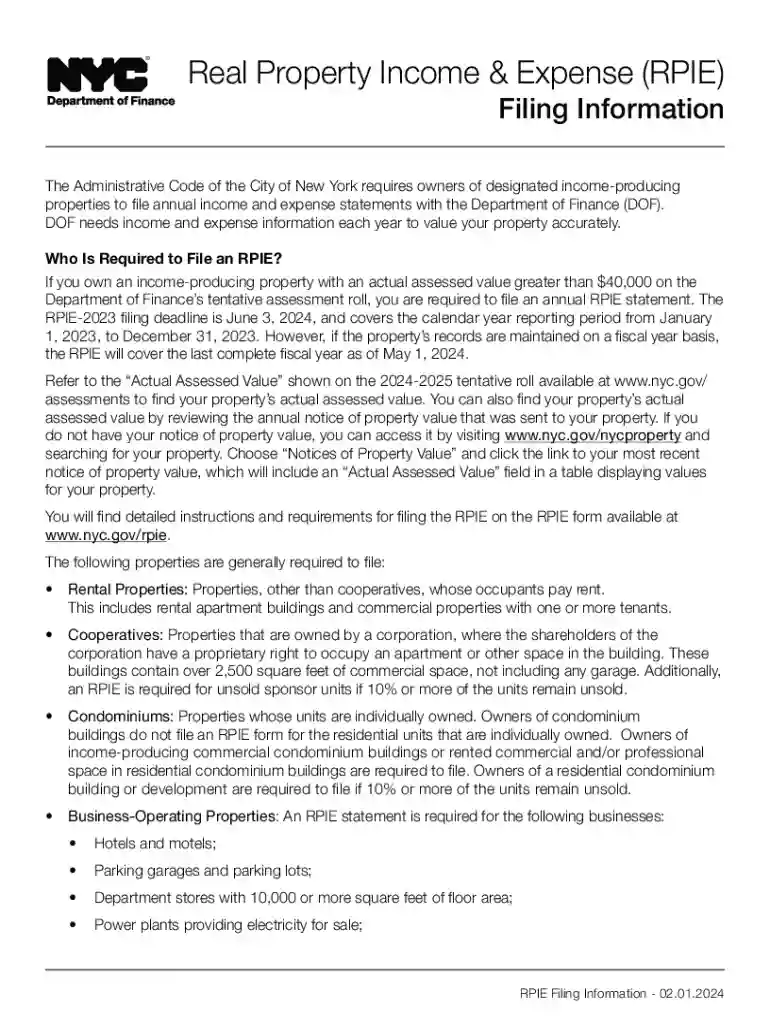
The 2023 Form NYC Real Property Income & Expense (RPIE) is instrumental for property owners in New York City, primarily those with income-generating properties. The form captures and reports income and expenses, aiding the city in accurately assessing property values. This annual filing obligation applies to owners whose properties boast an assessed value exceeding $40,000. The precise nature and categories of income and expenses reported are crucial for proper property valuation.
Acquiring the 2023 Form NYC RPIE for online usage is straightforward through resources like DocHub. The digital accessibility of this form allows property owners to download, fill, and submit it without physical paperwork. Known for its user-friendly approach, DocHub supports PDF formats, ensuring compatibility with the RPIE form. Following a download, users have the option to fill the form directly within platforms like DocHub, benefiting from editing and collaborative features.
Gather Required Information: Begin by collating all necessary financial documents related to property income and expenses from the past calendar year.
Filling Income Details: Provide detailed accounts of all rental and non-rental income derived from the property.
Expense Documentation: Enumerate and categorize all operating expenses, including utilities, maintenance, and taxes.
Review and Verify Entries: Cross-check all entries to ensure accuracy and compliance with NYC filing requirements.
Submit the Form Online: Utilize a platform like DocHub to securely submit the completed form by the June 3, 2024 deadline.
Timely filing of the RPIE form is essential to avoid penalties and ensure accurate property assessments. Delayed or inaccurate filings could lead to financial penalties and may also skew property tax assessments, potentially increasing the tax burden. By submitting this form on time, property owners contribute to the accuracy of NYC's tax assessment process, benefiting both the city infrastructure and community services.
Property owners who fail to file the RPIE form may be subjected to financial penalties by the city. These penalties not only carry a monetary cost but could also result in audits or reassessments of property taxes. Consistent non-compliance could result in further legal actions by the city's taxation authorities.
Filing the RPIE is mandated by New York City law for owners of qualifying properties. This mandate ensures that property assessments are based on current and accurate financial conditions. Non-filing or false reporting can lead to legal consequences, underlining the importance of adherence to this requirement.
The guidelines for filing the RPIE form are specific to New York City. Property owners must adhere to NYC-specific deadlines, documentation, and reporting standards. While these requirements might vary from other jurisdictions, they are specifically designed to cater to the city's unique economic landscape, focusing on transparency and accuracy in property assessments.
Maintaining compliance with these guidelines ensures that property owners are contributing towards a fair and efficient property tax system in New York City.
We've got more versions of the rpie filing form. Select the right rpie filing version from the list and start editing it straight away!
| Versions | Form popularity | Fillable & printable |
|---|---|---|
| 2025 | 4.8 Satisfied (43 Votes) | |
| 2024 | 4.5 Satisfied (36 Votes) | |
| 2023 | 4.5 Satisfied (43 Votes) | |
| 2022 | 4.8 Satisfied (32 Votes) | |
| 2021 | 4.8 Satisfied (151 Votes) | |
| 2020 | 4.4 Satisfied (255 Votes) | |
| 2019 | 4.3 Satisfied (104 Votes) | |
| 2017 | 4.4 Satisfied (58 Votes) | |
| 2012 | 4.3 Satisfied (129 Votes) | |
| 2011 | 4.3 Satisfied (329 Votes) |
At DocHub, your data security is our priority. We follow HIPAA, SOC2, GDPR, and other standards, so you can work on your documents with confidence.