




01. Edit your form 100 2023 online
Type text, add images, blackout confidential details, add comments, highlights and more.

Type text, add images, blackout confidential details, add comments, highlights and more.

Draw your signature, type it, upload its image, or use your mobile device as a signature pad.

Send form 100 california instructions 2023 via email, link, or fax. You can also download it, export it or print it out.
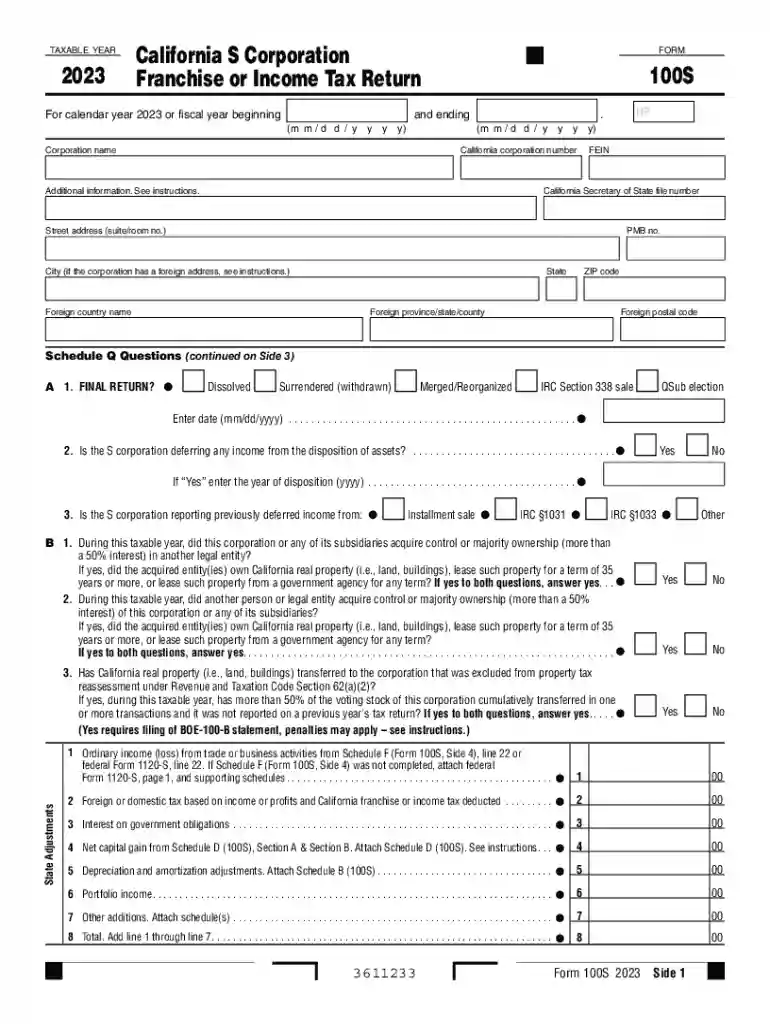
The 2023 Form 100S, titled "California S Corporation Franchise or Income Tax Return," is a critical document used by S corporations operating within California to report their annual income, tax credits, and deductions. This form is tailored to accommodate California-specific tax adjustments and requirements for S corporations, which allows these entities to pass income, losses, deductions, and credits through to their shareholders to be reported on individual tax returns.
Corporations can easily access the 2023 Form 100S through several channels:
Filing the 2023 Form 100S requires careful attention to detail. Here is a step-by-step guide:
Gather Financial Records
Complete Corporate Information Section
Calculate Income and Deductions
Apply Tax Credits
Review and Submit
The 2023 Form 100S is primarily utilized by:


The form consists of several important sections:
Unique rules apply to S corporations operating in California:
Understanding critical terminology enhances form accuracy:
Ensure timely filing with awareness of critical dates:
Several key documents are necessary for accuracy:
The form can be submitted through various means:
Failing to file or wrongly filing the 2023 Form 100S can result in:
Practical scenarios highlight the form's application:
This detailed approach provides comprehensive guidance for navigating the 2023 Form 100S requirements effectively.
We've got more versions of the form 100 2023 form. Select the right form 100 2023 version from the list and start editing it straight away!
| Versions | Form popularity | Fillable & printable |
|---|---|---|
| 2023 | 4.5 Satisfied (35 Votes) | |
| 2022 | 4.2 Satisfied (50 Votes) | |
| 2021 | 4.8 Satisfied (200 Votes) | |
| 2020 | 4.4 Satisfied (97 Votes) | |
| 2019 | 4.1 Satisfied (43 Votes) | |
| 2018 | 4.1 Satisfied (63 Votes) | |
| 2017 | 4.2 Satisfied (42 Votes) | |
| 2016 | 4.3 Satisfied (168 Votes) | |
| 2015 | 4.4 Satisfied (1516 Votes) | |
| 2014 | 4 Satisfied (59 Votes) | |
| 2013 | 4 Satisfied (58 Votes) | |
| 2012 | 4 Satisfied (34 Votes) | |
| 2011 | 4 Satisfied (33 Votes) | |
| 2009 | 4.2 Satisfied (42 Votes) | |
| 2004 | 4 Satisfied (52 Votes) |
At DocHub, your data security is our priority. We follow HIPAA, SOC2, GDPR, and other standards, so you can work on your documents with confidence.




Jul 1, 2005 The Franchise Tax Board administers two of Californias major tax programs: Personal Income Tax and the Corporation Tax.
May 28, 2026 You must file California S Corporation Franchise or Income Tax Return (Form 100S) if the corporation is: Incorporated in California; DoingRead more


