






Definition & Meaning
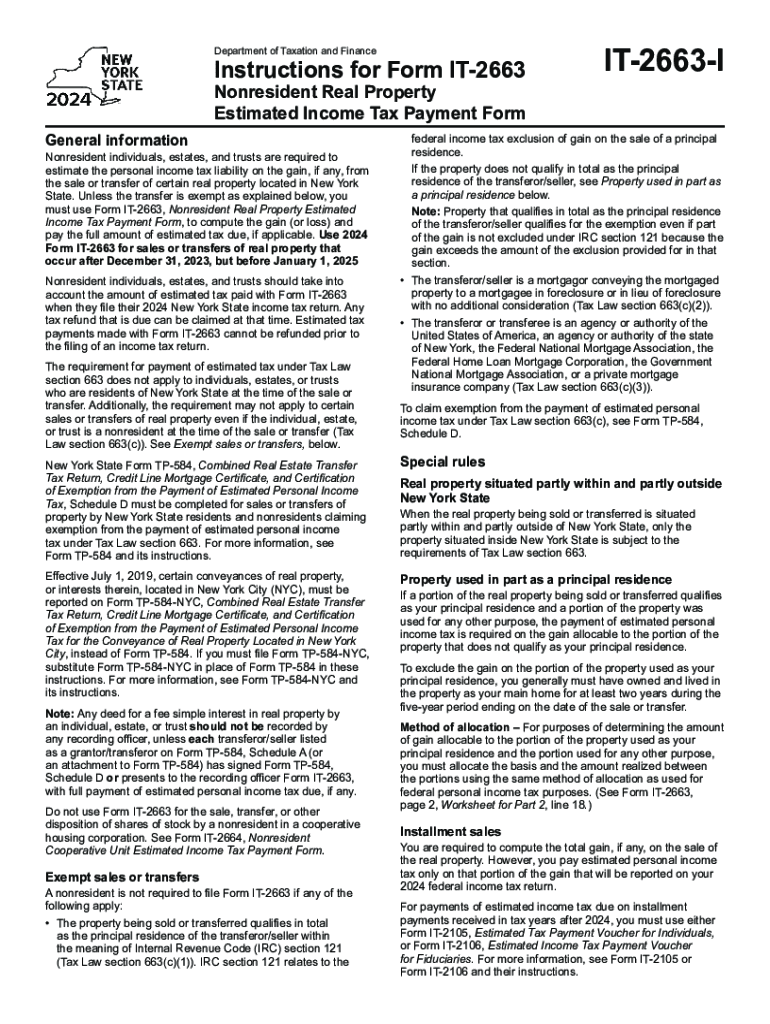
Form IT-2663 is a tax document required by nonresident individuals, estates, and trusts to estimate their personal income tax liability from gains related to real estate sales in New York State. It ensures the correct estimation and payment of taxes on real property transactions by individuals who do not reside in New York but hold property interests in the state. By filing this form, taxpayers disclose the calculated gain or loss from property sales and ensure compliance with New York tax laws.
Steps to Complete Form IT-2663
-
Begin with Personal Information: Enter the taxpayer's full name, address, and Social Security number.
-
Description of Property: Provide a detailed description of the property sold, including the full address and any pertinent details that support valuation.
-
Calculation Sections: Calculate the estimated tax due by determining the gain or loss. This involves subtracting the purchase price from the sale price, adjusting for any improvements or depreciation.
-
Exemptions and Deductions: Review any applicable exemptions, such as those related to principal residences or qualifying transfers between family members.
-
Finalizing and Reviewing: Confirm all calculations for accuracy. Consider legal and tax advice if necessary to ensure compliance.
-
Signature and Date: Sign and date the form to certify the truthfulness and accuracy of the provided information.
Who Typically Uses Form IT-2663?
The form is primarily used by nonresidents of New York State, including individuals, estates, and trusts. These taxpayers generally have sold or transferred real property within the state, prompting the need to estimate and fulfill their tax obligations on the realized gains. Nonresidents selling homes, vacation properties, or investment real estate commonly utilize this form.
Legal Use of Form IT-2663
Form IT-2663 is mandated under New York tax law and is legally required to be submitted when a property within New York State is sold or transferred by nonresidents. Its completion ensures proper estimation of tax liabilities and prevents later penalties or interest due to underpayment. The form acts as a legal declaration of income accrued from property transactions within the state.
State-Specific Rules for Form IT-2663
New York State imposes detailed rules regarding the use of Form IT-2663, such as:
- Mandatory Submission: Submit the form at the time of the property transfer.
- Payment: The required estimated tax payment must accompany the form.
- Exemptions: Conditions under which properties may be exempt from filing or reduced tax rates.
Noncompliance with these rules can result in the imposition of fines and penalties.
Important Terms Related to Form IT-2663
- Gain: The financial profit realized from selling the property.
- Transfer: The act of changing ownership of the property from one party to another.
- Exemption: Legal provisions allowing reduced tax liability under specific conditions.
- Nonresident: An individual or entity that does not reside in the state but holds property within it.
Examples of Using Form IT-2663
- Scenario One: A California resident sells a vacation home in the Hamptons, necessitating the use of Form IT-2663 to report gains.
- Scenario Two: An estate holding rental properties in Manhattan completes the form following the sale of one such property.
Penalties for Non-Compliance
Failing to file Form IT-2663 or underreporting the tax due can result in significant penalties. New York State can impose fines, interest, and even legal actions to recover the owed taxes. Taxpayers must ensure the accurate and timely filing of this form to avoid such penalties.
Required Documents
When completing Form IT-2663, ensure you have the following documents prepared:
- Purchase Agreement: Details on the initial purchase price.
- Sale Contract: Information on the selling price and transaction terms.
- Improvement Receipts: Records of renovations or improvements that affect property value.
Collecting these documents aids in ensuring the accuracy of calculations on the form.