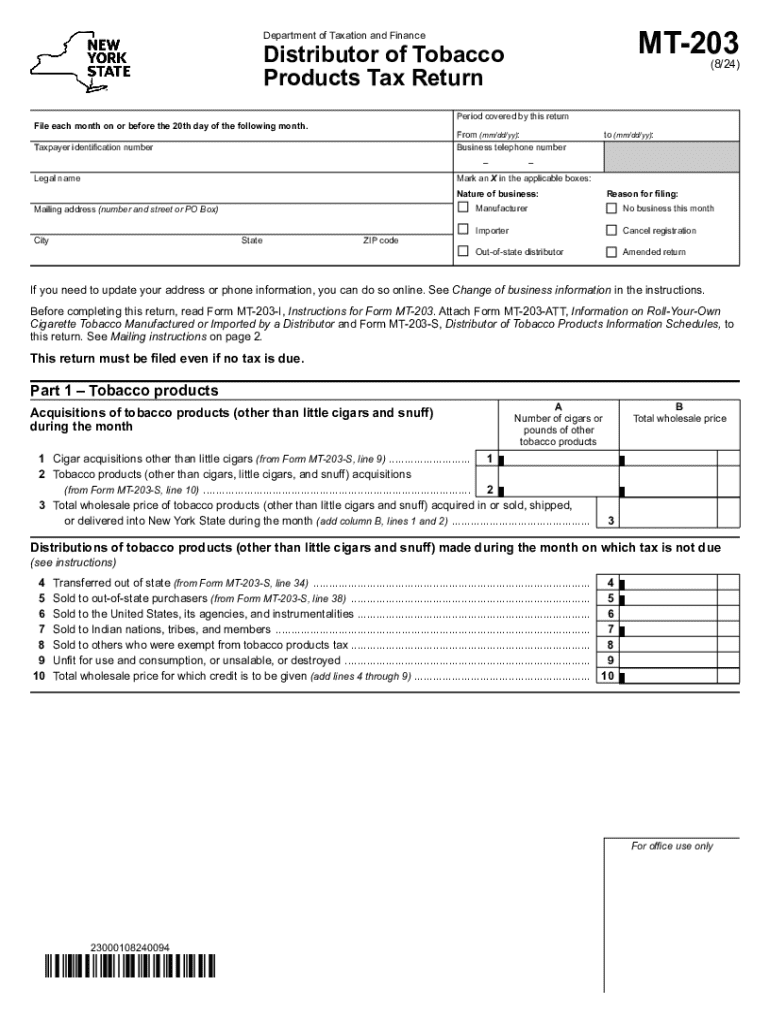







Definition & Purpose of Form MT-203
Form MT-203, officially titled "Distributor of Tobacco Products Tax Return," is a mandatory tax filing document for distributors dealing with tobacco products in New York State. This form is crucial for reporting monthly activities related to acquiring and distributing tobacco products such as cigars, snuff, and little cigars. It helps the state ensure compliance with tax obligations by computing taxes owed and verifying that businesses are appropriately taxed on their tobacco product transactions. Even in instances where no tax is due, the form must be submitted to maintain accurate records.
Key Elements of the Form
- Distributor Information: Includes the distributor's name, address, and identification number.
- Reporting Period: Specifies the month and year for which the tax return is filed.
- Product Details: Details on the types and quantity of tobacco products distributed.
- Tax Computation: A section for calculating the tax owed based on reported distributions.
- Attachments: May require additional documentation to support reported data, such as purchase invoices.
Steps to Complete Form MT-203
- Gather Necessary Documents: Collect all purchase and sales records for the month, including invoices and shipping documents.
- Enter Distributor Information: Complete the contact and identification section at the top of the form.
- Report Product Distribution: Input the quantities of each type of tobacco product distributed during the month.
- Compute Tax: Use the provided formulas to calculate the taxes owed based on the reported distribution.
- Attach Supporting Documents: Include any required attachments that validate the reported figures.
- Review & Submit: Double-check all entries for accuracy before submitting the form by the established deadline.
Filing Deadlines & Important Dates
- Monthly Filing Requirement: Form MT-203 must be submitted by the 20th day of the month following the reporting period.
- Extension Availability: Extensions are not typically granted; timely submission is crucial to avoid penalties.
- Fiscal Year-End Considerations: Ensure all annual filings align with fiscal reporting requirements for comprehensive compliance.
Penalties for Non-Compliance
Non-compliance with the guidelines for submitting Form MT-203 can lead to significant penalties, including:
- Late Payment Fees: Interest on overdue taxes and late submission charges.
- Fines: Monetary fines for failing to accurately report or submit the form within the designated timeframe.
- License Revocation: Persistent failures may lead to a revocation of the distributor's license to operate within New York State.
Legal Use & Considerations
- Mandatory Filing: Submission of Form MT-203 is a legal requirement for tobacco distributors.
- Accuracy: All information must be accurate and verifiable to avoid legal repercussions.
- Record-Keeping: Maintain comprehensive records for a minimum of three years to support reported data in case of audits.
State-Specific Rules
- New York Regulations: The MT-203 form is unique to New York State and adheres to specific state regulations concerning tobacco product distribution.
- Product Categories: Includes specific rules on different tobacco product categories, affecting how taxes are calculated.
Who Typically Uses Form MT-203
Businesses involved in the distribution of tobacco products are the primary users of Form MT-203. This includes:
- Wholesale Distributors: Entities supplying tobacco products to retailers.
- Importers: Businesses importing tobacco products into New York for local distribution.
- Retail Operations: Large retail chains with direct distribution operations separate from standard retail sales.
Required Documents
To complete Form MT-203 accurately, distributors should prepare and organize:
- Invoices: Records of tobacco product purchases and sales.
- Shipping Records: Documentation of product movement for accurate inventory tracking.
- Tax Calculation Worksheets: Tools or templates to assist in calculating owed taxes based on distribution activities.
Examples and Scenarios of Using Form MT-203
Real-World Scenarios
-
Scenario 1: A New York-based distributor receives an order for 10,000 cigars. They would report this acquisition on Form MT-203, calculate the tax owed based on the unit count for cigars, and include support documentation.
-
Scenario 2: A distributor with monthly sales of various tobacco products, such as snuff and chewing tobacco, would use the form to document these transactions and determine the overall tax liability for the period.
These scenarios highlight the importance of accurate reporting to comply with New York State tax obligations for tobacco distribution.