




01. Edit your form online
Type text, add images, blackout confidential details, add comments, highlights and more.

Type text, add images, blackout confidential details, add comments, highlights and more.

Draw your signature, type it, upload its image, or use your mobile device as a signature pad.

Send it via email, link, or fax. You can also download it, export it or print it out.
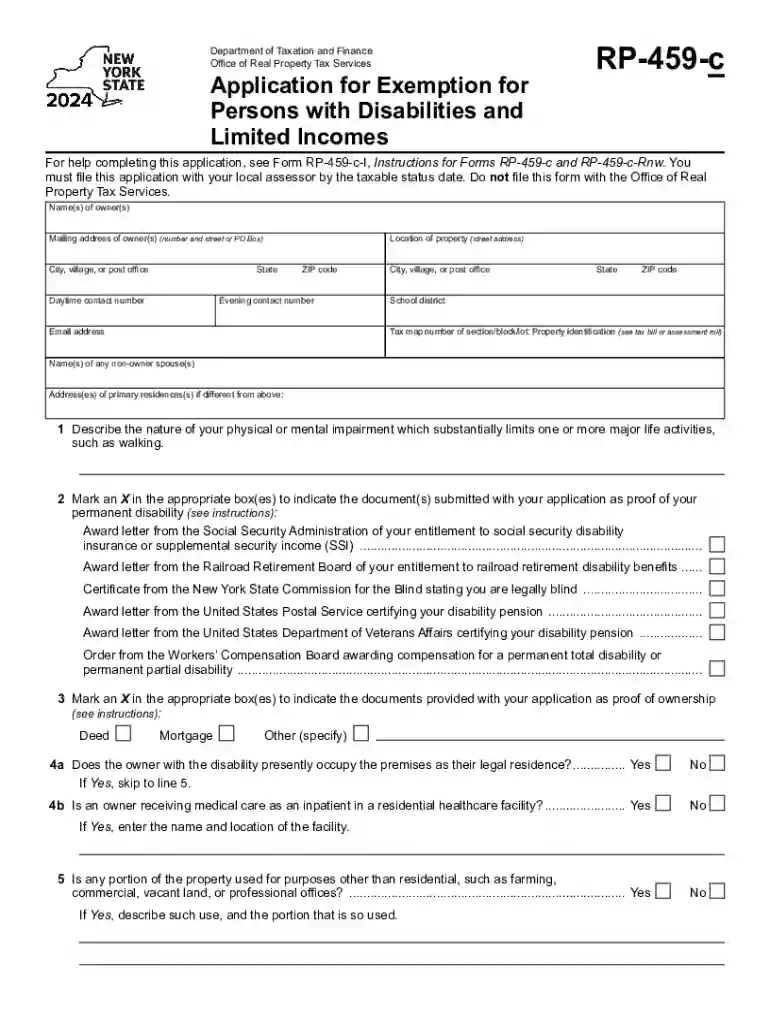
The Form RP-459-c, also known as the Application for Partial Tax Exemption for Real Property of Persons with Disabilities, is a critical document issued by the Department of Taxation and Finance’s Office of Real Property Tax Services. It allows individuals with disabilities and limited incomes to apply for a reduction in property taxes. The exemption is intended to ease the financial burden on those who may have diminished earning capacities due to their disabilities. This form requires detailed personal and financial information to verify eligibility, and it serves as a bridge to ensuring equitable tax relief for those eligible.
To be eligible for the partial tax exemption offered through the RP-459-c form, applicants must meet specific conditions, including:
Disability Status: Applicants must provide proof of disability through documentation from a qualified medical professional or a recognized public agency. Common sources include Social Security Disability Insurance (SSDI) awards or certifications from the U.S. Department of Veterans Affairs.
Income Limitations: Detailed income information must be included. Typically, eligibility might require the applicant's or household's income to fall below a certain threshold, which varies by county or state.
Property Ownership: The property in question must be owned by the applicant. Shared ownership situations might require additional documentation to clarify the applicant's share and eligibility for the exemption.
Primary Residence: The property must serve as the applicant’s primary residence. This ensures that the exemption benefits those who are directly living in the home.


Obtaining the Form RP-459-c can be done through various channels:
Online Access: The Department of Taxation and Finance provides this form on their official website. It can be downloaded as a PDF and printed for manual completion.
Local Assessor’s Office: Applicants may visit their local assessor’s office to obtain a hard copy. Staff members can provide guidance on required documentation and deadlines specific to the locality.
Mail Requests: In some cases, you may request to have the form mailed to you by contacting the local assessor's office, especially useful for those with limited internet access.
Personal Information: Begin with filling out personal details. This section includes the full legal name, contact information, and Social Security number.
Property Details: Accurately describe the property for which the tax exemption is sought. Include the address, parcel number, and ownership details.
Disability Documentation: Attach qualifying documentation that proves the applicant’s disability status.
Income Verification: Provide comprehensive income information. This may involve attaching recent tax returns, pay stubs, or other financial documents.
Residency Verification: Include proof of residency, which often consists of utility bills or a driver’s license with the property address.
Signature and Submission: The application must be signed and dated before submission. Verify with the local assessor's office for the preferred submission method, whether online, mail, or in person, along with consideration for deadlines.
Applicant Information Section: Captures personal and contact information.
Property Description: Requires details about the property, including location and ownership status.
Disability Verification: A section dedicated to confirming the applicant's eligibility based on disability.
Income Assessment: Requires detailed information on all income sources, ensuring that applicants meet financial eligibility criteria.
Certifications: A section where the applicant certifies the truthfulness and completeness of the information provided.
Filing for the RP-459-c application mandates several supporting documents:
Proof of Disability: This may include SSDI documentation or other official medical confirmations.
Income Documents: Tax returns, W-2s, or 1099 forms from the previous year.
Proof of Residency and Property Ownership: Recent utility bills, a driver’s license, and property deed or tax bills.
Timeliness is essential when submitting the Form RP-459-c application:
Taxable Status Date: Each locality might have varying deadlines, often aligned with the taxable status date. Typically, it coincides with the municipal property tax assessment dates.
Annual Submission: It is usually required to file annually to maintain the exemption. Check with local authorities to confirm specific dates.
Understanding the legal framework around the RP-459-c is crucial:
Compliance: Misrepresentation or omission of critical information can lead to denial, penalties, or legal consequences.
Periodic Review: Some jurisdictions may require periodic updates or audits to ensure continuous eligibility, especially if income or residency status changes.
By utilizing the Form RP-459-c, eligible homeowners can receive important tax relief, helping them manage their financial responsibilities more effectively. Proper completion and submission of this form can lead to significant annual savings for qualified individuals.
We've got more versions of the Form RP-459-c Application for Partial Tax Exemption for Real Property of Persons with Disabilities a form. Select the right Form RP-459-c Application for Partial Tax Exemption for Real Property of Persons with Disabilities a version from the list and start editing it straight away!
At DocHub, your data security is our priority. We follow HIPAA, SOC2, GDPR, and other standards, so you can work on your documents with confidence.
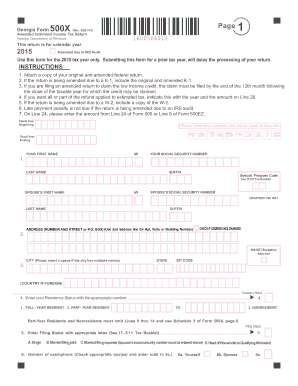



Jan 16, 2018 Application form. Use Form RP-459-c Application for partial tax exemption for real property of persons with disabilities and limited incomes.Read more
Jan 3, 2025 Form RP-459-c, Application for Exemption for Persons with Disabilities and Limited Incomes, or for renewal applicants:
FORM 1040. The IRS Says Bye-Bye to the Postcard Sort of. For 2018, the idea of a postcard tax return resulted in the old and trusted Form 1040 transformingRead more


