




01. Edit your form online
Type text, add images, blackout confidential details, add comments, highlights and more.

Type text, add images, blackout confidential details, add comments, highlights and more.

Draw your signature, type it, upload its image, or use your mobile device as a signature pad.

Send it via email, link, or fax. You can also download it, export it or print it out.
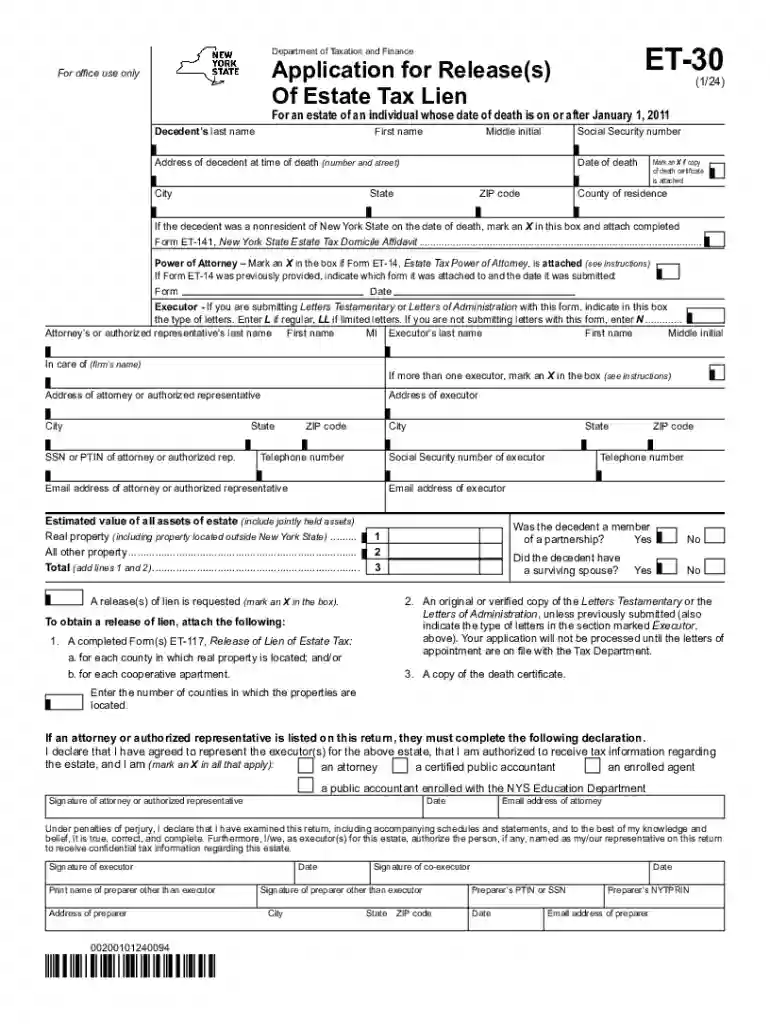
A release of estate tax lien is a document issued by the Department of Taxation and Finance to remove a tax lien placed on a decedent's estate. The lien acts as a legal claim against the estate’s assets to ensure that estate taxes are paid. This form is necessary for clearing any claims the state may have on the estate, allowing the executor to distribute assets to the beneficiaries without encumbrances. The release confirms that all due estate taxes have been settled or are accounted for in compliance with state requirements.
The use of the release of estate tax lien involves several steps to ensure that the estate’s assets are free and clear of any tax obligations. Executors or authorized representatives need this form to legally finalize the distribution of the deceased’s property. It is a critical part of estate settlement, ensuring that no estate taxes remain unpaid, which could otherwise delay asset allocation to heirs. To use the form effectively, the executor must first ensure that all estate tax filings are up to date and accurately reflect the estate's valuation and liabilities.
Gather Necessary Information: Collect details about the decedent and the estate, such as their Social Security number, date of death, and a comprehensive list of assets.
Compile Required Documentation: Include documents like the death certificate, letters of administration, and prior tax filings.
Complete the Form: Fill out the ET-30 form with precise information, adhering to instructions provided by the Department of Taxation and Finance.
Submit the Form: Send the completed form along with necessary documents to the relevant state department office. Confirm receipt and processing procedures.
Await Processing: Monitor the form's status. Follow up if necessary to ensure timely processing and release of the tax lien.
The release of estate tax lien ensures compliance with estate tax laws, protecting the rights of beneficiaries by confirming that the estate is free of governmental claims. Executing this form prohibits the state from holding claims against the decedent’s assets, thereby legally permitting the distribution of inheritance. Non-compliance, or failure to settle tax obligations, could result in encumbrances on estate assets, affecting their transferability to heirs.


Each state has its own set of guidelines and processes for the release of estate tax liens. For example, the New York State's Department of Taxation and Finance requires the ET-30 form. States may differ in deadlines, filing procedures, and required documentation. It is important for executors to be aware of their specific state’s requirements to ensure compliance and expedite the release process.
Eligibility to file for the release includes being the estate’s appointed executor or a legally authorized representative. The estate must have filed requisite tax returns, paid or arranged to pay any due estate taxes, and provided complete and accurate information about the estate and its assets. Executors must also furnish any state-specific documentation to fulfill these criteria.

We've got more versions of the Release of estate tax lien - Department of Taxation and Finance form. Select the right Release of estate tax lien - Department of Taxation and Finance version from the list and start editing it straight away!
At DocHub, your data security is our priority. We follow HIPAA, SOC2, GDPR, and other standards, so you can work on your documents with confidence.



May 11, 2023 The release of lien is an authorization to transfer the real property, located in New York State, free and clear of the estate tax lien.
The appropriate official shall issue a certificate of release for a filed notice of Federal tax lien, no later than 30 days after the date. In the case of an


