Virginia form 502 2026

Get Form
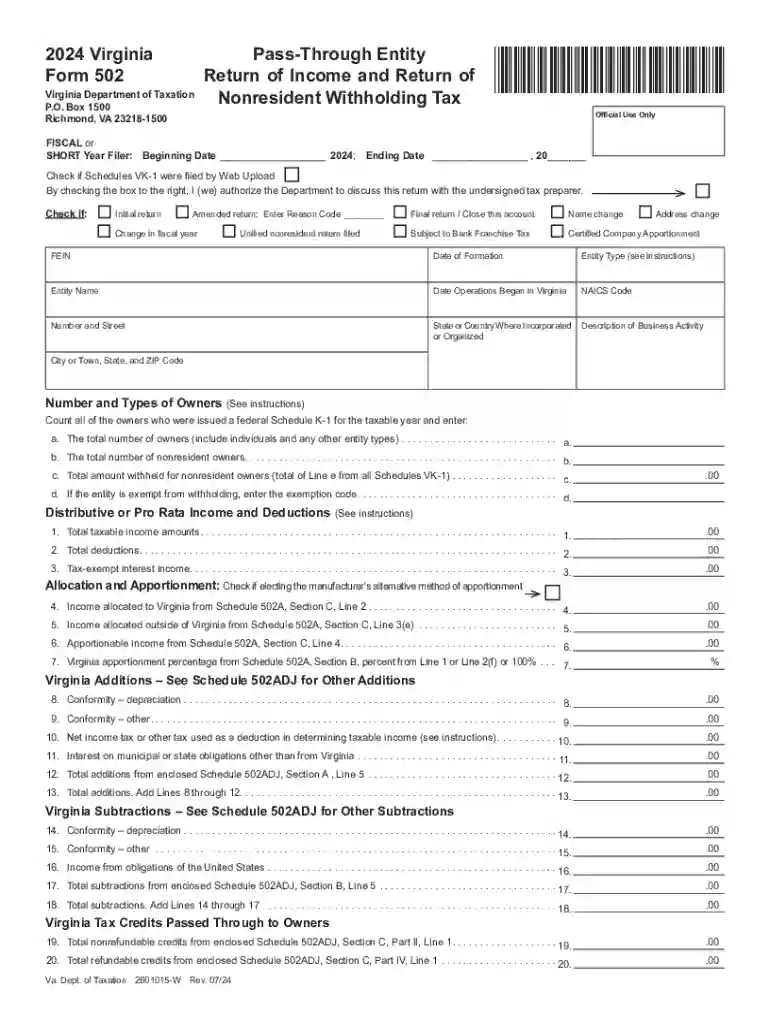
2024 virginia form 502 Preview on Page 1

Here's how it works

01. Edit your 2024 virginia form 502 online
Type text, add images, blackout confidential details, add comments, highlights and more.

02. Sign it in a few clicks
Draw your signature, type it, upload its image, or use your mobile device as a signature pad.

03. Share your form with others
Send it via email, link, or fax. You can also download it, export it or print it out.

Definition and Meaning of Virginia Form 502

Virginia Form 502 is a tax document used by pass-through entities to report income, deductions, and withholding tax for nonresident owners. Pass-through entities include S corporations, partnerships, and limited liability companies (LLCs) that elect to be treated as such for tax purposes. This form serves as a crucial tool for ensuring that these businesses comply with state tax obligations, accurately report financial activity, and facilitate tax payments for nonresident owners.

Key Elements of the Form

  • Entity Information: Includes identifying details such as the entity's name, address, and federal employer identification number (FEIN).
  • Income Reporting: Sections for declaring total income earned by the entity, including all sources and types of income subject to Virginia taxation.
  • Deductions and Credits: Space to report any allowable deductions and credits that the entity wishes to claim, which can reduce overall taxable income.
  • Withholding Tax Details: Information on tax withheld for nonresident owners, ensuring the correct amount is collected and remitted to the state.

How to Use Virginia Form 502

To effectively use Virginia Form 502, entities must gather all necessary financial information and complete each section accurately. This involves reporting income, deductions, and withholding tax details. Entities should double-check all entries for accuracy to avoid penalties or delays in processing.

Steps to Complete the Form

  1. Collect Required Information: Gather details for all income, deductions, and withholdings related to the entity and its nonresident owners.
  2. Fill Out Entity Details: Complete the initial section with the entity's information.
  3. Report Income and Deductions: Enter totals for all relevant income streams and deductions.
  4. Detail Withholding Tax: Include figures for any withholding undertaken on behalf of nonresident owners.
  5. Review and Verify: Double-check for accuracy and completeness.
  6. Submit the Form: File by the established deadline using the designated method (online, by mail, or in-person).

Required Documents for Filing

Completing Form 502 requires a series of supporting documents and information that corroborate the details reported within the form. Entities must prepare:

  • Financial Statements: Profit and loss statements, balance sheets.
  • Owner Information: Details on all parties with a financial stake in the entity.
  • Tax Records: Documentation related to income and deductions.
  • Withholding Records: Evidence of taxes withheld and filed on behalf of nonresident owners.

Filing Deadlines and Important Dates

Virginia Form 502 must be filed pursuant to state-mandated deadlines to avoid penalties. The general deadline is the 15th day of the fourth month following the close of the entity's fiscal year. For those aligned to a calendar year, this is typically April 15th. Extensions may be requested, which could provide additional time for filing, but not for payment.

Penalties for Non-Compliance

Failure to file Form 502 accurately or on time can result in penalties, including:

  • Late Filing Penalties: Assessed on returns filed past the deadline.
  • Inaccuracy Penalties: For errors in reporting income or deductions.
  • Nonpayment Penalties: Levied when withholding is insufficient or unpaid on behalf of nonresident owners.

Digital vs. Paper Submission

Entities can choose to file Virginia Form 502 either digitally or via traditional paper methods. Both options are viable, but electronic filing may offer advantages such as quicker processing times, easy access to submitted documents, and enhanced accuracy through automatic calculations.

Software Compatibility

Form 502 can be prepared using software solutions like TurboTax or QuickBooks, which streamline data entry and submission processes. These platforms help ensure compliance with state tax laws and simplify reporting through integration with digital bookkeeping records.

Business Entity Types Utilizing the Form

  • LLCs: That elect to be taxed as pass-through entities.
  • Partnerships: Required to report distributed income to nonresident partners.
  • S Corporations: That need a mechanism for reporting the distributions and taxes withheld for out-of-state shareholders.

State-Specific Rules for Virginia Form 502

Each state may have unique requirements for filing tax-related forms like Form 502. In Virginia, the specifics include guidelines for determining which entities must file, what constitutes taxable income, and specific forms of acceptable deductions and credits. Understanding these dynamics is essential for proper compliance.

Examples of Using Virginia Form 502

Consider a Virginia-based LLC with nonresident stakeholders. The LLC must fill out Form 502 to report all generated income, declare allowable deductions, and account for withholding taxes collected for nonresident owners. This process requires detailed record-keeping and precise financial reporting to comply with state tax laws.

Through this comprehensive documentation and adherence to guidelines, Virginia Form 502 helps clarify tax relationships between entities and the state, ensuring that all financial obligations are met efficiently and transparently.

be ready to get more

Complete this form in 5 minutes or less

Get form

Got questions?

We have answers to the most popular questions from our customers. If you can't find an answer to your question, please contact us.
Contact us
S Corporations, Partnerships, and Limited Liability Companies. Every pass-through entity (PTE) that does business in Virginia or receives income from Virginia sources must file an annual Virginia income tax return on Form 502 or Form 502PTET.
According to Virginia Instructions for Form 760, you must file a Virginia tax return IF: You are a resident, nonresident or part year resident of Virginia and you have to file a federal income tax return.
Nonresidents of Virginia with income at or above the filing threshold must file if any of their income is from Virginia sources.
Every pass-through entity (PTE) that does business in Virginia or receives income from Virginia sources must file an annual Virginia income tax return on Form 502.
If the wages are not subject to federal withholding, they are not subject to Virginia withholding. Complete instructions for withholding Virginia income tax from wages, salaries, and other payments are contained in the Virginia Employer Withholding Instructions.

Security and compliance

At DocHub, your data security is our priority. We follow HIPAA, SOC2, GDPR, and other standards, so you can work on your documents with confidence.

Learn more
ccpa2
pci-dss
gdpr-compliance
hipaa
soc-compliance

People also ask

Address requests to the Tax Commissioner, Virginia Department of Taxation, P.O. Box 2475, Richmond, VA 23218-2475.
In general, an employer who pays wages to one or more employees in Virginia is required to deduct and withhold state income tax from those wages. Since Virginia law substantially conforms to federal law, if federal law requires an employer to withhold tax from any payment, we also require Virginia withholding.
More In Forms and Instructions Publication 502 explains the itemized deduction for medical and dental expenses that you claim on Schedule A (Form 1040), including: What expenses, and whose expenses, you can and cannot include in figuring the deduction. How to treat reimbursements and how to figure the deduction.

Related links