The Complete Guide to Managing Sales Tax Exemption 2026

Get Form
The Complete Guide to Managing Sales Tax Exemption Preview on Page 1

Here's how it works

01. Edit your form online
Type text, add images, blackout confidential details, add comments, highlights and more.

02. Sign it in a few clicks
Draw your signature, type it, upload its image, or use your mobile device as a signature pad.

03. Share your form with others
Send it via email, link, or fax. You can also download it, export it or print it out.

Definition and Meaning

Sales tax exemptions play a critical role in business operations, allowing certain transactions to be exempt from state and local sales taxes. Typically, these exemptions apply to purchases made for resale, manufacturing, agricultural use, or by non-profit organizations. The Complete Guide to Managing Sales Tax Exemption outlines the necessary steps to qualify and maintain compliance with exemption regulations. Understanding these exemptions ensures that businesses avoid paying unnecessary taxes and adhere to legal stipulations.

How to Use the Sales Tax Exemption Guide

Using the sales tax exemption guide involves a meticulous review of applicable exemptions that benefit your business operations. It is essential to assess whether your transactions qualify under the exemption categories such as manufacturing, resale, or agricultural purposes. The guide provides comprehensive instructions for filling out necessary forms, detailing specific documentation needed for validation. Users should follow outlined steps to properly claim exemptions, ensuring that all relevant information is accurate and up-to-date during the process.

Steps to Complete the Sales Tax Exemption Form

Completing the sales tax exemption form involves specific steps that ensure the accurate submission of necessary information.

  1. Identify Applicable Exemption Categories: Begin by understanding which exemption categories your business transactions fall under, such as resale or manufacturing.
  2. Gather Required Documentation: Collect all necessary documents, including purchase orders or invoices that support your exemption claim.
  3. Fill Out the Form: Enter detailed information about your business and transactions. Ensure all required fields are completed accurately to avoid processing delays.
  4. Review for Accuracy: Double-check all entered information for accuracy, paying particular attention to legal business names and exemption category details.
  5. Submit the Form: Depending on state guidelines, submission may occur online, by mail, or in person. Confirm the correct submission method for your jurisdiction.

Important Terms Related to Sales Tax Exemption

Understanding key terms is crucial when dealing with sales tax exemptions:

  • Resale Certificate: A document issued by a buyer to a seller, asserting that they intend to resell purchased items and therefore are exempt from paying sales tax.
  • Nexus: The degree of presence a business has in a state, which determines the obligation to collect and remit sales tax.
  • Certifiable Use: The designation of a specific use for a product or service that qualifies it for sales tax exemption.

Having a clear grasp of these terms ensures precision in managing exemption processes.

Key Elements of the Sales Tax Exemption Form

The exemption form consists of several key elements which are critical for correct completion:

  • Business Information: Includes name, address, and tax identification number.
  • Exemption Category: Identification of the specific exemption for which you are applying.
  • Transaction Details: Information regarding sales or purchases, including invoice numbers, dates, and amounts.
  • Declaration: A signed statement verifying that the information provided is accurate and that the exemption is valid.

Each element requires careful attention to ensure the form is filled out correctly and accepted by the relevant tax authorities.

Who Typically Uses Sales Tax Exemption Forms

Sales tax exemption forms are typically used by a range of entities that meet specific criteria:

  • Retailers: Those purchasing goods for resale to consumers.
  • Manufacturers: Companies buying raw materials that will become part of a product intended for sale.
  • Non-Profits: Organizations that meet tax-exempt status under IRS guidelines.
  • Agricultural Producers: Farmers purchasing items used directly in production processes.

Understanding who qualifies ensures that entities leverage appropriate exemptions while remaining compliant.

Legal Use of the Sales Tax Exemption

Legal use of sales tax exemptions requires adherence to specific state and federal guidelines. Misuse can lead to significant penalties, thus it's crucial to:

  • Verify Eligibility: Ensure all criteria for specific exemptions are met before application.
  • Maintain Accurate Records: Keep detailed records of all transactions claimed under exemptions for audit purposes.
  • Revalidate Annually: Some exemptions require annual validation to ensure continued eligibility; staying informed about these requirements prevents lapses in compliance.

By understanding and adhering to these legal boundaries, businesses can protect themselves from potential infractions.

State-Specific Rules for Sales Tax Exemption

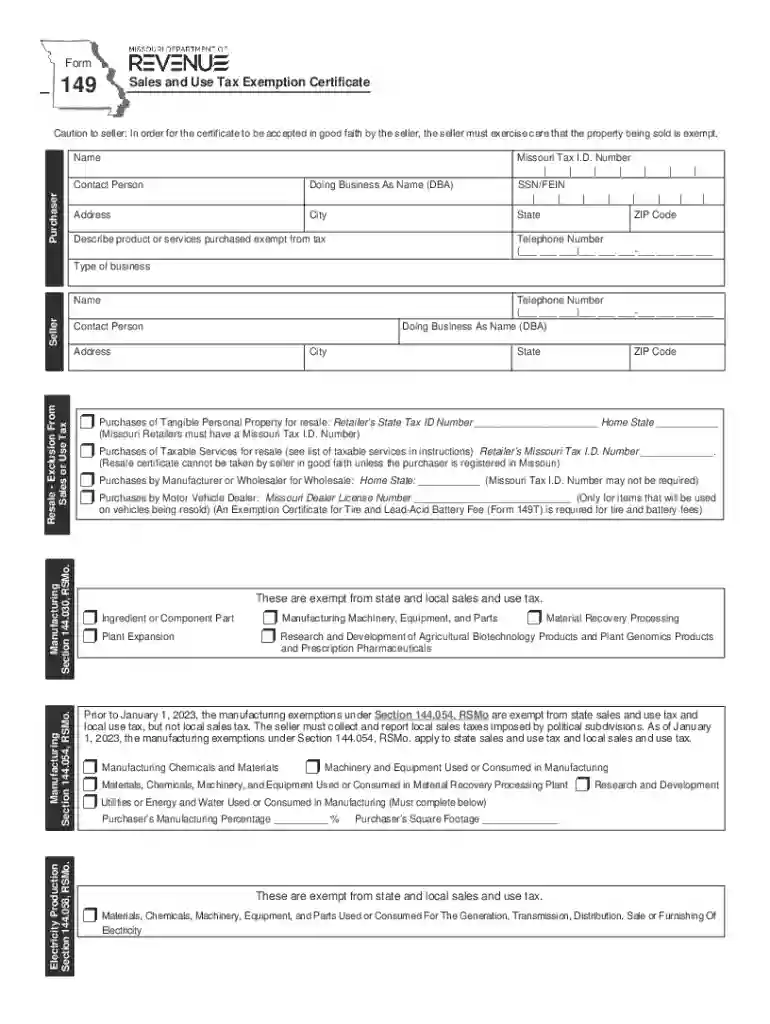
Sales tax exemption rules vary significantly from state to state, impacting eligibility, application procedures, and documentation requirements. Some states, such as Missouri, require specific forms like Form 149 to claim exemptions. Others may provide blanket certificates that ease the process for frequent transactions.

  • Variation in Exemption Categories: Different states may recognize various categories, necessitating thorough research for applicability.
  • Documentation Requirements: States dictate different documentary evidence, emphasizing the need for tailored record-keeping.
  • Renewal Procedures: Understand state-specific timelines and procedures for renewing exemptions to avoid automatic expiration.

These state-specific nuances are crucial for businesses operating in multiple jurisdictions or planning expansions across state lines.

be ready to get more

Complete this form in 5 minutes or less

Get form

Got questions?

We have answers to the most popular questions from our customers. If you can't find an answer to your question, please contact us.
Contact us
Customer Exemptions: Specific types of customers are exempt from paying sales tax on their purchases. Depending on the state, these may include government entities, non-profits, and schools, to name a few.
Anytime a tax-exempt organization asks you to remove sales tax from their order, require them to give you a copy of their tax-exempt certificate. You should also check that the certificate uses the correct form, all fields have been filled in and that it is signed and dated.
Yes. Not only do buyers use exemption certificates to prove to sellers they dont need to pay sales tax, sellers must keep the certificates on file to prove to taxing authorities they didnt need to collect the tax.
Who should be filing exempt on taxes? As noted above, you can claim an exemption from federal withholdings if you expect a refund of all federal income tax withheld because you expect to have no tax liability and had no tax liability in the previous tax year.
Generally, to obtain a sales tax exemption certificate, an exempt institution must first have a valid sales tax account. That account number is put on a form certificate issued by that state and the certificate can be used to purchase goods tax-free.

Security and compliance

At DocHub, your data security is our priority. We follow HIPAA, SOC2, GDPR, and other standards, so you can work on your documents with confidence.

Learn more
ccpa2
pci-dss
gdpr-compliance
hipaa
soc-compliance
be ready to get more

Complete this form in 5 minutes or less

Get form

People also ask

Requesting certificates: Your customer must provide you with a U.S. sales tax exemption certificate during a tax-exempt transaction. Youll need these certificates to prove why you didnt charge U.S. sales tax.
Most states provide helpful resale certificate information on their Department of Revenue websites. Does an LLC have to pay sales tax? Yes. An LLC isnt exempt from collecting sales tax on products or other tangible personal properties sold in the various jurisdictions where their businesses currently operate.
How to fill out the Form ST3 Certificate of Exemption Detailed Instructions? Enter the purchasers name and address. Select the reason for exemption by checking the appropriate box. Fill in the sellers information. Sign and date the certificate. Review all entries for accuracy.

Related links