01. Edit your form online
Type text, add images, blackout confidential details, add comments, highlights and more.

Type text, add images, blackout confidential details, add comments, highlights and more.

Draw your signature, type it, upload its image, or use your mobile device as a signature pad.

Send it via email, link, or fax. You can also download it, export it or print it out.
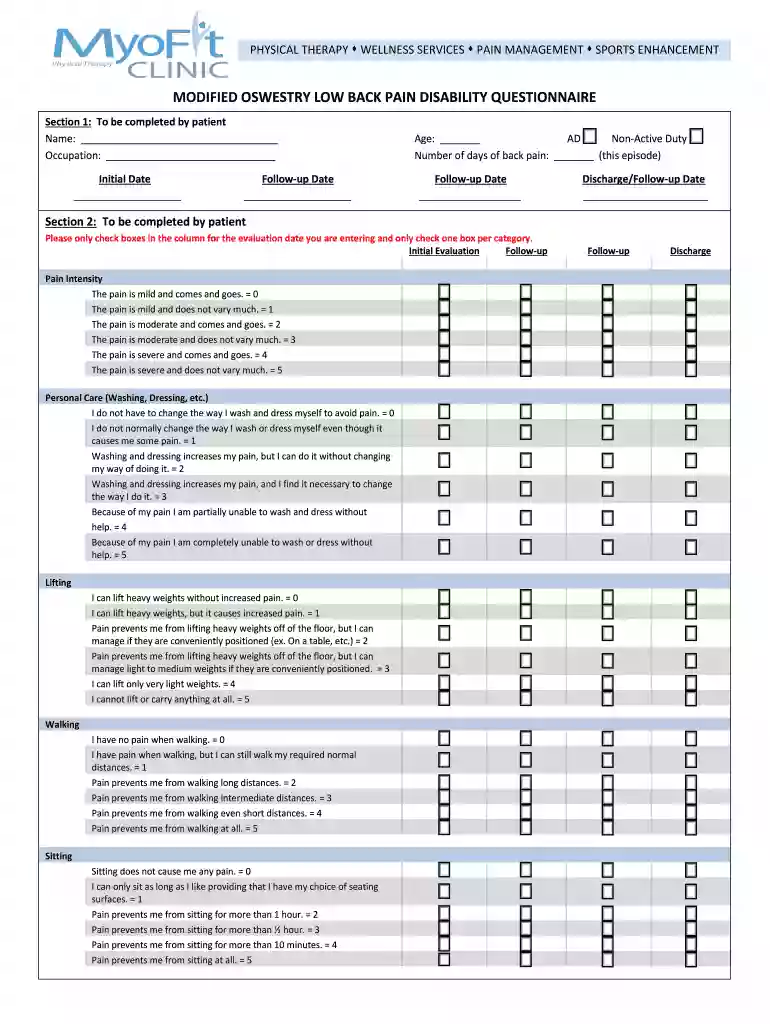
The Modified Oswestry Low Back Pain Disability Index (ODI) is a widely recognized questionnaire that evaluates the impact of low back pain on a patient's daily life. It serves as a standardized method to measure a patient’s functional disability level due to back pain. The purpose of this tool is to provide healthcare professionals with a clear and quantitative assessment of how back pain affects a patient’s ability to perform everyday activities. This insight can guide treatment planning and monitor the effectiveness of therapeutic interventions over time.
Using the ODI involves administering a 10-section questionnaire to the patient. Each section focuses on a specific aspect of daily life and includes activities such as walking, sitting, standing, and sleeping. Patients rate their difficulty with each activity on a scale from 0 to 5, with higher scores indicating greater disability. The results can be used to track changes in the patient’s condition and assess the impact of specific treatments. Clinicians often revisit the questionnaire at regular intervals to monitor progress or make necessary adjustments in treatment strategies.
Provide the Questionnaire: The patient receives a copy of the ODI questionnaire and instructions on how to complete it.
Patient Assessment: The patient reads each section and selects the statement that best describes their level of discomfort.
Score Calculation: Once the patient has completed all sections, each selected score is summed to calculate the total score.
Percent Disability Calculation: The total score is converted to a percentage to determine the level of disability. This is typically done by dividing the total by the maximum possible score and multiplying by 100.
Interpretation of Results: The healthcare provider interprets the score to assess the patient's level of impairment and discuss possible treatment options.
The primary users of the ODI are healthcare providers such as physicians, physical therapists, and chiropractors. It is particularly useful for professionals who specialize in musculoskeletal disorders, as it offers a quantitative measure of a patient's functionality. The index is also pertinent for researchers conducting studies on low back pain, providing a consistent measurement tool for evaluating patient outcomes. Patients experiencing chronic low back pain can also benefit from completing the ODI to better understand their condition and the effectiveness of treatments received.


Ten Questionnaire Sections: Each section focuses on a different aspect of life impacted by back pain, including personal care, lifting, and social life.
Scoring Methodology: Numerical scores for each section are summed to give a total score, which is then converted into a percentage to classify the disability level.
Ease of Use: The form is straightforward, allowing both patients and healthcare providers to easily understand and utilize the results.
Customization Potential: While standardized, the ODI can be adapted for specific patient needs or research environments, ensuring it remains relevant across diverse clinical settings.
Functional Disability: Refers to limitations in performing daily activities due to physical or mental impairments.
Standardized Assessment: A consistent method used across different individuals and settings to ensure reliability and validity in measuring outcomes.
Numerical Rating Scale: The use of a numeric scale to rate pain severity, allowing for a more objective interpretation of subjective data.
Longitudinal Tracking: Monitoring a patient's progress over time using repeated measures of the ODI to assess changes in disability levels.
The ODI is often employed within a legal context to document the extent of an individual’s disability for insurance claims, workers' compensation cases, and legal proceedings. Its standardized format provides an objective measure that can be cited as evidence when determining entitlements and benefits. The legal acceptability of the ODI is underpinned by its widespread use and recognition in both clinical and research domains, ensuring its credibility as a reliable tool for assessing functional impairment due to low back pain.
The Modified Oswestry Low Back Pain Disability Index is available in both digital and paper formats, allowing for diverse usage scenarios. Many electronic health record (EHR) systems integrate the ODI, enabling practitioners to administer and score the questionnaire digitally. This facilitates streamlined processing, easy data storage, and rapid retrieval for analysis. Compatibility with software applications such as Microsoft Word or PDF editors also allows for easy distribution and completion, whether at a healthcare facility or remotely by patients.
Patients across different backgrounds can benefit from the ODI. For instance, a construction worker experiencing chronic back pain might complete the ODI to evaluate how their condition affects job performance and daily life. Similarly, a retiree with back pain may use the ODI to assess mobility limitations and discuss these with a physical therapist. In research, the ODI can be employed to measure the efficacy of a new back pain intervention, comparing pre- and post-treatment disability scores to quantify improvement.
At DocHub, your data security is our priority. We follow HIPAA, SOC2, GDPR, and other standards, so you can work on your documents with confidence.