




01. Edit your form online
Type text, add images, blackout confidential details, add comments, highlights and more.

Type text, add images, blackout confidential details, add comments, highlights and more.

Draw your signature, type it, upload its image, or use your mobile device as a signature pad.

Send it via email, link, or fax. You can also download it, export it or print it out.
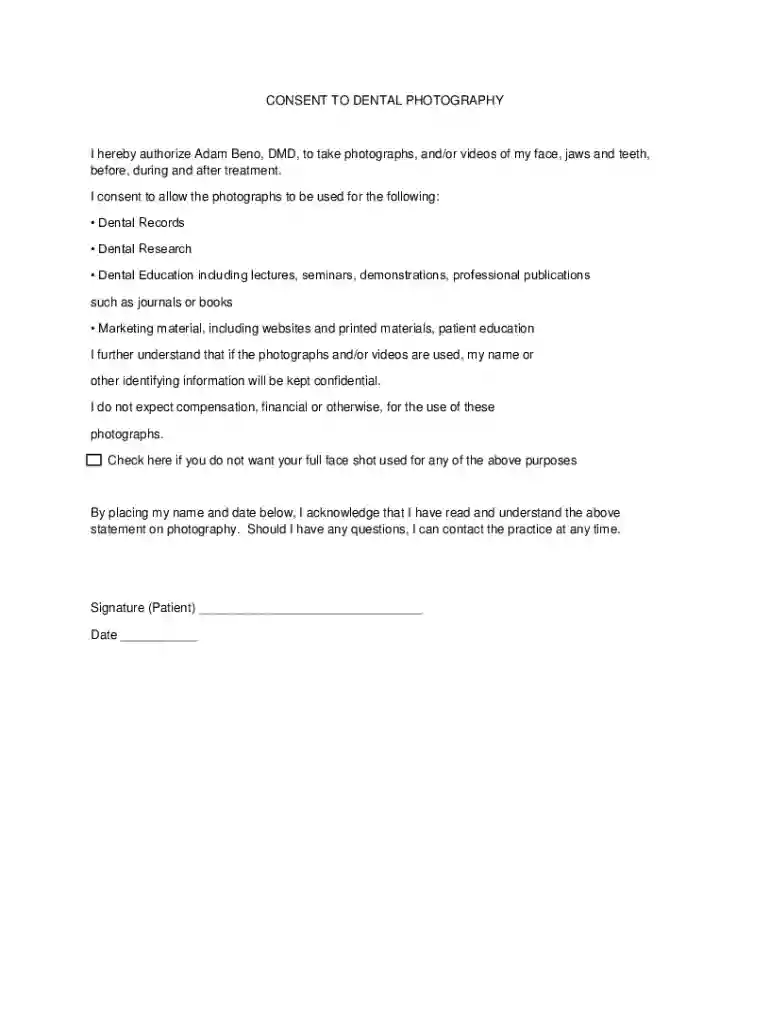
Consent to dental photography is a formal document granting permission to dental professionals to capture and use images of a patient’s face, jaws, and teeth. These photographs can be used for various purposes, including dental records, educational materials, research, and marketing. The document ensures that patients are fully informed about how their images will be used and that they agree to this usage, protecting both the patient's rights and the healthcare provider’s legal standing.
Photographs play a significant role in dental practices, serving as critical records and communication tools. To use the consent form efficiently, first, inform the patient about the type of images needed and their intended use. After the discussion, provide the consent form for the patient to review. It’s essential that patients have the opportunity to ask questions and discuss any concerns they may have before they sign the document.
Consenting to dental photography can enhance the quality of dental care by allowing the dentist to accurately track progress over time, improve treatment planning, and communicate effectively with other healthcare professionals. It also aids in patient education by visualizing treatment outcomes and proposals.
Securing informed consent for dental photography is both a legal and ethical requirement, safeguarding patients' privacy and ensuring the rightful use of their images. In the U.S., this is governed by laws like HIPAA, which require the protection of patient information and consent for uses beyond treatment.
This form is commonly used in dental practices, including orthodontics, oral surgery, and general dentistry. It is also relevant for dental education institutions, where student and staff training materials require visual documentation.


Understanding the vocabulary specific to these consent forms helps in ensuring both parties are on the same page.
Obtaining informed consent should be a structured process that prioritizes patient autonomy and understanding.
While general guidelines are applicable across the U.S., specific states may have additional requirements or considerations.
Understanding and complying with these nuances ensures legality and ethical integrity in dental practices nationwide.
At DocHub, your data security is our priority. We follow HIPAA, SOC2, GDPR, and other standards, so you can work on your documents with confidence.



These AI programs are trained by exposing them to staggering amounts of existing texts, photos, paintings, dental plan with an AI version of me.
by S Naidoo 2009 Cited by 15 While scientific journals invariably require written consent for photographs that may identify the patient, the format of the photograph consent form is usuallyRead more
Patients must give their written permission before they may be photographed for other business purposes, such as for marketing or public relations. It isRead more


