Definition and Purpose of the Parent-Teen Driving Contract
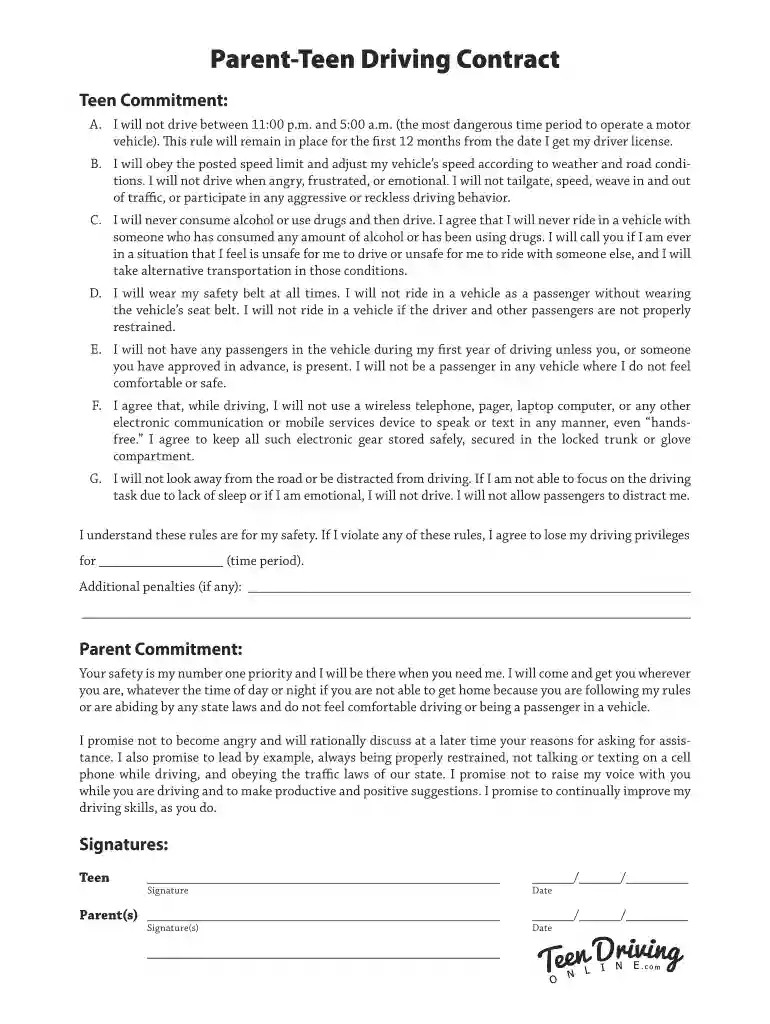
The Parent-Teen Driving Contract is a formal agreement designed to establish clear rules and expectations for teen drivers and their parents. It serves as a mutual understanding between both parties on safe driving practices and responsibilities. This document outlines specific commitments from the teen, such as adhering to speed limits, avoiding distractions, and abstaining from driving under the influence of substances. The parent agrees to support the teen with guidance and by modeling responsible driving habits. The contract underscores the importance of safety and accountability on the road, aiming to reduce the risk of accidents and promote safe driving habits.
How to Use the Parent-Teen Driving Contract
Overview of Usage
To effectively use the Parent-Teen Driving Contract, begin by reviewing the entire document with your teen to ensure that both parties understand the terms and conditions. It's crucial to discuss each section in detail, explaining the reasoning behind each rule to foster cooperation and commitment from the teen.
Steps for Implementation
- Review the Document: Read through all the clauses together. This ensures that both understand the expectations and consequences outlined in the contract.
- Customize the Terms: Adjust any terms to suit your family's specific circumstances or state regulations, such as curfew times or driving zones.
- Sign the Agreement: Ensure both you and your teen sign the contract to formalize the commitment. This solidifies the seriousness of the agreement and the accountability involved.
- Display for Reference: Post the contract at a visible location at home as a constant reminder of the commitments made by both the parent and the teen.
Obtaining the Parent-Teen Driving Contract
Where to Find the Contract
The Parent-Teen Driving Contract can be obtained from several sources. Many insurance companies, motor vehicle departments, and online platforms like DocHub offer downloadable templates. These templates are typically free and customizable to suit individual needs.
Recommended Platforms
- Insurance Websites: Often provide their versions to encourage safe driving and reduce claim rates.
- State DMV Sites: Offer standard forms aligned with state-specific traffic laws for parental guidance.
- DocHub: Offers a user-friendly interface to download, edit, and sign the document digitally.
Steps to Complete the Parent-Teen Driving Contract
- Gather Information: Collect essential information about driving regulations in your state and any specific family rules related to driving.
- Fill Out Sections: Address each section thoroughly, ensuring all expectations and responsibilities are clearly outlined in the document.
- Review with Teen: Go over the document with the teen to ensure they understand their responsibilities and the consequences of non-compliance.
- Make Adjustments: Modify any terms as needed to reflect customized family agreements or changes in state traffic laws.
- Sign and Date: Both parties should sign and date the document to signify mutual agreement and accountability.
Key Elements of the Parent-Teen Driving Contract
Teen Responsibilities
- Compliance with Traffic Laws: Adherence to all applicable state and local traffic laws.
- Restriction Adherence: Observing agreed-upon limits, such as curfews and passenger restrictions.
- Safety Measures: Commitment to seatbelt usage and maintaining vehicle safety standards.
Parental Support
- Guidance and Monitoring: Providing guidance and actively monitoring the teen's driving habits.
- Role Modeling: Exhibiting safe driving practices as a model for the teen.
- Emergency Availability: Being available to assist the teen in case of emergencies or to provide transportation alternatives if the teen is unable to drive safely.
Legal Use of the Parent-Teen Driving Contract
Compliance and Enforcement
While the Parent-Teen Driving Contract itself is not a legally binding document, it serves as an essential tool for setting family rules and expectations related to driving. Its strength lies in mutual respect and accountability rather than legal enforceability. However, by establishing clear rules and expectations, families can create a strong foundation for responsible driving practices.
State-Specific Rules for the Parent-Teen Driving Contract
Understanding State Variations
Different states have varying laws regarding teen driving, including age restrictions, driving hours, and passenger limits. Therefore, it is important to adjust the Parent-Teen Driving Contract to ensure it aligns with your state's specific requirements.
Example of State Variances
- Curfew Regulations: Certain states may prohibit teen drivers from operating a vehicle during specific nighttime hours.
- Graduated Licensing: Requirements might differ in terms of the number of supervised driving hours necessary before obtaining a full license.
- Additional Restrictions: Passenger limits and restrictions on cell phone usage while driving can vary by state.
Examples of Using the Parent-Teen Driving Contract
Examples of the Parent-Teen Driving Contract's use highlight its practical application in families across different scenarios:
- Accident Prevention: A family reports a significant decrease in risky driving behavior after consistent use of the contract, attributing this to the clear expectations set forth.
- Communication Improvement: One household credits the contract with improving communication between parents and their teen regarding driving expectations and responsibilities.
- Behavioral Changes: Teens have maintained a clean driving record after adhering to the contract's guidelines, leading to reduced insurance premiums and increased parental trust.