




01. Edit your form online
Type text, add images, blackout confidential details, add comments, highlights and more.

Type text, add images, blackout confidential details, add comments, highlights and more.

Draw your signature, type it, upload its image, or use your mobile device as a signature pad.

Send it via email, link, or fax. You can also download it, export it or print it out.
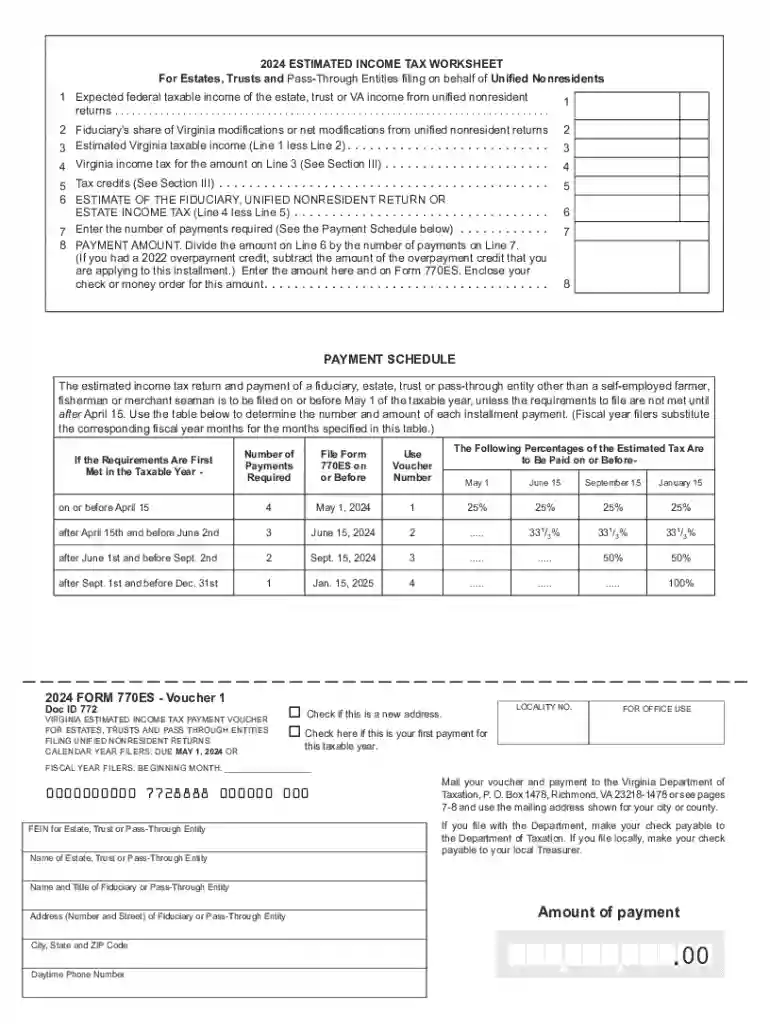
The 2024 Form 770ES is a Virginia Estimated Income Tax Payment Voucher primarily intended for estates, trusts, and entities defined under unified nonresident filings. It facilitates the submission of estimated tax payments to the Commonwealth of Virginia. This form is crucial for entities required to pay taxes on income received throughout the year, ensuring compliance with state tax obligations and avoiding penalties associated with underpayment or late payment. It is utilized by fiduciaries managing the financial affairs of estates and trusts, as well as nonresident entities engaging in income-generating activities in Virginia.
Acquiring the 2024 Form 770ES is straightforward. This document can be downloaded directly from the Virginia Department of Taxation's website. Alternatively, you may obtain a physical copy from tax preparation software or purchase it at office-supply stores. Online resources provide an easy-to-navigate process to either fill out or print the form for manual completion. Tax professionals often have these forms readily available for clients dealing with estate or trust tax matters.
Completing the 2024 Form 770ES involves several steps:
Enter the entity's identification details: Start by filling in the name, address, and federal tax identification number of the estate or trust.
Estimate your tax liability: Use prior year financial records or current year projections to calculate the estimated tax due.
Divide the estimated annual tax liability by four: This will determine the quarterly payment, assuming no changes throughout the year.
Include income adjustments: Account for any differences that may affect income, such as changes in income sources or taxable events.
Complete and attach payment vouchers: Submit the appropriate voucher with each quarterly payment.
Timely submission of the 2024 Form 770ES is essential. Estimated payments are typically due quarterly on the following dates:
These deadlines correspond to the tax year's quarterly periods. Missing these dates incurs penalties, so advance preparation and adherence to the calendar are recommended.
The form is specifically designed for:
Estates and trusts: Legal entities managing a deceased person's property and income.
Unified nonresident partnerships: Partnerships with multiple nonresident partners required to pay state income tax.
Fiduciaries: Individuals acting in a trust capacity, responsible for managing another party's assets.


Failure to comply with submitting estimated tax payments using 2024 Form 770ES can result in significant penalties. Underpayment penalties may apply if less than 90% of the current year's tax liability or 100% of the prior year's liability (whichever is smaller) is paid by the due date. Late payment penalties and interest charges are levied on payments not submitted in accordance with the quarterly deadlines.
Understanding the integral components of the form aids efficacious completion:
Taxpayer Information Section: Critical for ensuring all payments are correctly credited.
Calculation Worksheet: Helps determine the appropriate estimated tax payment amount.
Vouchers: These are submitted with payments, often pre-printed with the taxpayer's details.
The legal framework governing the 2024 Form 770ES mandates its use for precise tax compliance for estates, trusts, and unified nonresident entities. Virginia tax law obliges these entities to estimate and remit taxes periodically when expected annual income exceeds a specified threshold. Accurate use of this form is essential for meeting legal obligations and maintaining the financial integrity of the entities involved.
Taxpayers have the option to file the 2024 Form 770ES digitally or via paper submissions, each with distinct advantages:
Digital submission: Offers benefits such as immediate confirmation, reduced paperwork, and enhanced error checks through digital platforms. It is often completed through state websites or approved tax software.
Paper submission: Still preferred by some due to its tangible nature. Mailing the physical form ensures postage proves submission. However, success relies on postal efficiency and can be more prone to entry errors.
The 2024 Form 770ES and its associated filing requirements demand careful attention to detail to ensure proper handling of Virginia state taxes for estates, trusts, and unified nonresidents. Proper application and understanding of this form can prevent financial repercussions and simplify tax compliance.
We've got more versions of the 2024 Form 770ES, Virginia Estimated Income Tax Payment Vouchers for Estates, Trusts, and Unified Non form. Select the right 2024 Form 770ES, Virginia Estimated Income Tax Payment Vouchers for Estates, Trusts, and Unified Non version from the list and start editing it straight away!
At DocHub, your data security is our priority. We follow HIPAA, SOC2, GDPR, and other standards, so you can work on your documents with confidence.

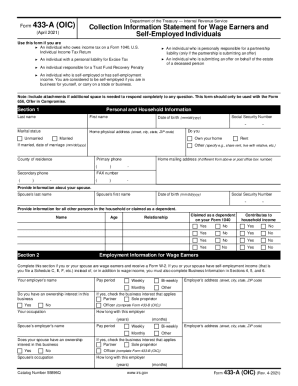


Jan 21, 2026 Links to federal and state tax forms. Payment Voucher for Individuals. The due date for your Virginia income tax return is May 1.
Forms ; 770ES, 2026, Virginia Estimated Payment Vouchers for Estates, Trusts and Unified Nonresidents ; 762, 2026, Return of Tangible Personal Property, MachineryRead more


