Definition & Meaning
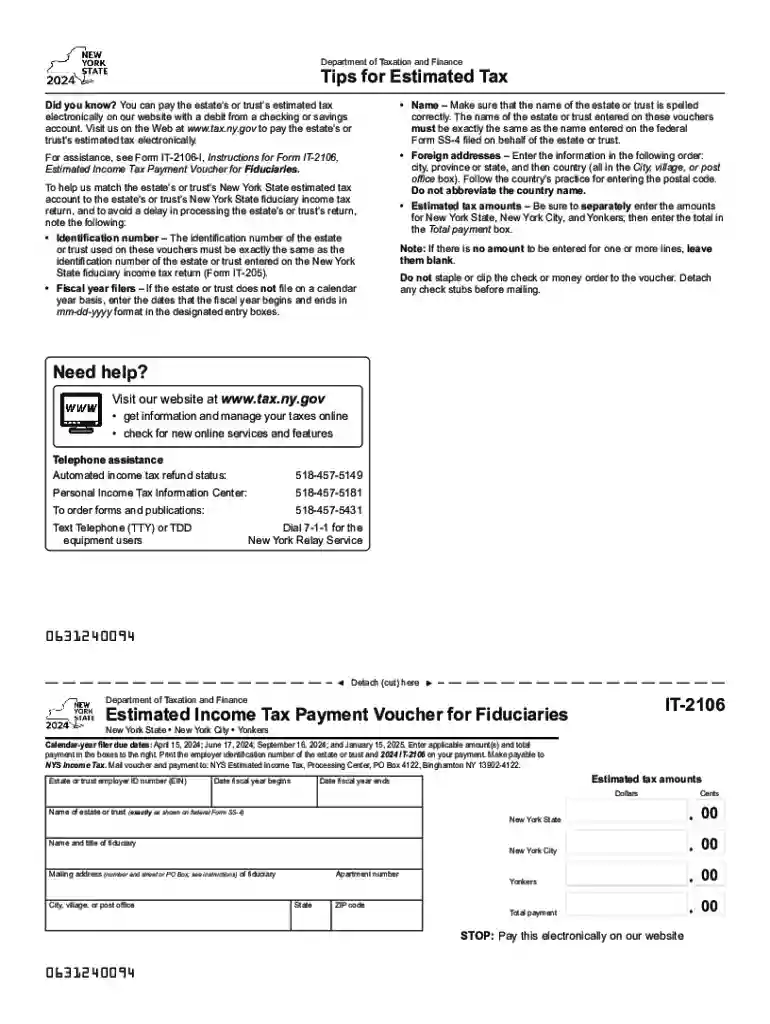
Form IT-2106, also known for its full name as the "Estimated Income Tax Payment Voucher for Fiduciaries Tax Year 2024," is a document used in the United States by fiduciaries managing estates and trusts to remit estimated income tax payments to the appropriate tax authorities. It serves as a payment guide and a record-keeping tool, ensuring fiduciaries adhere to tax requirements by submitting timely payments.
Purpose of Form IT-2106
- Tax Compliance: This form helps fiduciaries avoid penalties by paying estimated taxes on time.
- Record Maintenance: It acts as a record-keeping document, providing proof of tax payments.
- Financial Planning: Allows fiduciaries to distribute tax liabilities throughout the year rather than facing a large payment at year-end.
How to Use the Form IT-2106 Estimated Income Tax Payment Voucher for Fiduciaries Tax Year 2024
Steps to Fill Out the Form IT-2106
- Gather Necessary Information: Collect relevant details concerning the estate or trust, including income estimations, previous year's tax returns, and identification numbers.
- Enter Identifying Information: Include the estate's or trust's name and federal employer identification number (EIN) at the top of the form.
- Calculate Estimated Tax Payments: Determine the estimated taxes owed for the tax year based on projected income.
- Complete Payment Voucher: Fill out the voucher section to detail the payment being made, including the fiscal year and amount.
- Submit Payment: Send the completed form and payment to the designated tax authority address indicated on the form. Ensure it is received by the due date to avoid penalties.
Practical Example
For example, a fiduciary managing a trust with diverse income streams from investments might use Form IT-2106 to report and remit quarterly tax payments, ensuring compliance with state and federal tax laws.
Steps to Obtain the Form IT-2106 Estimated Income Tax Payment Voucher for Fiduciaries Tax Year 2024
- Download from the Internet: The form can often be downloaded directly from state tax authority websites or taxpayer resources.
- Request via Mail: Some taxpayers may prefer obtaining hard copies by requesting them through mail from tax agencies.
- Software Platforms: Tax preparation software such as TurboTax or QuickBooks may offer access to digital versions within their platform features.
Required Documents
Essential Documentation Needed
- Prior Tax Returns: Previous tax returns for the estate or trust to provide a reference point for estimated calculations.
- Financial Statements: Current income records and investment details to project future income.
- Identification Numbers: EIN and other relevant identifiers to accurately complete the form.
Handling Missing Documents
If essential documents are missing, fiduciaries can estimate based on available data while keeping adjustments and verification processes in mind once the actual figures are available.

Who Typically Uses the Form IT-2106 Estimated Income Tax Payment Voucher for Fiduciaries Tax Year 2024
Common Users of Form IT-2106
- Estate Executors: Responsible for overseeing estate tax obligations.
- Trust Administrators: Managing the financial aspects of a trust, including taxes.
- Financial Advisors: Assisting fiduciaries with managing and filing tax payments accurately.
Case Study
Consider a financial advisor guiding a trust designed to support a nonprofit organization. The advisor uses Form IT-2106 to ensure regular, correct tax payments, maintaining the trust’s compliance and focus on its charitable mission.
Filing Deadlines / Important Dates
Key Dates to Remember
- Quarterly Deadlines: Estimated tax payments are often due quarterly. Specific dates may vary state-by-state, so it is crucial to check local requirements.
- Annual Finalization: Final tax balance payments and reconciliation typically occur at the end of the tax year.
Missed Deadlines and Extensions
In cases of missed payments, fiduciaries may face penalties, but they can usually apply for an extension or manage underpayment through set procedures, depending on state-specific rules.
Penalties for Non-Compliance
Penalty Considerations
- Late Fees: For payments submitted after the due date, fiduciaries may incur interest and penalties.
- Underpayment Penalties: Failing to pay the appropriate estimated amount can result in additional fees or compounding interest.
Mitigation Strategies
To avoid these penalties, fiduciaries should plan payments ahead, keeping track of deadlines and ensuring all documentation is complete and timely.
State-Specific Rules for the Form IT-2106 Estimated Income Tax Payment Voucher for Fiduciaries Tax Year 2024
Variability Across States
- Different Filing Requirements: Some states may have unique rules increasing the complexity of filing estimated payments.
- Specific Forms or Addendums: States might require additional documentation or different versions of the form tailored to local tax laws.
Example by State
For instance, New York might require accompanying documentation or further identification numbers to be entered accurately on the form for processing state-level estimated taxes.