01. Edit your form online
Type text, add images, blackout confidential details, add comments, highlights and more.

Type text, add images, blackout confidential details, add comments, highlights and more.

Draw your signature, type it, upload its image, or use your mobile device as a signature pad.

Send it via email, link, or fax. You can also download it, export it or print it out.
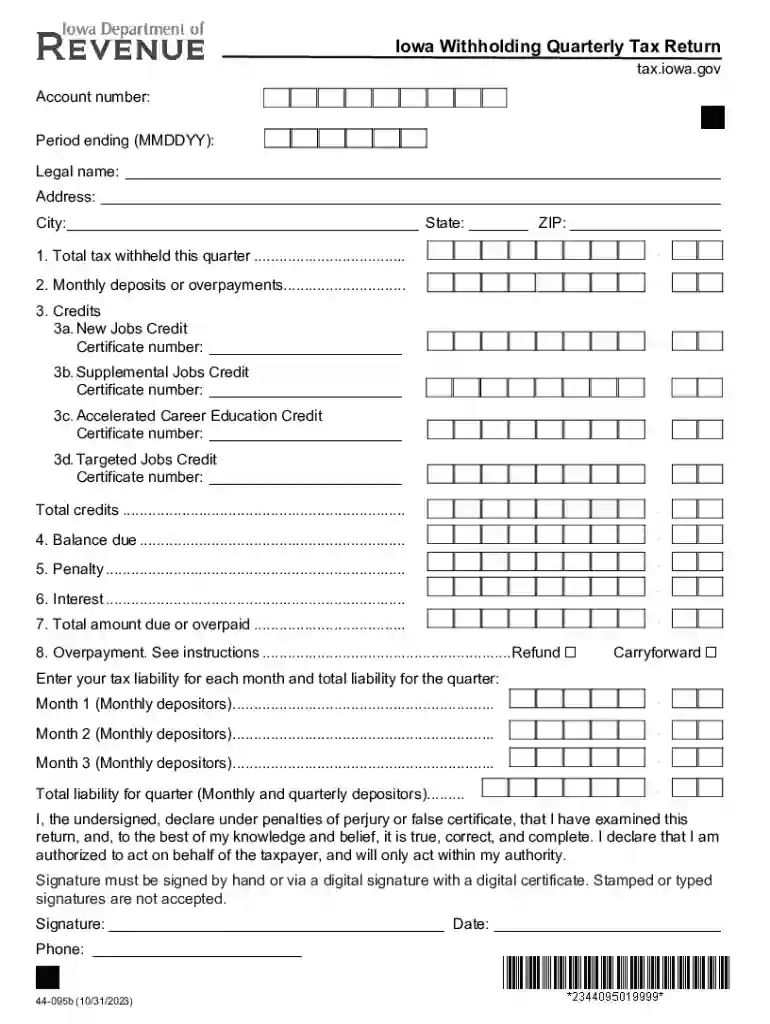
The Iowa Withholding Quarterly Tax Return is a crucial document for businesses and employers responsible for withholding taxes from employees' wages in Iowa. This form is used to report the total amount of taxes withheld over a quarter, ensuring accurate tax compliance with state laws. It is an official record that tracks the tax payments being transferred from employers to the state, which are then used to fund various public services.
To effectively utilize the Iowa Withholding Quarterly Tax Return, it’s essential to understand the reporting requirements and filing process. This form largely centers around documenting tax amounts you've withheld from your employees' earnings. Here’s how to get started:
Gather Your Documents: Collect payroll records, previous tax returns, and any relevant documentation showing total taxes withheld.
Complete Necessary Sections: Fill in the employer's information, enter the total tax withheld for each month of the quarter, and calculate any required adjustments or credits.
Submit by Deadline: Ensure you meet all deadlines for submission to avoid penalties.
Completing the Iowa Withholding Quarterly Tax Return involves several steps, focusing on accuracy and completeness:
Enter Employer Information: Provide your business name, address, tax identification numbers, and contact information.
Record Monthly Withholding: For each month within the quarter, note the exact amount of tax withheld.
Calculate Adjustments: Adjust for any credits, previous overpayments, or penalties that need to be accounted for.
Verify Totals: Ensure monthly totals accurately sum up to the quarterly total.
Sign and Date the Form: Offer certification of the information provided to validate the submission.
Filing the Iowa Withholding Quarterly Tax Return is integral for maintaining good standing with state tax regulations. It serves several purposes:
Ensures compliance with state tax laws by accurately reporting and remitting withheld taxes.
Helps avoid penalties and interest charges for late or inaccurate filing.
Provides a financial audit trail, critical for resolving future discrepancies or audits.
Compliance with this return is mandatory for businesses operating in Iowa with employees from whom taxes are withheld.
The Iowa Withholding Quarterly Tax Return is primarily used by:
Employers: All businesses that employ individuals and withhold state income tax from employee wages.
Bookkeepers and Accountants: Professionals managing financial records for businesses also engage with this form to ensure compliance.
Payroll Service Providers: Companies that handle payroll and tax reporting for businesses must complete this form.
Any business entity with employees in Iowa is obligated to use this form for tax reporting.


Understanding key terms is critical for accurately completing the form:
Withholding Tax: The amount of employee wages withheld by the employer for tax purposes.
Credits: Deductions applied to reduce the total tax liability.
Penalties and Interest: Fines imposed for late payments or filings.
Tax Period: The specific quarter for which the withholding tax is being reported.
Grasping these terms allows for accurate completion and understanding of the form's requirements.
Adhering to filing deadlines is crucial when handling the Iowa Withholding Quarterly Tax Return:
Quarterly Deadlines: Generally, the form must be filed by the last day of the month following the end of each quarter.
Reminder Notifications: Set reminders well ahead of due dates to ensure timely filings.
Missing deadlines can lead to significant penalties, making it essential to prioritize timely submissions.
There are several penalties associated with failing to comply with the requirements for the Iowa Withholding Quarterly Tax Return:
Late Filing Fees: A set percentage of the unpaid tax may be charged for failing to file on time.
Interest Charges: Accrual of additional fees over time for outstanding tax balances.
Increased Scrutiny: Non-compliance may lead to audits or more frequent reviews of your business's tax filings.
Staying compliant protects your business from financial and legal risks associated with tax discrepancies.
The Iowa Withholding Quarterly Tax Return can be submitted through:
Online Filing: Offers a fast, efficient method of submission via the Iowa Department of Revenue website.
Mail: Traditional mailing remains an option for those who prefer or require paper submissions.
Choose the method that best suits your business operations and ensures timely arrival of the documentation.
We've got more versions of the Iowa Withholding Quarterly Tax Return form. Select the right Iowa Withholding Quarterly Tax Return version from the list and start editing it straight away!
At DocHub, your data security is our priority. We follow HIPAA, SOC2, GDPR, and other standards, so you can work on your documents with confidence.