




01. Edit your hawaii rp online
Type text, add images, blackout confidential details, add comments, highlights and more.

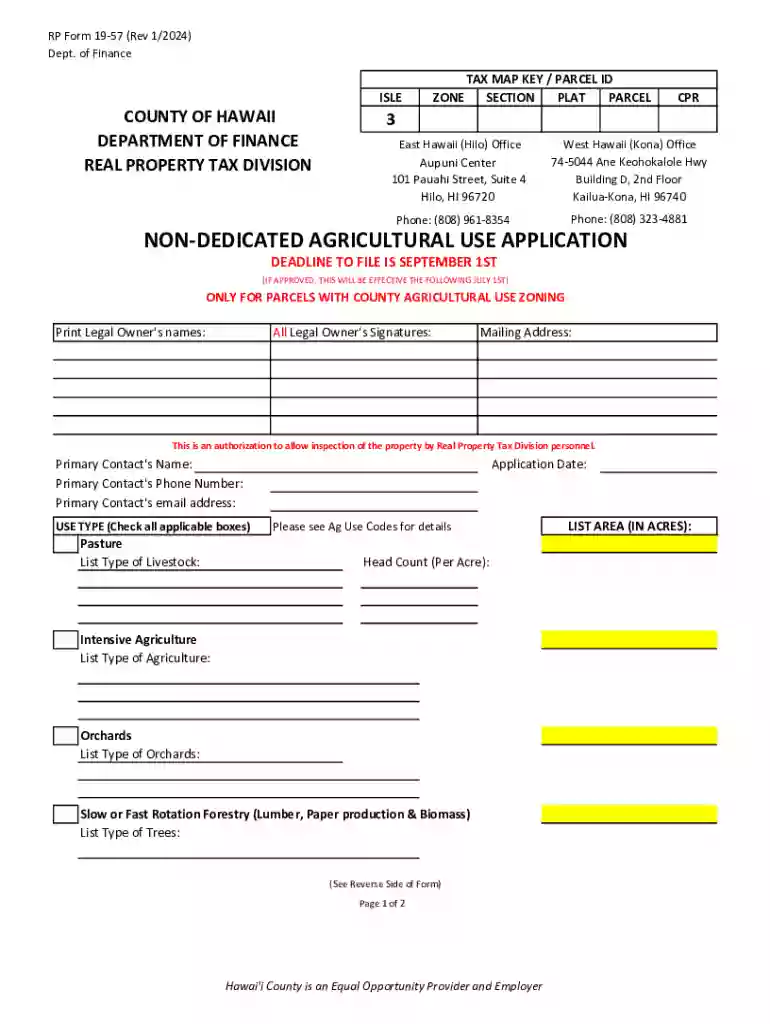
Type text, add images, blackout confidential details, add comments, highlights and more.

Draw your signature, type it, upload its image, or use your mobile device as a signature pad.

Send hawaii rp form 19 57 via email, link, or fax. You can also download it, export it or print it out.
The Hawaii RP Form, specifically referred to as RP Form 19-57, is a documentation instrument used within Hawaii County to apply for non-dedicated agricultural use on parcels that are zoned for county agricultural activities. This form requires legal property owners to furnish necessary details regarding their land to qualify for certain tax considerations or other county-specific incentives. Understanding the purpose and function of this form can aid in ensuring compliance with local regulations and optimizing the use of agricultural land.
Using the RP Form 19-57 effectively involves several key procedures. Property owners must gather all relevant property information, including legal ownership documentation, and details about the kinds of agricultural activities they engage in. This form is filled out with precise data, ensuring that any stated agricultural use aligns with county regulations and definitions. Familiarity with the requirements will aid applicants in ensuring their submissions are both accurate and comprehensive, thus minimizing the risk of issues arising from incomplete documentation.
Completing the RP Form 19-57 requires close attention to detail:
Gather Required Information: Obtain all necessary legal documents related to property ownership. This includes land deeds, current zoning designations, and any existing agricultural use certifications.
Detail Agricultural Activities: Describe the type of farming or agricultural activities taking place. This might include crop types, livestock, or other resources utilized on the parcel.
Review Submission Guidelines: Ensure that each section of the form is completed according to the instructions provided by Hawaii County authorities to avoid any delays or rejections.
Submit by Deadline: The form must be submitted by September 1st to affect tax considerations or zoning changes effective the following July 1st.
The Hawaii RP Form is accompanied by legal stipulations ensuring that declared agricultural use complies with county and state regulations. Users must be aware of possible consequences such as deferred taxes should the land use change from its declared purpose. Additionally, adherence to zoning regulations remains crucial, as violations can lead to penalties or a revocation of benefits associated with agricultural designation.
Understanding the terminology used in RP Form 19-57 can facilitate an easier completion process:
Submitting the RP Form 19-57 necessitates providing several auxiliary documents:
Meeting deadlines for the RP Form 19-57 is crucial in securing intended benefits:
Several scenarios illustrate the practical use of the RP Form 19-57:
Failure to comply with the guidelines and regulations linked to the RP Form 19-57 can result in several penalties:
Understanding these considerations can ensure proper utilization, compliance, and maximization of the benefits associated with the RP Form 19-57 in Hawaii County.
We've got more versions of the hawaii rp form. Select the right hawaii rp version from the list and start editing it straight away!
At DocHub, your data security is our priority. We follow HIPAA, SOC2, GDPR, and other standards, so you can work on your documents with confidence.



This policy covers admission and access to and participation, treatment, and employment in the universitys programs and activities. Discriminatory harassment,Read more
The Revocable Permit (RP) is utilized by the Department of Hawaiian Home Lands (DHHL) to grant permission to an individual or an entity to occupy and utilizeRead more


