







Definition and Purpose of the Senior Property Tax Homestead Exemption
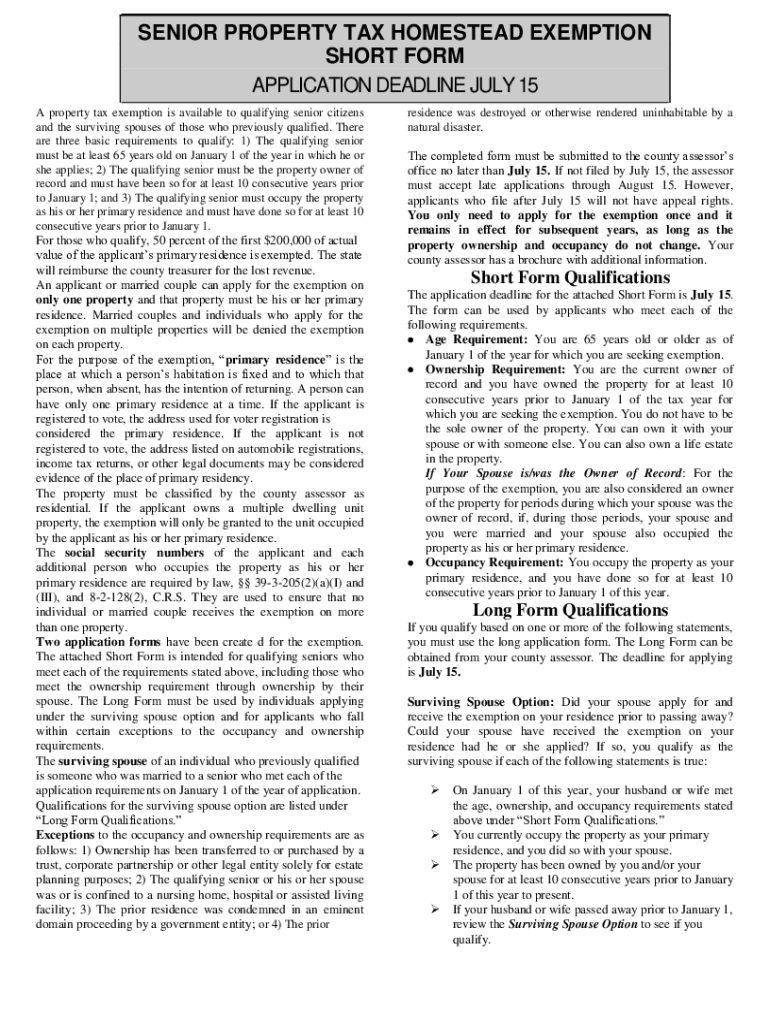
The Senior Property Tax Homestead Exemption is designed to provide financial relief to eligible senior citizens and their surviving spouses by reducing property taxes on their primary residences. This exemption is specifically for individuals aged 65 and older who have owned and lived in their primary residence for a set period, typically ten years. The exemption allows for a property tax reduction, often calculated as a percentage of the property's assessed value. For instance, in El Paso County, Colorado, it provides a 50% reduction on the first $200,000 of the property's actual value. Understanding this exemption is crucial for seniors looking to ease their financial burden during retirement.
Steps to Obtain the Senior Property Tax Homestead Exemption
-
Determine Eligibility: Verify that you meet the eligibility criteria, such as age, ownership, and occupancy requirements. Typically, applicants must be at least 65, have owned their residence for at least ten consecutive years, and it must be their primary residence.
-
Complete the Application: Obtain and fill out the necessary application form from your local county assessor's office. Ensure all required information and documentation are accurately provided.
-
Submit the Application: Submit the completed application to the county assessor's office by the stipulated deadline, usually by mid-July. Some jurisdictions allow late applications until mid-August without appeal rights.
-
Await Confirmation: After submission, the assessor's office will review your application. Once approved, you will receive confirmation that the exemption has been applied to your property taxes.
Eligibility Criteria for the Senior Property Tax Homestead Exemption
- Age Requirement: Applicants must be at least 65 years old at the time of application.
- Ownership Requirement: The applicant must have owned the property for a minimum of ten continuous years.
- Occupancy Requirement: The property must be the applicant's primary residence.
- Surviving Spouses: Provisions often exist for a surviving spouse to continue eligibility if they meet the other criteria.


Required Documents for Application
To apply for the Senior Property Tax Homestead Exemption, applicants generally need to provide:
- Proof of Age: Such as a birth certificate, driver’s license, or another government-issued ID.
- Proof of Ownership: Property deed or title showing at least ten years of ownership.
- Proof of Residency: Documents like utility bills, tax returns, or voter registration confirming primary residency status.
- Death Certificate: Required for surviving spouses to prove eligibility.
Important Filing Deadlines
To qualify for the current tax year, applicants must adhere to key deadlines:
- Regular Application Deadline: Usually by July 15.
- Late Application Deadline: Typically extends to August 15, but note that late applications may not allow appeal if denied.
State-Specific Rules for the Senior Property Tax Homestead Exemption
While the basic framework of the Senior Property Tax Homestead Exemption remains consistent, specific rules and benefits can vary significantly between states:
- Colorado: Offers a 50% reduction on the first $200,000 of a property’s value.
- California: Exemptions might vary by county, with specific requirements for ownership duration.
- Florida: Offers additional exemptions for seniors with limited income alongside the standard homestead exemption.
Legal Use and Compliance
It is imperative to ensure that all information provided during the application is accurate. Misrepresentation can lead to penalties, including disqualification from future exemptions and additional fines. Compliance with local regulations is necessary to maintain eligibility, and any changes in ownership or residency should be reported to the relevant authorities.
Form Submission Methods
Applicants can submit the Senior Property Tax Homestead Exemption form through multiple channels:
- Online: Some counties provide online application services through their assessor's websites.
- Mail: Physical forms can be mailed to the county assessor’s office.
- In-Person: Direct submission at the assessor's office can ensure immediate receipt confirmation.
Examples and Scenarios
- Example 1: Jane Doe, aged 66, owns and resides in a home valued at $250,000. In Colorado, she applies for the exemption and qualifies for a 50% reduction on the first $200,000, significantly lowering her property tax bill.
- Example 2: John Smith, who inherited his late wife’s residence, qualifies as a surviving spouse under Colorado’s rules, maintaining the exemption as long as other criteria are met.
These examples illustrate the potential impact of the exemption and underscore the importance of accurate and timely application submission.




