




01. Edit your form online
Type text, add images, blackout confidential details, add comments, highlights and more.

Type text, add images, blackout confidential details, add comments, highlights and more.

Draw your signature, type it, upload its image, or use your mobile device as a signature pad.

Send it via email, link, or fax. You can also download it, export it or print it out.
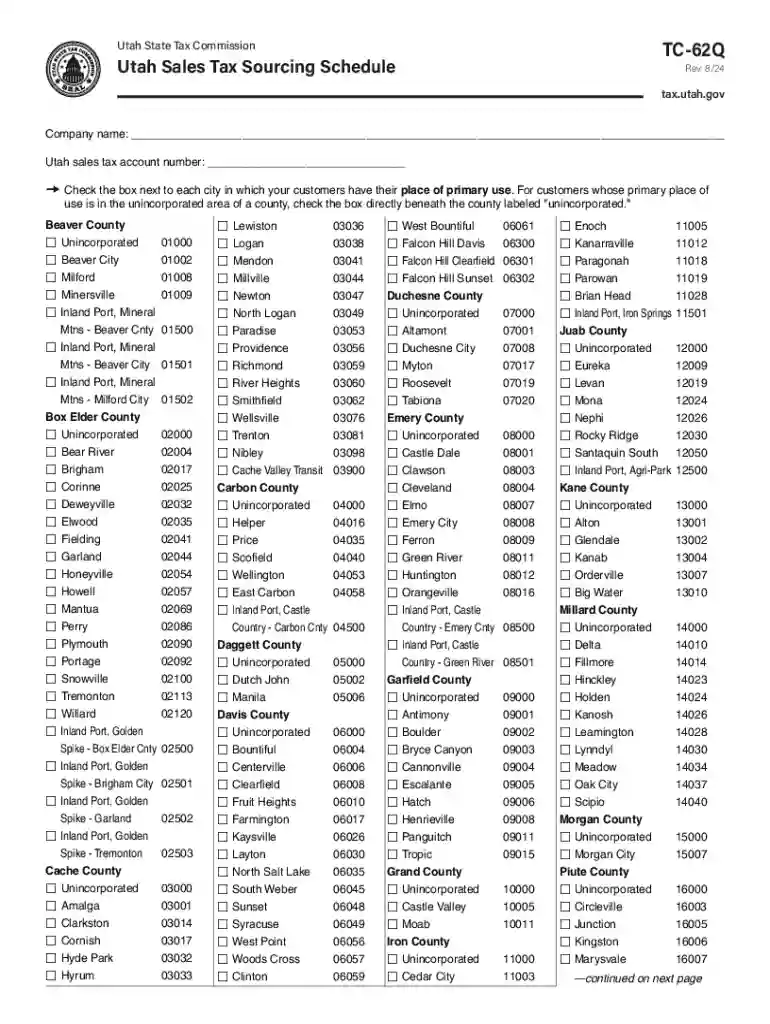
The TC-62Q form is specifically utilized for sales tax registration in the state of Utah. This form serves as a critical document for businesses that need to report and remit sales tax based on customer locations within Utah. It assists in detailing sales tax liabilities by requiring companies to provide specific information such as their business name, sales tax account number, and a compiled checklist of cities and unincorporated areas where their customers primarily use their products or services. Through this form, businesses ensure accuracy in sales tax reporting, thereby complying with state tax regulations.
To effectively use the TC-62Q form, businesses should follow a structured approach. Here are the steps typically involved:
Gather Necessary Information: Start by collecting all pertinent details, including your business's sales tax account number and a complete list of customer locations categorized by cities and counties in Utah.
Complete the Form: Fill out the form with care, ensuring that all required fields are completed accurately. This involves listing each city or unincorporated area where clients use your products or services.
Verification and Review: Thoroughly review the completed form to verify the accuracy of the provided information. This check is vital to ensure compliance and avoid potential penalties associated with incorrect reporting.
Submission: Submit the form as per the instructions provided, either online or through mail, depending on the state's guidelines for submission.
Filling out the TC-62Q form requires attention to detail and accuracy. The process is outlined as follows:
Identify Relevant Locations: Determine all the Utah locations where your sales activities lead to customer transactions. This includes both cities and unincorporated areas.
Enter Business Information: At the top of the form, input your business name and the associated sales tax account number to connect the report with the correct entity.
Checklist Completion: Utilize the checklist provided within the form to indicate every city and area applicable to your sales. This checklist is organized by county for convenience and precision.
Signature and Date: After completing the form, the business owner or authorized representative must sign and date it, confirming the accuracy of the information submitted.
The TC-62Q form is predominantly used by businesses with sales operations within Utah. This includes:
These entities utilize the form to ensure compliance with state tax obligations by accurately reporting where sales tax liabilities are due based on the primary usage location of their goods or services.


Compliance with the TC-62Q form ensures that businesses adhere to Utah's legal requirements regarding sales tax reporting. Failing to use the form or incorrectly completing it can result in substantial penalties. Legal use involves:
These measures help businesses avoid audits and align with state tax codes, thereby minimizing potential legal issues related to tax non-compliance.
Utah imposes specific rules to ensure that businesses register and account for sales tax appropriately. Key aspects include:
Understanding these rules is crucial for compliance and helps businesses navigate potential variations in regulations that may impact their operations.
Non-compliance with the TC-62Q form carries several potential penalties, outlined below:
These penalties reinforce the importance of accurately completing and timely submitting the TC-62Q form to avoid costly repercussions.
The TC-62Q form is available in both digital and paper formats. Each version has its unique benefits:
Choosing the appropriate format depends on the specific needs and resources of the business, with both options designed to accommodate various preferences.
We've got more versions of the TC-62Q Forms and Publications form. Select the right TC-62Q Forms and Publications version from the list and start editing it straight away!
At DocHub, your data security is our priority. We follow HIPAA, SOC2, GDPR, and other standards, so you can work on your documents with confidence.


Forms Pubs. Detailed Filing Instructions for TC-62S TC-62M Sales and Use Tax Returns call 801-297-3996 or 800-662-4335. Detailed Filing Instructions for
by AL Feld 1978 Cited by 19 the excess cost of books and magazines in all may be deducted as medical expenses. 62 T.C. expenditures for food and lodging incidental to travel for medical


