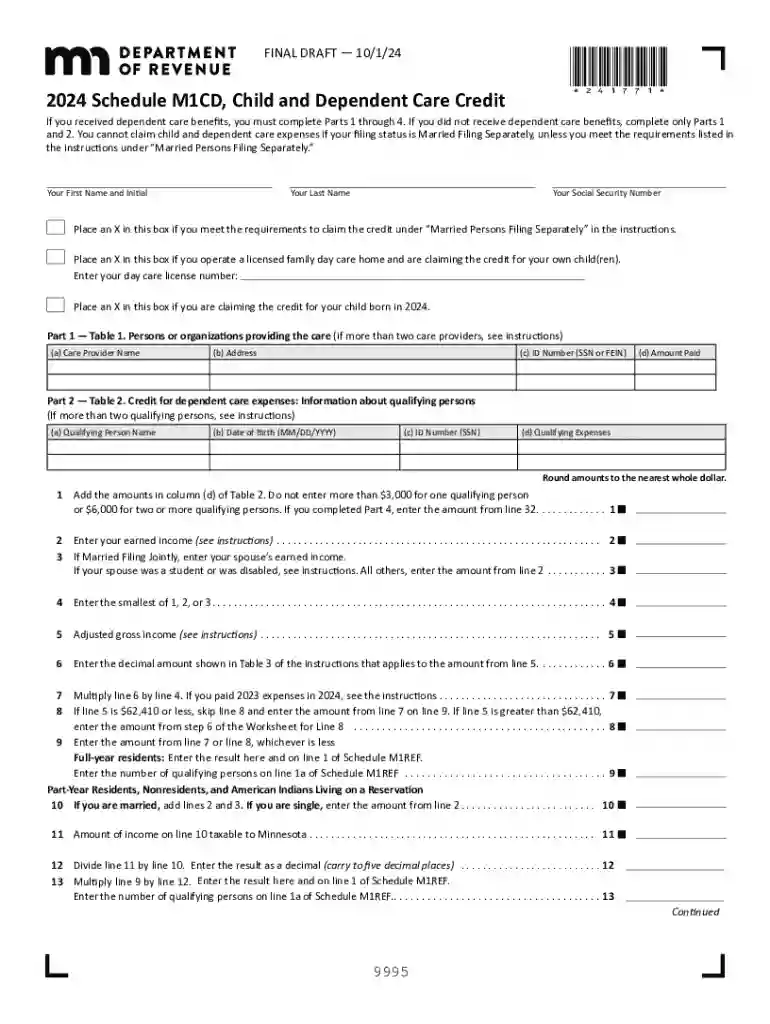
2024 M1CD, Child and Dependent Care Credit M1CD, Child and Dependent Care Credit-2026

Get Form
2024 M1CD, Child and Dependent Care Credit M1CD, Child and Dependent Care Credit Preview on Page 1

Here's how it works

01. Edit your form online
Type text, add images, blackout confidential details, add comments, highlights and more.

02. Sign it in a few clicks
Draw your signature, type it, upload its image, or use your mobile device as a signature pad.

03. Share your form with others
Send it via email, link, or fax. You can also download it, export it or print it out.

Definition & Purpose of the 2024 M1CD Form

The 2024 M1CD, Child and Dependent Care Credit form, is vital for residents of Minnesota who seek to claim tax credits for eligible child and dependent care expenses. This form is specifically designed to assist individuals in offsetting costs associated with caring for a child or dependent while working or actively seeking employment. The credit directly reduces the taxpayer's Minnesota state tax liability based on qualifying expenses, offering financial relief to qualifying individuals and families.

Key Elements

  • Qualifying Expenses: Includes costs incurred for the care of children under age 13 or disabled dependents necessary for the taxpayer to work.
  • Eligible Providers: Costs paid to daycare centers, babysitters, or other qualified care providers.
  • Credit Calculation: Based on income and eligible expenses, with specific sections for different filing statuses.

Steps to Complete the 2024 M1CD Form

Filing the 2024 M1CD form involves several detailed steps to ensure accuracy and eligibility for the Child and Dependent Care Credit.

  1. Collect Required Documents:

    • Social Security numbers for dependents
    • Proof of employment or job-seeking status
    • Documentation of care expenses and provider information
  2. Complete Personal Information:

    • Accurate taxpayer and spouse identification
  3. Report Expenses:

    • Fill out sections detailing care providers and expenses incurred
  4. Calculate the Credit:

    • Use the form’s instructions to calculate eligible credit amount based on expenses and income
  5. Attach Supporting Documents:

    • Include necessary documentation as proof of eligibility and expenses
  6. Submit the Form:

    • Ensure completion and accuracy before submitting electronically or by mail

Common Issues

  • Incomplete Information: Missing SSNs or signatures.
  • Incorrect Calculations: Ensure calculations match given parameters on the form.

Eligibility Criteria

To qualify for the Child and Dependent Care Credit in 2024, certain criteria must be met:

  • Residency: Must be a resident of Minnesota for the taxable year.
  • Dependents: Care must be for children under 13 or a person physically or mentally unable to care for themselves.
  • Employment Requirement: Applicant (and spouse, if filing jointly) must earn income from a job or be actively looking for work.
decoration image ratings of Dochub

Income Limits

  • Income Thresholds: Vary by filing status and determine the credit phase-out.
  • Documentation: Necessary to show proof of work or job search activities.

Key Terms Related to the 2024 M1CD Form

Understanding essential terminology enhances the accuracy and efficiency of completing the form:

  • Dependent Care Expenses: Fees paid for the care of a qualifying person.
  • Earned Income: Includes wages, salaries, tips, and self-employment income.
  • Filing Status: Tax filing category that affects credit eligibility (e.g., Single, Married Filing Jointly).

Examples of Terms in Use

  • A taxpayer may use "Dependent Care Expenses" to refer to fees paid to a licensed daycare center.
  • "Earned Income" must include all forms of employment earnings as documented on the taxpayer's W-2.

State-Specific Rules for Minnesota

Minnesota has specific regulations regarding the Child and Dependent Care Credit that may differ from federal guidelines:

  • Compliance: Ensure adherence to state income requirements and documentation standards.
  • Differing Eligibility: Minnesota may offer broader or more restrictive rules than federal counterparts.

Practical Scenarios

  1. Multiple Dependents: Minnesota allows credits for multiple dependents, subject to detailed documentation.
  2. Partial Year Residency: Credits may be prorated based on residency duration within the tax year.

Filing Deadlines & Important Dates

Understanding critical deadlines ensures timely filing and avoids penalties:

  • Tax Filing Date: The standard deadline for Minnesota is April 15 each year unless extended.
  • Documentation Deadline: Ensure all required documents are collected and available before filing to avoid delays.

Required Documents

Proper documentation supports the accuracy of the information provided on the form:

  1. Expense Receipts: Proof of payments to care providers.
  2. Provider Information: Name, address, and tax identification number.
  3. Employment Verification: Pay stubs or employer statements confirming work status.

Real-World Application

A taxpayer can submit receipts from a licensed daycare along with their tax identification number to support their claim on the M1CD form.

IRS Guidelines

Although the M1CD is a state form, it relates to federal tax regulations for consistency:

  • Federal Alignment: Ensure M1CD entries conform to federal dependent care credit guidelines where applicable.
  • Documentation: Cross-reference with federal returns to ensure consistency across both state and federal filings.

How This Aligns with Federal Forms

Some details required by the M1CD form may also apply to the IRS Form 2441, thereby ensuring unified tax treatment.

Importance of Accurate Filing

Accurate completion of the 2024 M1CD form maximizes potential benefits and ensures compliance:

  • Financial Benefits: Incorrect information or omissions could lead to denied credits or additional tax liability.
  • Legal Compliance: Accurate and complete filing upholds state tax requirements.

Avoid Common Mistakes

  • Review Calculations Thoroughly: Ensure all computations match guidelines.
  • Verify All Information: Double-check personal and dependent details for accuracy.
be ready to get more

Complete this form in 5 minutes or less

Get form

Got questions?

We have answers to the most popular questions from our customers. If you can't find an answer to your question, please contact us.
Contact us
The Child Tax Credit is a tax benefit to help families who are raising children. Nearly all families with kids will qualify. Couples making less than $150,000 and single parents (also called Head of Household) making less than $112,500 will qualify for the additional 2021 Child Tax Credit amounts.
If you have a child, you may be eligible for the Child Tax Credit. For 2024, the credit is up to $2,000 per qualifying child.
Yes, you may claim the child tax credit (CTC)/additional child tax credit (ACTC) or credit for other dependents (ODC) as well as the child and dependent care credit on your return if you qualify for those credits.
Qualifying families with incomes less than $75,000 for Single, $112,500 for Head of Household, or $150,000 for Married Filing Jointly returns were eligible for the temporarily increased credit of $3,600 for children under 6 and $3,000 for children under 18.
Families must have at least one qualifying child under 6 years old at the end of the tax year, must file a California state tax return, and meet the requirements of the CalEITC. Taxpayers do not need to have earned income to be eligible however, you must otherwise meet CalEITC and YCTC requirements.

Security and compliance

At DocHub, your data security is our priority. We follow HIPAA, SOC2, GDPR, and other standards, so you can work on your documents with confidence.


Learn more
ccpa2
pci-dss
gdpr-compliance
hipaa
soc-compliance
be ready to get more

Complete this form in 5 minutes or less

Get form

People also ask

If you have a child, you may be eligible for the Child Tax Credit. For 2024, the credit is up to $2,000 per qualifying child. To qualify, a child must: Have a Social Security number.
You can claim the Child Tax Credit by entering your children and other dependents on Form 1040, U.S. Individual Income Tax Return, and attaching a completed Schedule 8812, Credits for Qualifying Children and Other Dependents.
To claim the credit, you (and your spouse, if youre married) must have income earned from a job and you must have paid for the care so that you could work or look for work. You can claim from 20% to 35% of your care expenses up to a maximum of $3,000 for one person, or $6,000 for two or more people (tax year 2024).

Related links