
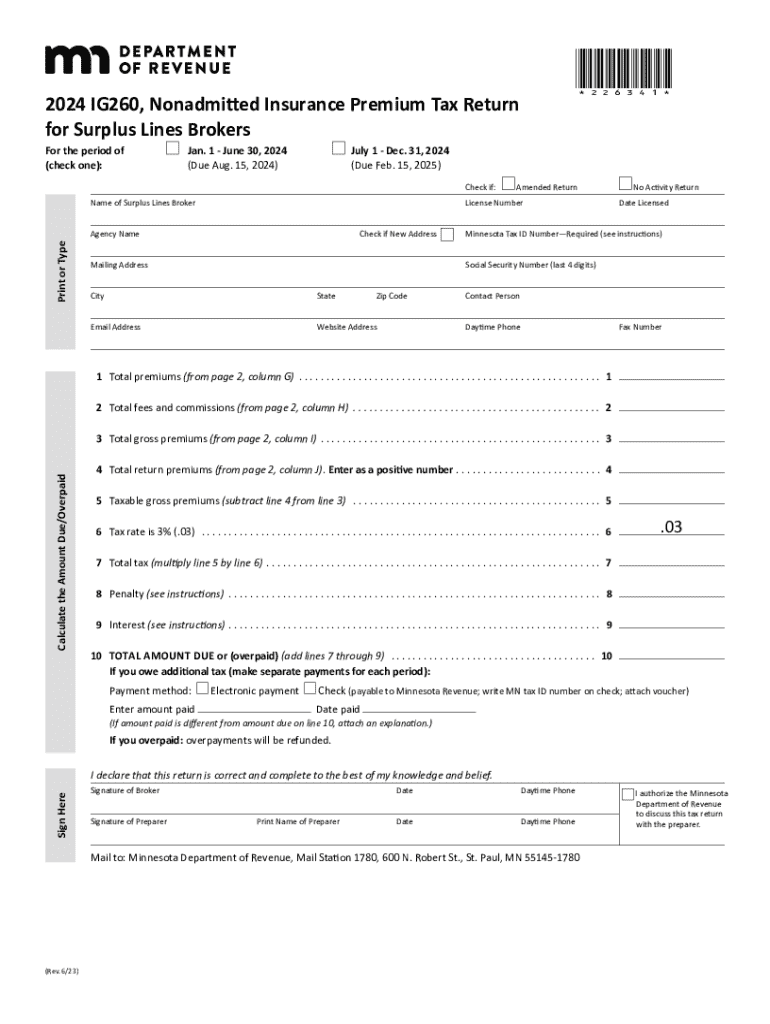







Definition and Purpose of Minnesota Form IG260
Minnesota Form IG260, also known as the Nonadmitted Insurance Premium Tax Return, is essential for surplus lines brokers operating in Minnesota. It is used to report and remit taxes on premiums collected from nonadmitted insurance coverage. This form outlines procedures for compliance with state tax laws, ensuring brokers report and pay appropriate taxes on insurance policies that aren't covered by admitted insurers within the state.
Key Elements of the Form
- Reporting Requirements: Detailed sections require reporting of premiums, fees, and commissions.
- Instructions: Clear guidelines on filling out the form, including specific fields for taxable and exempt premiums.
- Tax Computation: Sections dedicated to calculating the tax owed, considering applicable rates and deductions.
Steps to Complete Minnesota Form IG260
Filling out the Minnesota Form IG260 involves several critical steps for accuracy and compliance.
- Gather Information: Collect data related to premiums, such as policy numbers, insured parties, and insurance carriers.
- Complete Premium Sections: Enter detailed information on total premiums received and distinctions between taxable and non-taxable premiums.
- Calculate Tax: Utilize provided guidelines to compute the tax based on reported premiums.
- Finalize and Review: Verify all entries to ensure accuracy and completeness before submission.
Example Scenario
A broker collects $100,000 in nonadmitted insurance premiums. They need to report this amount, calculate taxes accordingly, and ensure any deductions or exemptions are applied accurately.
How to Obtain the Minnesota Form IG260
Obtaining the Minnesota Form IG260 can be accomplished through several methods.
- Online Access: Visit the official Minnesota Department of Revenue website for downloadable PDF versions.
- Direct Request: Contact the Minnesota Department of Revenue to request a physical copy if online access is unavailable.
- Through Software: Certain tax preparation software may provide access to this form as part of their service package.
Important Deadlines and Compliance Dates
Surplus lines brokers must adhere to strict deadlines when filing the Minnesota Form IG260.
Filing Calendar
- Quarterly Deadlines: Forms are typically due at the end of each quarter, aligning with fiscal reporting periods.
- Annual Summary: An annual summary may be required to reconcile quarterly reports and ensure comprehensive tax reporting.
Penalties for Late Submission
Non-compliance with filing deadlines can result in penalties, including:
- Monetary Fines: Set percentages of unpaid taxes or missed filing deadlines.
- Interest Charges: Accruing monthly interest on unpaid amounts until full payment is received.
Software Compatibility
The Minnesota Form IG260 is compatible with several accounting and tax preparation software solutions, aiding brokers in seamless tax reporting.
Supported Platforms
- QuickBooks: Integration for tracking premiums and generating reports.
- TurboTax: Capability to handle tax calculations specific to nonadmitted insurance premiums.
Benefits of Digital Platforms
- Accuracy: Automated calculations reduce human error.
- Efficiency: Streamlined processes and data import options simplify tax preparation.
Who Typically Uses Minnesota Form IG260
The primary users of Minnesota Form IG260 are surplus lines brokers who deal with nonadmitted insurance.
Applicable Business Types
- Insurance Brokers: Particularly those dealing in nonadmitted policies not covered by standard insurers.
- Large Corporations: Businesses requiring specific or high-risk insurance policies typically sourced from nonadmitted carriers.
State-Specific Rules and Regulations
Minnesota has unique regulations governing nonadmitted insurance and the use of Form IG260.
Regulatory Highlights
- Tax Rates: Defined tax rates specific to nonadmitted policies in Minnesota.
- Exemptions: Situations under which certain premiums may be exempt from taxation.
Compliance Requirements
- Recordkeeping: Maintaining detailed records of all transactions related to nonadmitted insurance.
- Certification: Ensuring compliance certification accompanies the form when submitted.
Penalties for Non-Compliance
Failure to submit the Minnesota Form IG260 or inaccuracies within the form can lead to serious consequences.
Potential Penalties
- Fines: Up to three percent of outstanding taxes per month.
- Legal Action: Persistent non-compliance may result in legal proceedings initiated by the Minnesota Department of Revenue.
Risk Mitigation
- Timely Submission: Prioritize adhering to submission deadlines.
- Verification Procedures: Implement checks to validate information before filing.
This comprehensive guide on the Minnesota Form IG260 is structured to provide surplus lines brokers with the knowledge and tools required to fulfill their tax-reporting responsibilities efficiently and accurately.




