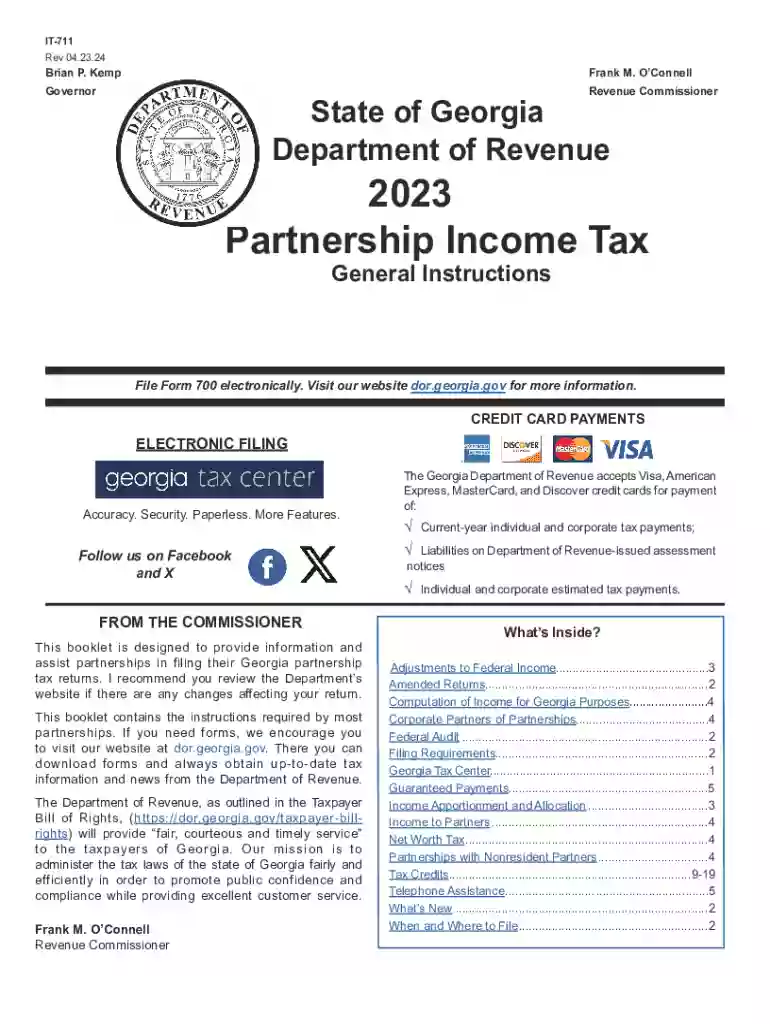
Definition and Purpose of the 2023 Partnership Income Tax - Department of Revenue
Understanding the 2023 Partnership Income Tax form issued by the Department of Revenue is critical for partnerships operating in the U.S. This form is utilized by partnerships to report income, deductions, and credits to the state tax authorities. Unlike corporations that file separate income tax returns, partnerships use this form to pass income and deductions onto individual partners, who then report these on their personal tax returns.
- Pass-through taxation: Partnerships do not pay income taxes directly; instead, profits and losses "pass through" to partners.
- Filing entity: Required for partnerships, limited partnerships, and limited liability companies that are treated as partnerships for federal income tax purposes.
Steps to Complete the 2023 Partnership Income Tax - Department of Revenue
Completing the 2023 Partnership Income Tax form involves several steps to ensure accurate filing:
- Gather financial documents: Collect all necessary financial records, including income statements, balance sheets, and documentation of deductions.
- Identify each partner's share: Determine each partner’s share of income, deductions, and credits.
- Fill out the form sections: Complete each section of the form with care, ensuring all financial data is accurately entered.
- Review state-specific instructions: Check for state-specific requirements that may affect your reporting.
- Submit the form by due date: Ensure that the form is submitted by the state's deadline to avoid late fees or penalties.
Importance of Using the 2023 Partnership Income Tax Form
Utilizing the correct form is imperative for compliance and efficient tax processing:
- Compliance with state laws: Filing the correct form ensures compliance with state tax obligations and avoids potential penalties.
- Accurate income reporting: Proper use of the form ensures that each partner reports their share of partnership income accurately on their personal tax returns.
- Tax planning and strategy: Understanding tax obligations can help optimize financial planning and tax strategy at both the partnership and individual levels.
Key Elements of the 2023 Partnership Income Tax - Department of Revenue
The form comprises several crucial elements necessary for accurate filing:
- Partner information: Includes names, addresses, and Social Security numbers or Employer Identification Numbers (EINs).
- Income calculation: A detailed calculation of the partnership's total income or loss.
- Deductions and credits: All applicable deductions and credits applicable to the partnership’s activities.
- Partner’s distributive share: Comprehensive breakdown of how each partner’s share of income and deductions is calculated.
IRS Guidelines for Partnership Income Tax
The IRS provides specific guidelines to ensure consistency and legal compliance:
- Federal and state alignment: Make sure federal income is adjusted according to state-specific laws before submission.
- Consistency with Schedule K-1: Ensure consistency between what is reported on partners' Schedule K-1 and the state form.
- Retention of documentation: Maintain accurate records to substantiate all claims made on the form for at least the period specified by IRS regulations.
Filing Deadlines and Important Dates
Adhering to the specified deadlines is paramount:
- Annual deadline: Typically due by March 15, unless the partnership has chosen a different fiscal year.
- Extensions: Filing for an extension can provide additional time, typically extending the deadline by six months.
Required Documents for Submission
Preparation of supporting documents ensures a smooth submission process:
- Financial statements: Up-to-date balance sheets and income statements.
- Expense receipts: Proof of deductible expenses to support claims.
- Investment documentation: Records related to any investments the partnership has made.
Penalties for Non-Compliance
Failing to comply with filing requirements can result in significant penalties:
- Late filing penalties: Fines calculated per month per partner for late submissions.
- Underpayment fines: Additional penalties if estimated tax payments are insufficient or incorrect.
Available Form Submission Methods
Different methods can be utilized for form submissions based on preference and convenience:
- Online filing: Utilize the state’s online portal for electronic submissions.
- Mail submissions: Physical copies of forms can be sent to the relevant Department of Revenue office.
- In-person submissions: Some states allow forms to be submitted in person at designated tax offices.
Business Entity Types Utilizing the Form
Various business entities may be required to use the 2023 Partnership Income Tax form:
- General partnerships: Businesses where all partners share equal responsibility.
- Limited partnerships (LPs): Entities where some partners have limited liabilities.
- Limited liability companies (LLCs): Treated as partnerships for tax purposes, requiring this form for filing.