




01. Edit your form online
Type text, add images, blackout confidential details, add comments, highlights and more.

Type text, add images, blackout confidential details, add comments, highlights and more.

Draw your signature, type it, upload its image, or use your mobile device as a signature pad.

Send it via email, link, or fax. You can also download it, export it or print it out.
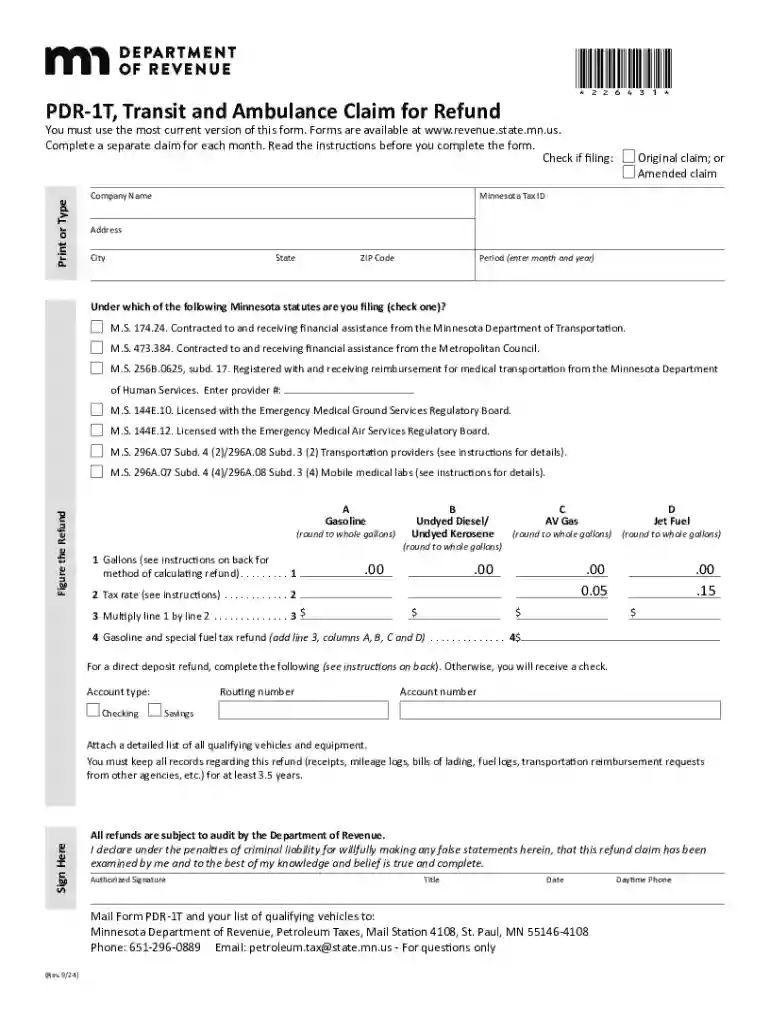
The PDR-1T form is used for claiming refunds on excise taxes that have been paid for gasoline and special fuels. These refunds are specifically applicable to transit systems, ambulance services, and other qualified transportation providers in Minnesota. The form ensures that eligible organizations can efficiently reclaim taxes and redirect those funds into their operational budgets, contributing to better service delivery. It is crucial for entities under specific Minnesota statutes, providing financial relief and promoting economic sustainability within qualified transportation sectors.
Understanding the steps to properly use the PDR-1T form is essential for applicants. Typically, the process starts with determining the eligibility under Minnesota tax statutes. Applicants should prepare detailed documentation of all relevant fuel purchases. This form requires careful attention to detail when calculating the refunds, as discrepancies can lead to processing delays or audits. Once all information is accurately compiled, the form can be submitted for processing. Ensuring all entries are correct will streamline the process and speed up the refund approval.
The PDR-1T form can typically be obtained from the Minnesota Department of Revenue's official website. Ensuring you have access to this official source is key to gaining the most recent and accurate version of the form. Additionally, physical copies can also be requested through regional offices if digital access is a concern. It is advised to always check for any updates or changes annually to comply with any modification in tax policies or form structures.
Completing the PDR-1T form requires methodical entry of all required data points. Initially, gather detailed records of excise taxes paid, which will be reflected on the form. The sequence usually involves:
Ensuring all steps are followed precisely will aid in avoiding processing errors or inquiries from the revenue department.
The PDR-1T form is specifically targeted at organizations providing essential transport services, such as transit systems and ambulance services in Minnesota. Eligibility is determined by statutory criteria under applicable Minnesota laws. A precise understanding of these requirements is crucial to ensure that only qualified entities file for refunds. Misinterpretation can result in rejection, so consulting with tax professionals knowledgeable in Minnesota tax regulations is advisable for entities uncertain about their eligibility.


Several critical elements are included on the PDR-1T form:
Understanding these elements thoroughly ensures complete and accurate submissions, reducing the chances of rework.
Minnesota has specific regulations governing the PDR-1T form. These include distinct statutes that outline which transport providers qualify for excise tax refunds. Minnesota law requires consistent monthly submission of these forms. It is imperative for applicants to regularly keep abreast of any legislative changes or tax code adjustments within the state. Regular consultations with tax experts familiar with state-specific laws are advisable.
Failure to comply with the guidelines for filing the PDR-1T can result in significant legal and financial penalties. These can include fines or mandatory audits, which can further inconvenience an organization's operations. Non-compliance not only affects tax obligations but could also lead to diminished credibility with regulatory bodies. Staying informed and diligent with submissions is crucial in avoiding these penalties.
We've got more versions of the Pdr-1t form. Select the right Pdr-1t version from the list and start editing it straight away!
At DocHub, your data security is our priority. We follow HIPAA, SOC2, GDPR, and other standards, so you can work on your documents with confidence.



A. be submitted on a form PDR-1 or other form as prescribed by the commissioner;. . B. cover only one month;. . C. be filed within one year from the fuelRead more
by K Tadaki 2019 Cited by 45 We derive the incident far-ultraviolet flux and the hydrogen gas density through PDR modeling by properly subtracting the contribution of ionized gas to theRead more


