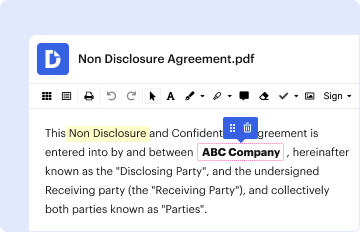
Type text, add images, blackout confidential details, add comments, highlights and more.
02. Sign it in a few clicks
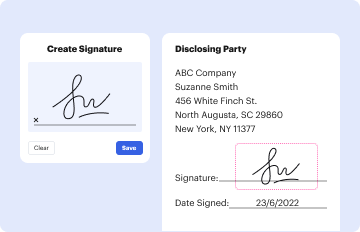
Draw your signature, type it, upload its image, or use your mobile device as a signature pad.
03. Share your form with others
Send it via email, link, or fax. You can also download it, export it or print it out.
How to use or fill out Illicit Discharge Detection and Elimination (IDDE) Program with Our Platform
Ease of Setup
DocHub User Ratings on G2
Ease of Use
DocHub User Ratings on G2
Click ‘Get Form’ to open the Illicit Discharge Detection and Elimination (IDDE) Program document in the editor.
Begin with the 'Overview' section. Familiarize yourself with the definition of illicit discharges and their implications for stormwater management.
Move to 'Municipal Storm Sewer System Mapping'. Here, you can input relevant data regarding storm sewer locations and attributes directly into the form fields.
In the 'Current Program' section, detail your existing practices related to illicit discharge detection. Use our platform's text boxes for easy editing.
Proceed to 'Ordinances'. Fill in any local regulations that prohibit illicit discharges, ensuring compliance with NPDES requirements.
For 'Detection and Elimination Program', outline your strategies for identifying and addressing illicit discharges. Utilize checkboxes for quick responses.
Complete sections on public education and staff training by entering specific outreach activities and training schedules as required.
Start using our platform today to streamline your IDDE program documentation for free!
Fill out Illicit Discharge Detection and Elimination (IDDE) Program online It's free
Illicit Discharge Detection and Elimination. (IDDE) programs and the design and. procedures of local investigations of non- storm water entries into storm drainage. systems.
What are examples of operational issues that may result in illicit discharges?
Illicit discharges occur through either direct connections, such as piping mistakenly or deliberately connected to the storm drains, or indirect connections such as infiltration from ed sanitary sewer pipes and degradation of older manholes. Illicit discharges also result from ordinary, everyday citizen behavior.
What is the IDDE program for illicit discharge detection and elimination?
An infiltration basin is a shallow impoundment that infiltrates stormwater into the soil. This control is effective at increasing groundwater recharge (thus increasing baseflow to nearby streams) and can also help remove pollutants from stormwater.
What is an example of an illicit discharge?
Illicit discharges include dumping of motor vehicle fluids, hazardous waste (industrial or household), paint, grass clippings, leaf litter, or animal waste.
What is not considered an illicit discharge?
Other discharges not considered illicit discharges include: Drums or other containers containing potentially hazardous materials that are found abandoned are considered unknowns or other potential hazardous materials cargo.
Related Searches
Illicit discharge detection and elimination idde program quiStormwater Public education and outreach
People also ask
What is an example of illicit discharge?
The IDDE program prevents illicit discharges by requiring permitted industrial dischargers to have spill control plans when necessary and requiring facilities with 1200-Z industrial storm water discharge permits to follow Best Management Practices (BMPs) to prevent discharges of pollutants.
What does IDDE stand for?
Examples include discharges of gray water (laundry) from homes, commercial carwash wastewater, fleet washing, commercial laundry wastewater, and floor washing to shop drains. Liquid wastes refers to a wide variety of flows, such as oil, paint, and process water (radiator flushing water, plating bath wastewater, etc.)
Related links
October 30, 2020 Pablo Martos MS4 Permit Manager
Nov 1, 2020 7.1.1 Element #1: Illicit Discharge Detection and Elimination. BMP: Implement the Illicit Discharge Detection and Elimination (IDDE) Program.
Cookie consent notice
This site uses cookies to enhance site navigation and personalize your experience.
By using this site you agree to our use of cookies as described in our Privacy Notice.
You can modify your selections by visiting our Cookie and Advertising Notice.