





Definition & Meaning
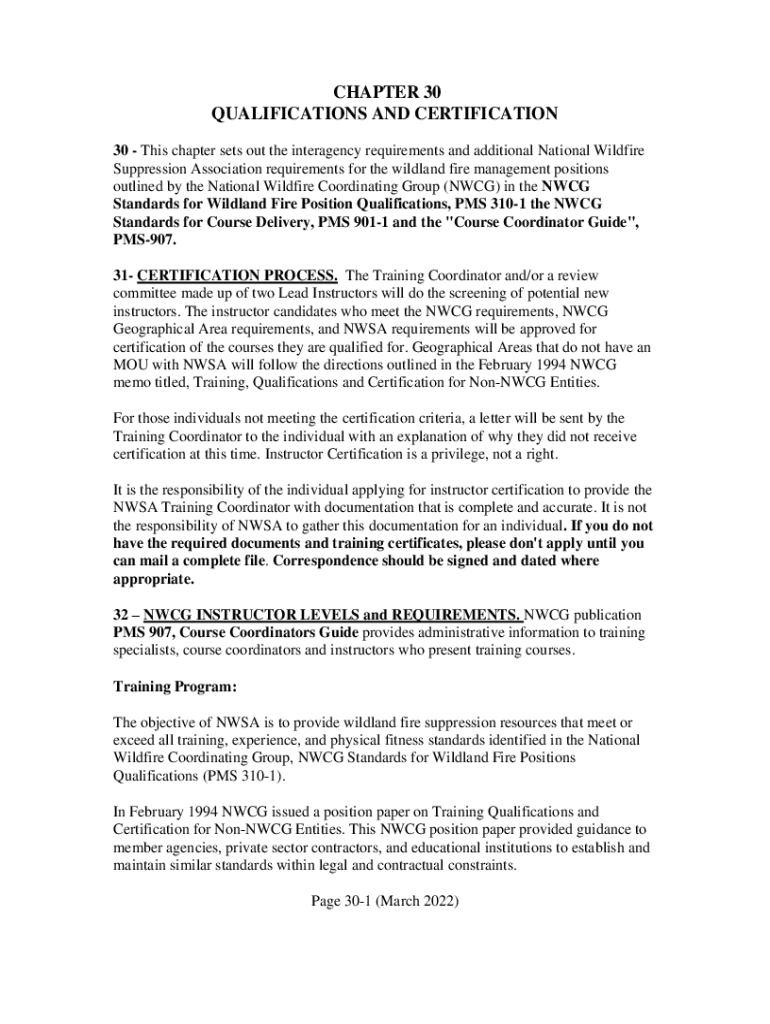
The "Forest Service Fire and Aviation Qualifications Guide Chapter 2 Part 1" encompasses standards and procedures essential for the training and certification of personnel in fire and aviation roles within the Forest Service. This document provides guidelines that ensure individuals meet the necessary qualifications and competencies required for specific positions, fostering a safe and efficient wildfire response.
Key Components
- Training Requirements: Comprehensive details on mandatory training courses and certifications for various roles in forest fire management.
- Competency Evaluation: Criteria and methods used to assess the skills and knowledge of candidates applying for roles.
- Role Specifications: Outlines the specific duties, responsibilities, and required qualifications for each role.
How to Use the Forest Service Fire and Aviation Qualifications Guide Chapter 2 Part 1
The guide serves as a key resource for personnel and administrators involved in training and qualifying forest service roles. Its structured approach ensures all parties understand the requirements for various positions.
Steps for Utilization
- Identify Role Requirements: Determine the specific role you're interested in and refer to the corresponding section in the guide.
- Review Training Needs: Cross-reference your current certifications with the training requirements listed to identify any gaps.
- Plan Certification: Use the guide to schedule necessary training sessions and assessments, ensuring timely completion of all requirements.
Steps to Complete the Forest Service Fire and Aviation Qualifications Guide Chapter 2 Part 1
Completing the relevant sections of the guide involves adhering to specified procedures and fulfilling all necessary conditions. The completion process includes documentation, verification, and submission steps.
Detailed Process
- Gather Required Information: Collect all necessary personal, professional, and training documents.
- Training Enrollment: Enroll in required training programs as specified in the guide.
- Track Progress: Log all completed training and evaluations, ensuring each is documented.
- Submit Documentation: Compile and submit all documents for verification as per guide instructions.
- Receive Certification: Await official notification of qualification certification upon successful completion of requirements.
Key Elements of the Forest Service Fire and Aviation Qualifications Guide Chapter 2 Part 1
The guide is composed of several critical elements that collectively ensure comprehensive coverage of qualifications needed for forest service roles.
Essential Components
- Qualification Standards: Detailed benchmarks for each position, ensuring personnel meet national safety and operational standards.
- Training Programs: An array of specialized training programs tailored to different roles and levels of expertise.
- Documentation Requirements: Guidelines on necessary documentation, including proof of training, certifications, and experience logs.
Important Terms Related to Forest Service Fire and Aviation Qualifications Guide Chapter 2 Part 1
Understanding specific terms is crucial for comprehending the guide's instructions and requirements.
Glossary of Terms
- Qualifications: The set of criteria one must meet to be deemed suitable for a specific role.
- Certification: Official recognition of having met the necessary training and ability standards for a role.
- Roles: Specific positions within fire and aviation services described in the guide.
Who Typically Uses the Forest Service Fire and Aviation Qualifications Guide Chapter 2 Part 1
This guide is primarily utilized by individuals involved in or aspiring to work in fire and aviation positions within the Forest Service or related agencies.


User Profile
- Current Employees: Personnel seeking advancement or confirmation of qualifications.
- Prospective Candidates: Individuals aiming to qualify for specific fire and aviation roles.
- Training Coordinators: Administrators responsible for planning and overseeing training programs.
Examples of Using the Forest Service Fire and Aviation Qualifications Guide Chapter 2 Part 1
Practical applications of the guide can be found in various scenarios where it assists individuals in achieving qualification for desired roles.
Use Case Scenarios
- New Applicants: Individuals examining role requirements to begin their certification process.
- Ongoing Training: Staff members engaged in periodic skills renewal to maintain qualification status.
- Inter-agency Coordination: Agencies collaborating on standards and training for joint operations in wildfire management.
Legal Use of the Forest Service Fire and Aviation Qualifications Guide Chapter 2 Part 1
Adhering to the guide ensures compliance with legal and operational standards set by governing bodies like the National Wildfire Coordinating Group (NWCG).
Compliance Measures
- Accurate Record-Keeping: Ensuring all training and certification records are up-to-date and valid.
- Standardized Procedures: Following established protocols to maintain adherence to national qualifications standards.
- Audit Readiness: Preparation for periodic reviews and audits by maintaining precise and complete records.