




01. Edit your form online
Type text, add images, blackout confidential details, add comments, highlights and more.

Type text, add images, blackout confidential details, add comments, highlights and more.

Draw your signature, type it, upload its image, or use your mobile device as a signature pad.

Send it via email, link, or fax. You can also download it, export it or print it out.
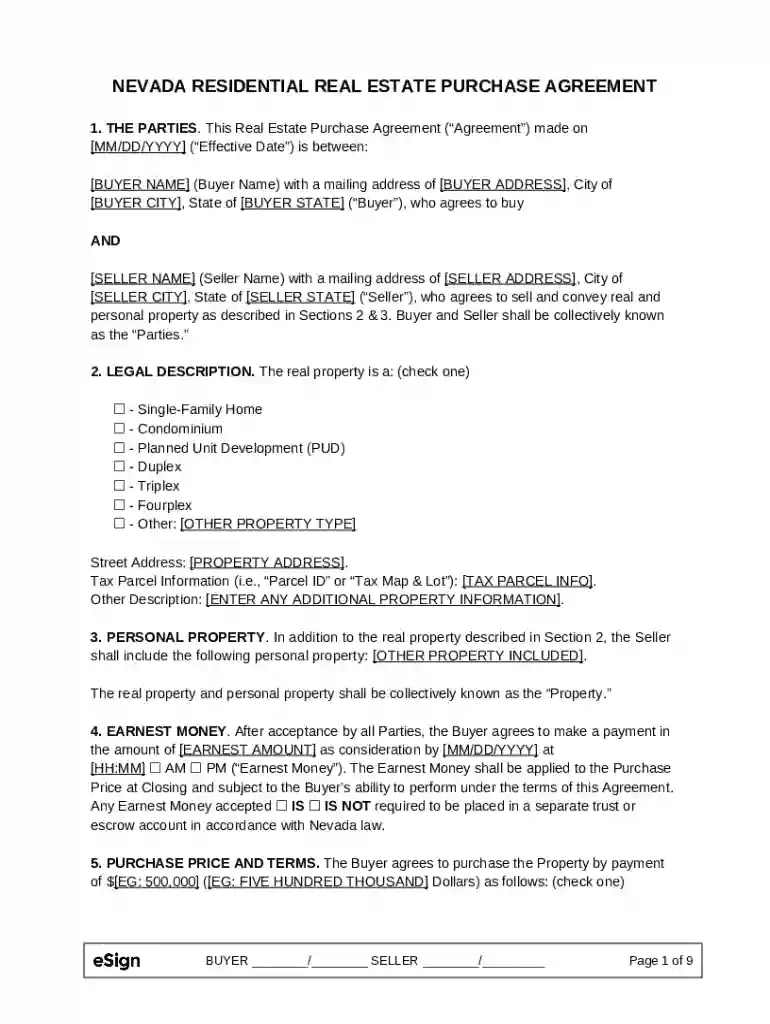
A Nevada Residential Real Estate Purchase Agreement is a binding legal document used during the sale of residential property in Nevada. This agreement outlines the terms and conditions agreed upon by the seller and buyer, detailing the obligations and rights of each party. The agreement typically encompasses critical components such as the legal description of the property, purchase price, financing options, earnest money, and contingencies related to inspections and disclosures. This document enforces a contractual relationship between both parties to ensure compliance with Nevada real estate laws and practices.
Utilizing a Nevada Residential Real Estate Purchase Agreement involves several steps to ensure all parties agree and abide by the terms set within the document. First, both the buyer and seller must review the agreement to confirm all details accurately represent their negotiations. Essential components include:
Parties can also consult with real estate professionals or attorneys to ensure the document’s adequacy and compliance with state law.
Preliminary Negotiations: Both parties discuss and agree on key transaction elements, including the sale price, necessary repairs, and personal property included.
Drafting the Agreement: Use a standardized form or obtain the outline from a real estate professional to draft initial terms.
Filling Required Information: Complete sections related to parties’ details, property description, price, and terms of the sale.
Inclusion of Contingencies: Add clauses addressing inspections, financing conditions, or other buyer/seller demands.
Signature and Agreement Date: Ensure both parties sign with corresponding dates to validate the contract.
Final Review by Legal Counsel: It is advisable to have a legal professional or real estate agent review the completed document.
Parties Involved: The buyer and seller are explicitly named alongside their contact information, ensuring clear identification.
Property Details: Precise legal description alongside the street address, detailing land size and any included fixtures.
Purchase Price and Payment Terms: Explicit statement of agreed price, earnest money deposit, and payment method.
Contingencies: Conditions such as home inspections, financing, and appraisal, allowing for legal withdrawal if unmet.
Closing Costs: Defines responsibility allocation between seller and buyer, such as title insurance and recording fees.
Dispute Resolution: Terms outlining conflict resolution methods, commonly arbitration or mediation, to avoid litigation.
In Nevada, this agreement is used to formally document the sale and ensure compliance with state-specific real estate regulations. Legal use includes:
Enforcing Buyer and Seller Obligations: Both parties are legally bound by the contract terms, ensuring adherence to sale provisions.
Property Condition Disclosure: Sellers must provide adequate transparency regarding the property's condition, reducing potential liability.
Title Transfer: Guarantees proper transfer of property rights from seller to buyer upon agreement completion.
Legal considerations often warrant involving real estate attorneys to fully grasp obligations and rights specified in the contract.
Nevada’s real estate transactions must adhere to state-specific regulations. Some of the notable rules include:
Disclosure Laws: Sellers must comply with state disclosure laws by providing pertinent property condition reports.
** Earnest Money Regulations**: Must be deposited in a trust or escrow account by specified time frames.
Fair Housing Compliance: Ensures all parties engage without discrimination according to state and federal laws.
Property Tax Prorations: Taxes are typically prorated based on the real estate agreement specifics and Nevada statutes.
Understanding and adhering to these rules is necessary for a lawful transaction and avoids potential penalties.
Consider the following practical scenarios:
New Home Buyers: John and Sarah plan to purchase their first home. They use the agreement to articulate their inspection contingency, ensuring any major repair costs are covered before closing.
Selling and Buying Concurrently: Jane, who is relocating for work, uses the purchase agreement to manage the sale of her current home while entering a purchase contract for another property. The agreement helps in setting closing dates that align with her move.
Investor Transactions: An investor utilizing multiple purchase agreements for diverse properties ensures compliance by using standardized agreements tailored for each type of residential property.
These scenarios demonstrate how the agreement maintains order and protects parties’ interests in various transactions.
Earnest Money: A deposit made by the buyer representing good faith in the transaction.
Inspection Contingency: A clause allowing the buyer to withdraw if unforeseen property issues arise during the inspection.
Financing Clause: Specifies the buyer's ability to obtain requisite financing, often tied to mortgage approval.
Closing Costs: Expenses incurred during the final transaction stage, often split between buyer and seller.
Each term plays a vital role in shaping the responsibilities and expectations within the agreement framework.
Essential documents generally accompany the Nevada Residential Real Estate Purchase Agreement:
Seller's Property Disclosure Form: Communicates known issues and conditions related to the property.
Lead-Based Paint Disclosure: Necessary for homes built before 1978, protecting against lead paint hazards.
Pre-Approval Letter: Demonstrates the buyer's financial capability to fulfill purchase terms.
Title Report: Confirms property ownership, ensuring clear title transfer post-sale.
These documents support a thorough and legally compliant real estate transaction, crucial for mitigating disputes and ensuring transparency.
At DocHub, your data security is our priority. We follow HIPAA, SOC2, GDPR, and other standards, so you can work on your documents with confidence.


This is a binding contract by which you agree to purchase an interest in real property.
Before You Purchase Property In a Common-Interest Community. This form is required to be kept as an association record and should Client Form 04/23/2025


