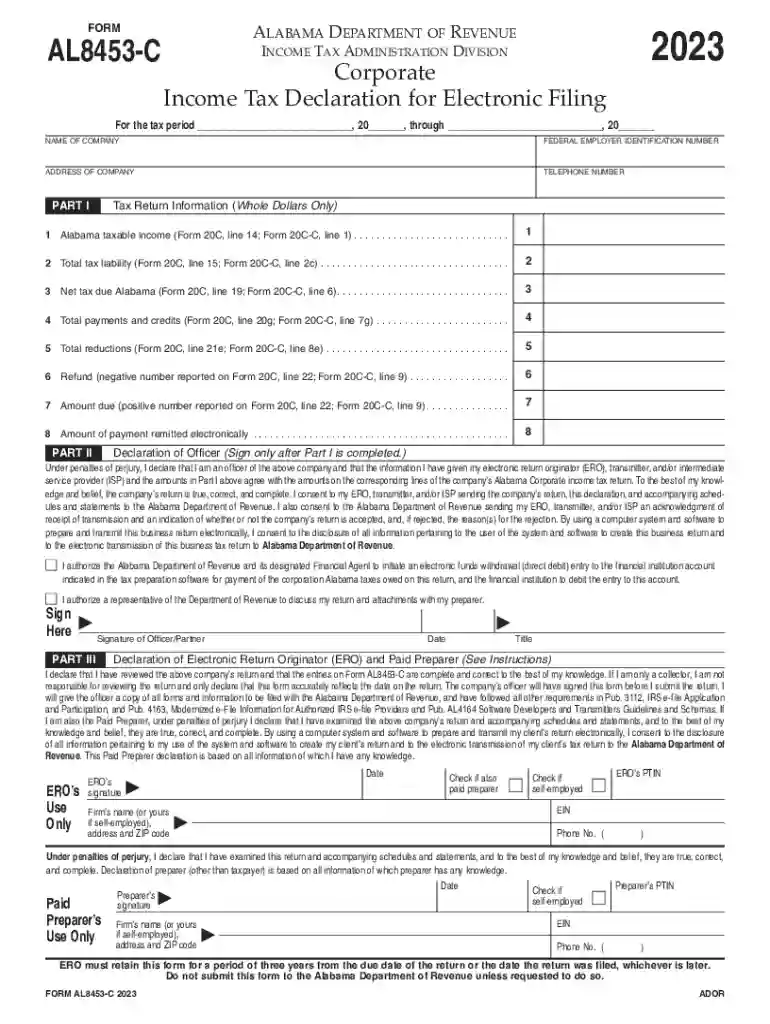
1 Alabama taxable income (Form 20C, line 14; Form 20C-C, line 1) 2026

Get Form
1 Alabama taxable income (Form 20C, line 14; Form 20C-C, line 1) Preview on Page 1

Here's how it works

01. Edit your form online
Type text, add images, blackout confidential details, add comments, highlights and more.

02. Sign it in a few clicks
Draw your signature, type it, upload its image, or use your mobile device as a signature pad.

03. Share your form with others
Send it via email, link, or fax. You can also download it, export it or print it out.

Definition & Meaning

The "1 Alabama taxable income (Form 20C, line 14; Form 20C-C, line 1)" refers to specific lines on Alabama’s corporate income tax forms that determine the taxable income for corporations operating within the state. This line item captures the income after adjustments, deductions, and exemptions allowed under state law and is crucial for calculating tax liability.

Understanding Taxable Income Lines

  • Form 20C, Line 14: Represents the taxable income for C corporations after accounting for all necessary deductions and adjustments.
  • Form 20C-C, Line 1: Used for S corporations or partnerships delineating their income that may be passed on to individual owners or partners.

Importance for Businesses

Businesses use these lines to report income accurately, ensuring compliance and determining the correct amount of state tax owed. Correctly calculating Alabama taxable income helps organizations avoid penalties and ensures legal compliance with state tax laws.

Steps to Complete the 1 Alabama Taxable Income Forms

Accurately completing the "1 Alabama taxable income (Form 20C, line 14; Form 20C-C, line 1)" involves several steps. These steps ensure your corporate income tax return is filed correctly:

  1. Gather Financial Records: Collect all necessary financial documents, including income statements, balance sheets, and any other records of revenue and expenses.
  2. Determine Adjustments: Identify all state-specific adjustments and deductions that apply to your corporation. These may include specific expense deductions or tax credits.
  3. Calculate Deductions: Subtract allowable deductions from total income to arrive at a preliminary taxable income figure.
  4. Identify Exemptions: Apply any exemptions that your corporation qualifies for under Alabama state law.
  5. Complete the Form: Enter the resulting taxable income on Line 14 of Form 20C for C corporations or Line 1 of Form 20C-C for applicable entities.
  6. Review and Verify: Double-check all entries to verify accuracy before submission.

Practical Examples

  • C Corporation: An Alabama-based manufacturing company calculates its gross income and applies industry-specific deductions before reporting on Line 14 of Form 20C.
  • S Corporation: A local consulting firm uses Form 20C-C to denote its pass-through income, requiring individuals to report their share.

State-Specific Rules for 1 Alabama Taxable Income

Alabama has distinct rules and regulations affecting how taxable income is calculated and reported:

  • Deductions: Certain expenses, such as employee benefits and local business taxes, can significantly impact taxable income.
  • Apportionment: For businesses operating both inside and outside Alabama, income is apportioned using a formula that considers Alabama-based sales, property, and payroll.
  • Credits: Alabama offers specific tax credits like those for job creation or investing in certain economic zones, influencing taxable income.

Considerations for Compliance

Understanding the nuances in Alabama’s tax code is crucial. Engage with tax professionals or utilize software equipped with Alabama tax regulations to ensure full compliance and accurate reporting.

Examples of Using the 1 Alabama Taxable Income Form

Here are scenarios detailing practical use cases for the forms related to "1 Alabama taxable income":

  • Manufacturing Corporation: A company producing goods in Alabama reports all revenue after deducting operational costs and applies the state-specific tax credits for energy-efficient projects.
  • Service Industry Company: A tech startup operating in Alabama uses Form 20C-C to handle its pass-through taxes, allowing owners to report income on individual tax returns.

Filing Deadlines / Important Dates

Knowing the critical filing deadlines is essential for maintaining compliance and avoiding penalties:

  • Corporate Income Tax Deadlines: Typically, Alabama corporate income tax returns are due by the fifteenth day of the fourth month following the tax year end, similar to federal deadlines.
  • Extensions: Businesses may file for an extension should they need additional time, with accompanying payment of any estimated taxes due to avoid interest and penalties.

Important Terms Related to Alabama Taxable Income

A solid grasp of key terminology aids in understanding and accurately completing the form:

  • Taxable Income: The amount of income subject to tax after deductions and exemptions.
  • Adjustments: Modifications made to gross income, including any state-specific considerations.
  • Exemptions: Specific allowances that reduce taxable income, based on Alabama law.

Required Documents

Ensuring you have the correct documentation available is crucial:

  • Financial Statements: Include income statements and balance sheets for all relevant operations.
  • Proof of Deductions: Keep detailed records of claimed deductions and credits.
  • Apportionment Documents: Necessary for businesses operating in multiple states, to support the allocation method applied.

Penalties for Non-Compliance

Failing to comply with Alabama tax reporting can result in penalties:

  • Late Filing Penalties: Incurred if forms are not submitted by the due date—calculated as a percentage of tax due.
  • Accuracy-Related Penalties: Applied if errors on your return result in underpayment due to negligence or disregard of rules.

Understanding and adhering to these requirements ensures compliance and a smooth tax filing process.

be ready to get more

Complete this form in 5 minutes or less

Get form

Got questions?

We have answers to the most popular questions from our customers. If you can't find an answer to your question, please contact us.
Contact us
Employers can put just about anything in box 14; its a catch-all for items that dont have their own dedicated box on the W-2. In TurboTax, enter the description from your W-2s box 14 on the first field in the row. Enter the dollar amount and select the correct tax category that goes with that description.
Box 14 of Form W-2 Wage and Tax Statement allows your employer to enter a variety of information. Employers might use abbreviations and codes in Box 14, and you may need to ask your employer to interpret those abbreviations or codes.
Income and source deductions Report your employees total income before deductions using box 14. A maximum of 10 digits, including cents, can be reported using box 14. Depending on the type of payment you made, you may also need to report these amounts in Other information using specific codes.
CONSTITUTIONAL PROVISIONS 2 percent on first $500 of taxable income. 4 percent on next $2,500. 5 percent on all over $3,000.
Line 1 reports your taxable wages from form W-2 (most common form of employment income). Income from deferred comp payments, including non-governmental 457 plans and from employer equity awards (stock options, restricted stock, SARs, etc.), are also reported on Line 1. Line 2 reports interest income.

Security and compliance

At DocHub, your data security is our priority. We follow HIPAA, SOC2, GDPR, and other standards, so you can work on your documents with confidence.

Learn more
ccpa2
pci-dss
gdpr-compliance
hipaa
soc-compliance

People also ask

Form 20C-C, Con- solidated Corporate Income Tax Return, must be filed by all AAGs with a binding consolidated election. All transactions between and among members of the AAG shall be reported on an arms length basis.
Your contributions shown in Box 14 are not subject to federal income tax, but are subject to FICA (social security and Medicare), state, and local taxes.
Reporting employer-sponsored benefits in Box 14 Employer-sponsored benefits are part of employee compensation and can be reported in Box 14 of the W-2 form. These benefits may include retirement plan contributions, health insurance premiums, tuition assistance and wellness reimbursements.

Related links