
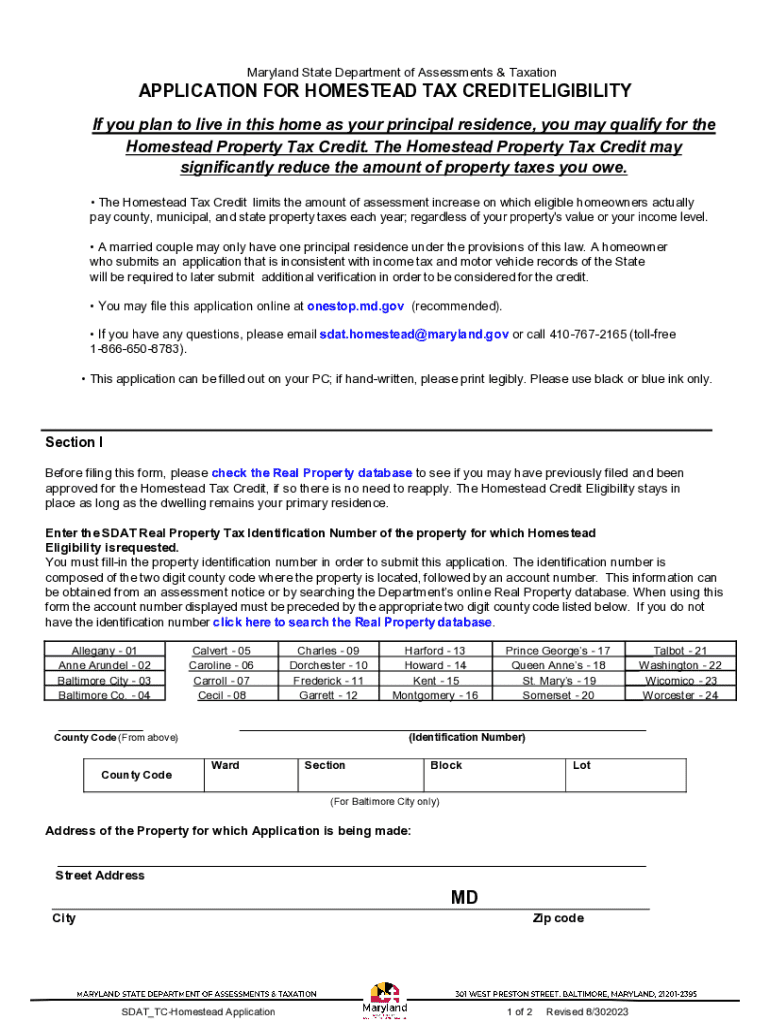







Definition and Purpose of the Homestead Tax Credit
The Homestead Tax Credit is designed to reduce property tax bills for homeowners who use their property as their primary residence. This financial benefit is crucial as it limits the amount a homeowner's taxable assessment may increase annually. Specifically in Maryland, the credit ensures that property taxes do not skyrocket beyond a reasonable limit, protecting homeowners from sudden and significant increases. The primary aim is to provide economic relief and maintain affordable housing costs.
Eligibility Criteria for the Homestead Tax Credit
To qualify for the Homestead Tax Credit, several criteria must be met:
- The property must be the applicant's primary residence, meaning the place where they live for more than six months of the year.
- The owner must have resided in the property as of January 1 of the effective tax year.
- The property must be assessed and meet the assessment caps set forth by the state.
- Homeowners must submit an application to confirm their eligibility status.


Steps to Obtain the Homestead Tax Credit Application
- Research Eligibility: Before applying, confirm you meet all criteria for eligibility, focusing primarily on residency and property status.
- Locate the Form: The application form can usually be found on the Maryland Department of Assessments and Taxation’s website or through local tax offices.
- Document Preparation: Gather necessary documents, including proof of residency and ownership, to support your application.
- Complete the Application: Fill out the form with detailed and accurate information.
- Submission: Submit the application online through the state's designated portal or mail it to the department’s address. Ensure submission occurs before the deadline.
Required Documentation for Application
Applicants must provide several key documents when applying for the Homestead Tax Credit:
- Proof of ownership, such as a deed or mortgage statement.
- Proof of residency, like utility bills or a driver’s license showing matching addresses.
- Completed application form, either digital or paper version.
Ensuring that all information provided is accurate and updated is vital to prevent delays or rejection.
Application Process and Approval Timeframe
Once the application is submitted, the review process begins:
- Verification: State officials verify the details provided, confirming residency and ownership.
- Processing Period: This can take several weeks to a few months, depending on the volume of applications and administrative efficiency.
- Notification: Applicants are notified of approval or denial via mail or email. Approved applicants will see the credit reflect in their upcoming property tax bill.
Prompt and complete submissions generally result in smoother processing.
Important Deadlines for Filing
The Homestead Tax Credit application must be filed within a designated period prior to the upcoming tax year. Typically, homeowners should apply by the following deadlines:
- Early Application: Recommended by December 31 of the assessment year to be effective for the next tax year.
- Final Deadline: Set by the state, often several months before the start of the fiscal year.
Meeting these deadlines is crucial to benefit from the credit in the subsequent tax billing cycle.
Penalties for Providing False Information
Submitting fraudulent information for the Homestead Tax Credit application carries significant consequences. Penalties include:
- Financial penalties that may require repayment of received credits with interest.
- Legal action, which can result in fines or further prosecution.
- Denial of future applications.
Applicants should ensure all provided information is truthful and accurate to avoid these repercussions.
Digital vs. Paper Application Methods
Applicants have the choice of submitting their applications digitally or via traditional paper methods. Key differences include:
- Digital Submission: Offers faster processing, immediate confirmation of receipt, and reduced likelihood of errors.
- Paper Submission: Suitable for those less comfortable with technology but entails a longer processing time and higher risk for lost documents.
Both options aim to provide flexibility, yet digital submissions often result in expedient handling and response.
Variations and Alternatives to the Homestead Tax Credit
Apart from the standard Homestead Tax Credit, some jurisdictions offer alternative relief programs, such as:
- Senior Citizen Credits: Additional benefits catered to senior homeowners.
- Veteran Discounts: Tax reliefs for military veterans residing permanently in a state.
- Disabled Homeowner Benefits: Specific credits or reduced property taxes for individuals receiving disability benefits.
These alternatives ensure that diverse homeowner populations receive appropriate assistance, aligning with their unique circumstances.




